Comments
Thank you for writing this helpful article! I’m looking forward to employing the Going All Out strategy when I attend my first EAG.
Thank you for writing this helpful article! I’m looking forward to employing the Going All Out strategy when I attend my first EAG.
You are welcome!
"There's no better time than now" (seems like lots of people were credited with this quote, not sure who was the original)
EAGxVirtual 2023 is coming up in 10 days and I just got the "Get ready for EAGxVirtual" email 8 hours ago :)
The requirements and deadline to apply are as follows:
We welcome all who have a genuine interest in learning more or connecting, including those who are new to effective altruism. Admissions will not be based on prior EA engagement or EA background knowledge.
EAGxVirtual is free. The deadline for applications is 11:59 pm UTC on Thursday, 16 November.
Caveat: it will be a little different than the in person conference because "Admissions will not be based on prior EA engagement or EA background knowledge."
Regardless, I'm interested in seeing just how different it is (though I can only attend a couple days because of prior commitments that weekend).
Hope to connect with more of you all around the world :)
I sincerely applaud your efforts and hope you will have a significant positive impact. At the same time, I want to very gently push back on some perceived sentiment in this post: I do not think it is right for all to push as hard as you do. I think even that your advice might not be suitable for most people. This is because the risk of burnout is large. Burnout has been written about elsewhere on the Forum, on the 80k hrs podcast (I think, couldn't quickly find the episodes) and beyond and I would encourage people to err on the side of too much self care rather than too little. This is especially because the chance of another large EA donor in the coming years is significant and we then really should not lose any talent to burnout or similar decreases in productivity. And also because I care about the EA community - people who sincerely want to do good deserve to live fulfilling lives.
I agree 100%. This is absolutely not for everybody.
In light of this comment, I want to reiterate the Final Thoughts section:
If you use the “go all out” strategy, your body might take a toll. This extreme strategy is not for everybody, and you have to listen to your body.
I felt under the weather after I flew back home, when all the adrenaline was gone.
I’ve taken a complete day off to recover, and am still coughing a bit as I’m typing this up.
Burnout is something I actively talk to my team about, and I'm also the person that keeps saying to slow down, take a break, leave work behind and enjoy your time-off.
In fact, I was just nagging my co-founder of this morning, about the importance of resting up and having downtime. There is simply too much to do, and it's important for all of us to take care of our mind and body so that we can jog/run at a sustainable pace, not overdoing it.
I'm glad you had a productive EAG!
Curious if you are willing to share, what were the most valuable experiences you got out of these 1:1s? (Or maybe: what were the most valuable 1:1s you ended up having, and why were they valuable?) :)
Thank you for the talk you gave at 2022’s San Francisco EAG! It was so helpful!!
what were the most valuable 1:1s you ended up having, and why were they valuable?
Those are the ones that came to mind :)
My first EAG is coming up within the next 10 days. Thank you for many helpful advice that encouraged me to go all out for my first EAG as well. This will for sure be a great test for my upper bound limits!
Having been to two EAG’s so far, going all-out definitely feels like the correct approach. It’s such an insane opportunity, it feels wasteful not to treat it seriously. Other thoughts:
It can be good to leave some time slots free to make new meeting requests. I remember during my first EAG how I pivoted on the first day of the conference from wanting to talk to one set of people to another set of people, and I was only able to follow through with that pivot because I wasn’t completely booked.
I usually try to stick around for a day after the conference so I can hang out more casually with people I’ve met and to explore the city the conference is in. During both EAG’s, some of the most lastingly memorable events have taken place on the Monday after the conference. During the conference, I’m always asking myself “who am I going to hang out with on Monday?”
Similarly, it can be good to have at least one evening free to walk around talking to random people. I usually have a targeted mission when I go to an EAG depending on where I am in life, but it’s good to talk to miscellaneous people about what they do. Breathe in the culture, make connections you wouldn’t expect to make. Similarly, speed meeting events can be great.
Glad you had an awesome time! Cheers!
Thank you!
Yes, all valid points :)
Regarding point (1), yes, I would also try fit more pre-conference bookings on Friday, and leave more open slots for Saturday and Sunday for spontaneous or recommended reach-outs meetings during the conference.
For point (2) and (3), you are more of an extrovert than me. Meeting and talking to random people (unscheduled appointments) at the conference wasn't easy for me. Always learning, maybe this is an area of improvement for me
Just attended my first ever EA Global conference (EAG Boston last week) and I have nothing but positive things to say.
In total, I had about 47 one-on-one conversations depending on how you count the informal 1:1s (43 scheduled via SwapCard, while the other noteworthy conversations happened at meetups, the organization fair, office hours and unofficial satellite events).
I came into the conference with an open mind, wanting to talk to others who are smarter than me, more experienced than me, and experts in their own domain. I invited redteaming of our nonprofit StakeOut.AI’s mission/TOC, and gathered both positive and negative feedback throughout EAG. I came out of the conference with new connections, a refined strategy for our nonprofit startup going forward and lots of resources.
I am so grateful for everyone that met with me (as I’m a small potato who at many times felt out of his depth during EAG, and likely one of the most junior EAs attending). I thank all the organizers, volunteers, helpers, speakers and attendees who made the event a huge success.
The post below goes over The Preparation, the Statistics and Breakdown, why consider going all out at an EAG, 12 Practical Tips for Doing 30+ 1:1s and potential future improvements.
To be honest, as a first-time attendee, I really didn’t know what to expect nor how to prepare for the conference.
I had heard good things and was recommended to go by fellow EAs, but I had my reservations.
Luckily, an email titled “Join us for an EAG first-timers online workshop!” by the EA Global Team came to the rescue.
Long story short, I highly recommend anyone new to EAG to attend the online workshop prior to the conference if you want to make your first EAG a success.
Few highlights I will note here:
I was quite hesitant at first about introducing myself on SwapCard and trying to schedule 1:1s. This all changed after watching the presentation and attending the “Join us for an EAG first-timers online workshop!” virtual event.
Something that was repeated over and over again from this presentation, the online workshop, and talking to others is the value of the 1:1s.
People told me most sessions will be recorded and hence can be watched later, but having the 1:1s is where the true value is at EAG. After hearing it from so many people, I made 1:1s a core part of my conference planning and did not regret it.
As I’m writing this after the conference, I can see why 1:1s are said to be the true value of EAG. I estimate that 80% (maybe even closer to 90%, I would know better after I sort through the notes) of the 1:1 conversations I had were beneficial and had a positive impact on either me or the direction of our nonprofit, StakeOut.AI.
In terms of how many 1:1s, here is the range I gathered from different sources:
Since I wanted to maximize my EAG experience, I set the goal of 30 and started reaching out via SwapCard one week before the conference.
The main reason for starting early is because everyone is busy at the conferences, and everyone is trying to optimize their schedule.
This is especially true for senior EAs (more well-known) who would get requests from other senior EAs (likely people they know from before who have been around EA and want to connect in person) and juniors EAs who feel the senior’s advice would really help. Thus, the senior EAs’ schedules in theory would fill up much quicker when compared to junior EAs.
That’s why you want to contact and introduce yourself ASAP (before their calendar is filled).
I am not sure if I was late to the game starting to message out seven days before the conference. Would I have secured more meetings if I started earlier? I’m not sure there is a way to test this since I cannot repeat being a first-timer.
Either way, I committed hours and hours and hours to reading profiles, and sending introduction messages.
Then, to my surprise, I had 28 1:1s booked by Wednesday, a couple of days before the conference started on Friday.
EAG has a very cool culture built in, and it’s unlike anything I’ve ever seen. Coming from the business world where the conferences and seminar environments are mostly about “getting”, what I experienced at EAG Boston is the exact opposite: “giving.”
The numbers below are an attempt to quantify this, and these are staggering percentages when I compare it to anything else I’ve been to in terms of professional networking.
Caveat
I went all out because I believe we have an idea, a vision that can really do good in the AI safety cause area. And I wanted to check it against experts and other EAs by inviting on the spot red teaming, to make sure we are not crazy nor being illogical.
I went all out because AI risks are an urgent and critical global issue. It's imperative to pause or, at the very least, slow down AI until we research and implement robust measures to prevent both short-term risks and long-term catastrophic, potentially even extinction-level events.
My conviction in this is so high that I’ve been basically volunteering with StakeOut.AI since Sep 4th, 2023 without income, despite the need to provide for my kids. I’m spending more than full-time hours certain weeks on our nonprofit, in hopes that we will eventually succeed in fundraising and, as a result, secure even a modest salary.
Without funding nor a regular income, coming to EAG was a leap of faith, paying for the travel expenses out of pocket. I tried my best to keep the costs down by flying red-eye, couchsurfing 2 out of the 4 nights, commuting via by foot and public transit only, and limiting expenses on meals (aka eating conference snacks and Soylent as dinner).
Because you can get more done in 2.5 days of conference time, than weeks of work combined.
The EAG conference attendees all require their applications to be approved before they go. That means, everyone who is going at some level is vetted. This makes it a conducive environment for meaningful and noteworthy conversations.
Additionally, when you spend the time to read the other attendees' profiles and find people who can help you (or who you can help), these conversations are more than likely to have a positive impact for either or both parties.
Lastly, think about the last time you tried to reach out to an expert or someone more senior, was it easy or difficult to get some time with them even for a virtual meeting? My experience is that coordination takes time even if they are willing to meet. This is because reaching out to others are usually interruptions to their normal work routine, while they are actively juggling mountains of to-dos.
In contrast to an EAG, seniors and juniors alike, everyone that’s attending already committed their time to the conference and are in the mindset of meeting and helping others. They made themselves available, and this is the low hanging fruit and time you want to maximize. This is where you can meet with as many collaborators or experts as possible to get advice from while they are mentally primed to collaborate.
Just think, when is the next time you can get a full 25 minutes of uninterrupted time with experts in the field, people smarter than you, or more experience than you, talking about your particular situation or questions? This is something that rarely happens in the business world, but in EA, it’s part of the culture that’s amazingly the norm at EAGs!
If you use the “go all out” strategy, your body might take a toll. This extreme strategy is not for everybody, and you have to listen to your body.
I felt under the weather after I flew back home, when all the adrenaline was gone.
I’ve taken a complete day off to recover, and am still coughing a bit as I’m typing this up.
But would I do it again if I was accepted to another EAG? The answer is unequivocally yes.
There is no question coming out from this 2.5 days conference was equivalent to doing weeks of work and totally worth the effort and time.
Of course, this wouldn’t be possible without everyone involved, so thank you again to all the organizers, volunteers, helpers, speakers and attendees who made the EAG Boston phenomenal.
This post was just my take and definitely not representative of attendees as a whole, please read the following posts for other advice (as I did) about maximizing your EAG listed in no particular order:
One comment from the above posts really helped me a lot and I think would be useful to highlight is from https://forum.effectivealtruism.org/posts/3kFWJLy7uBYgeQ4xs/advice-for-getting-the-most-out-of-one-on-ones?commentId=wouXJuYjj2SXEi8vW:
This seems like great advice to me. This part particularly rings true:
First, speaking from experience, I find that EAs are more likely than average to hold a meeting with you even if you don't have anything tangible to offer them. When you think about it, by helping you have more of an impact, they're also increasing they're own impact, which is motivating for most EAs. Don't let not having anything to offer immediately keep you from reaching out to someone you think you could have a valuable conversation with!
I was very surprised with how many "EA celebrities"* were happy to meet with me at EAG, despite me being pretty new to EA and not having much to contribute for them. And they seemed not just begrudgingly willing based on a cost-benefit analysis of the possibility they'd increase my impact, but genuinely enthusiastic about being helpful, asking me about my current plans, etc.
So definitely don't be too shy about reaching out to people!
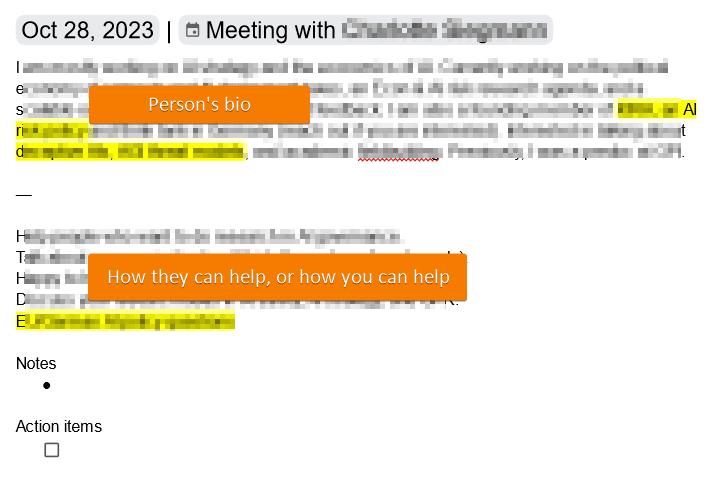
I had prepared a list of backpocket questions for the one-on-ones inspired by one of the posts above. I did not end up using it at all because most of my conversations naturally flowed and we had more than enough to talk about for the given time slot.
Each category has three questions, feel free to reference this as you see fit:
1. Understanding Background and Motivation:
2. Practical Aspects of the Role:
3. Assessing Impact and Contribution:
4. Advice and Recommendations:
5. Passion and Future Plans:
I would like to give a special thank you to Dr. Peter S. Park and Amy Frieder for editing this post and for all our future collaborations!

43 1:1s, holy moly surely that must be the record - well done!
Thank you :)
I met someone else at EAG Boston who also did 40+ at the last conference. Definitely something achievable, just have to do the right pre-conference preparations and stay hydrated/fed during the event.
If I can do it (I'm mid-career, aka older with less energy), you can too with a BIG ENOUGH WHY!