Acknowledgments
I would like to thank Michael Plant, Matt Lerner and Rosie Bettle for their helpful comments and advice.
Summary
Understanding the relationship between wellbeing and economic growth is a topic that is of key importance to Effective Altruism (e.g. see Hillebrandt and Hallstead, Clare and Goth). In particular, a key disagreement regards the Easterlin Paradox; the finding that happiness varies with income across countries and between individuals, but does not seem to vary significantly with a country’s income as it changes over time. Michael Plant recently wrote an excellent post summarizing this research. He ends up mostly agreeing with Richard Easterlin’s latest paper arguing that the Easterlin Paradox still holds; suggesting that we should look to approaches other than economic growth to boost happiness. I agree with Michael Plant that life satisfaction is a valid and reliable measure, that it should be a key goal of policy and philanthropy, and that boosting income does not increase it as much as we might naively expect. In fact, we at Founders Pledge highly value and regularly use Michael Plant’s and Happier Lives Institute’s (HLI) research; and we believe income is only a small part of what interventions should aim at. However, my interpretation of the practical implications of Easterlin’s research differ from Easterlin’s in three ways which I argue in this post:
- Easterlin finds small coefficients in his preferred regressions of changes in countries’ happiness on changes in GDP. He concludes that these coefficients have low “economic significance” and that increasing economic growth is not a good way to make people happier. However, even if we take these coefficients at face value, they still represent a very meaningful increase in wellbeing within the effective altruism framework, consistent with the impacts of unconditional cash transfers on individuals. The benefits become very large when aggregated across all the people in a country for many years.
- We also have reason to doubt Easterlin’s results, in that they are highly sensitive to small changes in methodology. We perform two variations on his regression that fully accept his methodology of only including “full cycle” countries, but update it slightly, reversing the result. If we replicate his results counting one more country as a “transition” economy, the Easterlin paradox largely disappears. If we repeat his analysis with new data from 2020 instead of 2019, the paradox also seems to largely disappear.
- It may be difficult to find things we can influence whose change over time will have a higher correlation to a country’s change in happiness than changes in GDP. Even if we accept that boosting GDP does not meaningfully increase happiness, other potential means of boosting national happiness may increase it even less. If we rerun Easterlin’s analysis using three interventions Easterlin and Plant suggest (health, pollution, and a comprehensive welfare state), their implied impacts on national happiness are much smaller than the impacts for GDP or negative. However, I have low confidence in this conclusion, and think it is a very valuable project to identify the interventions that are most likely to have an impact on happiness.
1. Taking Easterlin’s results at face value and estimating impact
Easterlin and O’Connor (2022) rely on two regressions for their conclusions, both comparing annual changes in a country’s happiness to annual changes in per capita GDP. The first measures happiness using a “life satisfaction” survey question on a smaller set of countries from 1981-2019 and the second uses a “best possible life” survey question on a larger set of countries from 2005-2019. After excluding some of the countries in the dataset, the authors find that a one percent increase in annual GDP growth rate increases happiness by .001 and .0024 life satisfaction points in the two regressions. They conclude that these coefficients imply that it would take 500-1000 years of one percentage point higher GDP growth to increase happiness by one point, and have low “economic significance.” At first glance, these numbers do seem negligible.
However, once we compare these numbers to what we would expect from the literature on the happiness impacts of cash transfers, we find that they are no smaller than we should expect. Despite being small, these numbers are not exactly 0, and to get a sense of their practical implications we need to convert them to units more familiar in effective altruism. If we want to compare the impact of economic growth to the impact of interventions like cash transfers or deworming, it is helpful to convert the happiness impact of one percentage point higher growth to units capturing the happiness impact of doubling income. In order to do this, we have to consider that it would take 71 years to create an additional doubling of income by boosting growth by one percentage point. Therefore, a doubling of income would produce a 0.07 point increase in happiness using Easterlin’s first regression and a 0.17 point increase using the second. In comparison, HLI’s meta-analysis suggests that providing a cash transfer that doubles income for an individual leads to a 0.1 standard deviation increase in subjective well being. This equates to roughly 0.2 life satisfaction points for the recipient of the transfer. When we use HLI’s methodology to adjust for the fact that other household members likely experience smaller benefits, we get an expected increase of 0.14 life satisfaction points for an average person. So one of Easterlin’s estimates is lower than the impact of a cash transfer, and one is higher. The overall picture appears to be consistent with changes in GDP providing as much happiness as changes in individual income resulting from cash transfers. GiveDirectly, which provides unconditional cash transfers, has historically been one of GiveWell’s top charities, and generally seems like a very good use of money even if it is not the very best.
The happiness impacts of boosting GDP become very large when we take individual impacts that are comparable to GiveDirectly and aggregate them for a whole country for many years. Let us consider the impact of boosting incomes for a whole country with the same population as Ethiopia. We assume that we can find an intervention that boosts GDP growth by one percentage point for 40 years, and that the happiness impacts of this are as small as estimated by Easterlin. Only considering effects over forty years is a fairly arbitrary choice, picked to match GiveWell’s methodology of valuing income increases for 40 years, discounted at 4% annually. I think this is a fairly conservative choice, as some economic research suggests very long-term persistence of changes to GDP. We sum the discounted happiness boost across the entire population. The impact of boosting annual GDP growth from 2% to 3% would produce the equivalent of approximately 400 million person-years of doubled income. HLI and GiveWell each independently estimate that the most cost effective interventions they have identified are approximately 10 times as cost effective as GiveDirectly at improving well-being. Using this multiple, the current costs of GiveDirectly suggest that EA as a community should be happy to spend $10 billion to boost GDP growth in Ethiopia by 1 percentage point for forty years. The amount would be even higher if we incorporated the likely impact of higher GDP on health and education. This is more than ten times as much as all of the money EA is likely to move this year, and likely more than the annual funding of all economics professors worldwide, the IMF, and development economics at the World Bank combined. This does not have any conclusive implications for whether boosting growth in a country like Ethiopia is tractable at these funding levels. However, it does suggest that the well-being benefits are very significant from an EA perspective, in contrast to Easterlin’s interpretation.
2. Easterlin’s estimates of impact become much larger with small changes in methodology.
The previous section looks at the impacts suggested by Easterlin’s methodology if we take it at face value. However, this methodology generates lower regression coefficients than most similarly reasonable alternative specifications. We compare Easterlin’s results with those we get if we rerun his analysis making a different choice about whether we consider India a transition economy, and then by rerunning his analysis with updated happiness survey data. Additionally, we compare Easterlin’s headline results with alternative versions he presents in his paper. These alternative versions of the analysis yield coefficients more consistent with the idea that GDP gains over time yield as much happiness increase as we would expect from cross sectional data than they are with the Easterlin Paradox. Therefore, I don’t think this latest paper should update us much away from the intuitive idea that higher incomes lead to more well being.
Cross sectional data suggests that we should expect a 0.5 point increase in happiness from a doubling in income. If we look at a regression of Cantril Ladder “best possible life” scores against GDP on a log scale, the coefficient implies slightly under 0.5 points per GDP doubling.
Cantril Ladder versus GDP (Sacks et al. 2010)
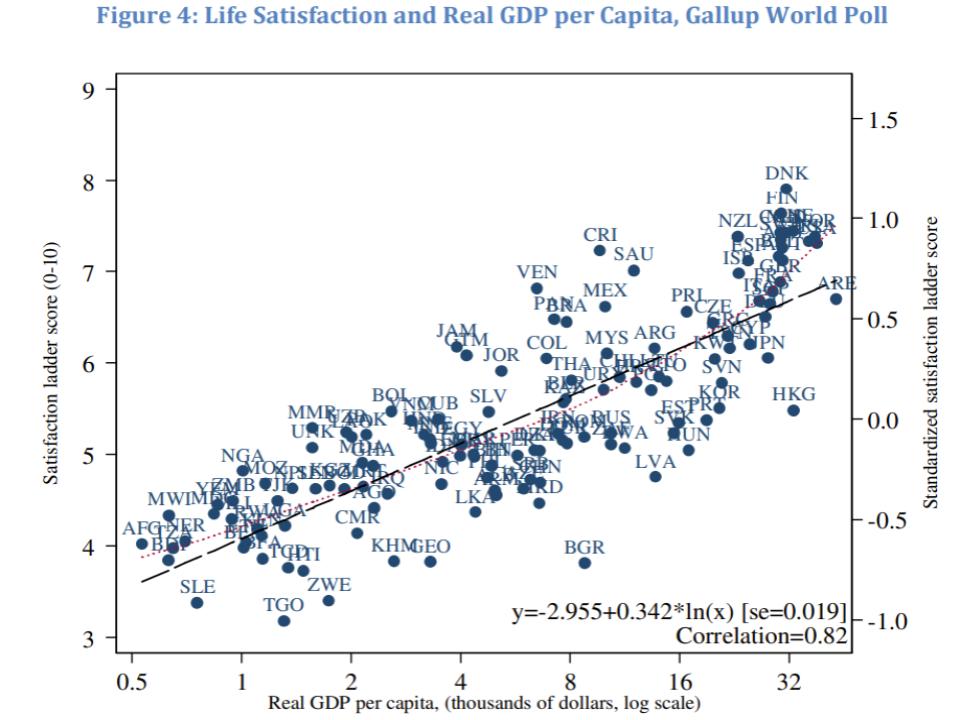
Similarly, if we look at a graph of Cantril Ladder scores for individuals versus their incomes (figure 1 in Michael Plant’s post), we can estimate around 0.5 points per income doubling. In contrast, if we look at Easterlin’s .0024 regression coefficient, it only implies an increase of 0.17 points per income doubling. This is close enough to 0 that it is reasonable for Easterlin to classify it as a paradox when compared to the 0.5 point estimates from alternative sources of data. However, when I rerun Easterlin’s analysis classifying one additional ambiguous case as a transition economy, or using newer data, the coefficients increase. The new results are closer to 0.5 than they are to 0, and don’t seem to imply the existence of a paradox.
Easterlin argues that we need to exclude countries that transitioned from socialist to capitalist economies from our analysis in order to remove the noise created by countries that only start to conduct happiness surveys just as their economies plummet with the start of the transition to capitalism. Most of the countries he excludes are Eastern European, but he also considers China a transition economy. I think it would be reasonable to put India in the same category as China, since both countries experienced a more gradual transition from socialism than did Eastern Europe with the collapse of the Soviet Union. If we repeat Easterlin’s analysis with his data, but exclude India along with China, we get an estimate of 0.3 life satisfaction points per income doubling. So the estimate moves from being closer to 0 to being closer to 0.5 after a minor methodological adjustment.
Next, I replicate Easterlin’s analysis with newly available 2020 “best possible life” scores, instead of the 2019 data in the original paper. In this regression I accept all of his methodological choices about which transition economies to exclude, and how to decide whether a country needs to be excluded for insufficient data. The new regression implies an impact of 0.3 life satisfaction points per income doubling. Once again, this version of the analysis is closer to being consistent with the cross sectional data (0.5 points per income doubling), than it is to a paradox (0 points).
Similarly, if we look at alternative versions of the regressions included in Easterlin and O”Connor (2022), almost all of them have much higher coefficients than the main result. Easterlin makes two key methodological choices. The first is excluding transition economies. For both the “life satisfaction” and “best possible life” regressions, not excluding the transition economies would imply an impact of 0.4 life satisfaction points per income doubling. The second choice Easterlin makes is excluding all countries from the “best possible life” regression that have fewer than 12 years of data available. When he includes the 8 additional countries with 10 or 11 years of data, the impact also goes up to 0.4. I think Easterlin makes good arguments for these two choices. However, I think we have to consider how sensitive his conclusion is to judgment calls when deciding how much to believe that there is a surprising paradox in the happiness data.
3. The happiness impact of alternative interventions is smaller than the impact of GDP.
Easterlin concludes his latest paper by suggesting that even though he does not believe that GDP growth has a meaningful impact on happiness, that there are a number of better interventions. Michael Plant adds some suggestions to the list in his post, coming up with a set of potential interventions that includes:
“...job security, a comprehensive welfare state, getting citizens to be healthy, and encouraging long-term relationships…[taking] mental health and palliative care more seriously…improved air quality, reduced noise, more green and blue space (blue spaces being water), and getting people to commute smaller distances (Diener et al. 2019). Social interactions could be enhanced via urban design, reducing corruption, increasing transparency, supporting healthy family relationships, and maybe even things like progressive taxation.”
All of these sound like promising ideas, and are a good research agenda for future investigation. However, it may be difficult to find one of these measures that has a higher impact on country-level happiness than GDP using Easterlin’s methodology. To perform an exploratory analysis, I start with Easterlin’s data from his “best possible life” regression (taking his relatively low estimated impacts at face value as I do in section 1.) I then choose three interventions from Michael Plant’s list that seem to have a fair amount of annual data available on OurWorldInData.org: health, pollution and a comprehensive welfare state. I replace annual GDP growth in Easterlin’s regression with annual growth on these three metrics, and perform a separate analysis for each one. Each regression looks at annualized changes in a country’s Cantril ladders scores versus annualized changes in the specified metric for the past 12-14 years. The health regression estimates how much a decrease in the number of years people in a country lose to ill health corresponds to increases in happiness. This regression produces coefficients that are either an order of magnitude smaller than the GDP regression, or negative, depending on whether we exclude countries that have less than 12 years of data. In both cases the r-squared of the regression is essentially 0.. There does not appear to be a way to interpret these results to suggest that changes in health have a higher impact on national happiness than changes in GDP. The pollution regression repeats the methodology for health, but looks at only the changes in the years of life lost to pollution. This analysis actually shows negative results of a magnitude similar to the positive results of the GDP regression. This would imply that increases in pollution are actually associated with countries getting happier. For example, the Republic of Congo and Benin both had large annual increases in happiness despite increasing levels of pollution. The comprehensive welfare state regression examines the impact of changes in a score of whether a country has an adequate safety net. This analysis also shows negative results, however there are very few countries and years for which this data is available and the data appears to be of low quality, suggesting that we should not read too much into this result. In all three of these analyses we do not find any evidence consistent with any of these metrics having a higher impact on national happiness than changes in GDP.
I do not have a high level of confidence in these initial results. There are likely better sources of data, and better methodologies to employ. However, I do think they suggest that it may be difficult to find any interventions of their kind which will imply a larger impact on happiness than GDP using Easterlin’s methodology.
4. Conclusion
Easterlin’s estimates of the impact of GDP growth on happiness are not as small as they initially appear. They are consistent with experimental data from individual cash transfers, and imply large welfare gains when aggregated for an entire country. When I consider slight variations in methodological choices that Easterlin makes, or update his data for 2020, the estimated impacts get much bigger. This leads me to decrease my belief in the existence of an Easterlin Paradox that we need to explain. But even if we accept Easterlin’s estimates, it may be difficult to find other things we can influence that will have a larger measured impact on happiness than GDP growth. I find three of the more promising potential ways to boost national happiness to have a smaller impact than boosting GDP. Of course, other interventions may prove to be far more tractable than boosting GDP, even if they have a lower impact on happiness. Also, we can likely find better sources of evidence than regressions with fewer than a hundred datapoints. So my conclusion is not that different from Easterlin and Michael Plant in that I do think the interventions they propose are very promising routes to explore towards increasing happiness. I just don’t think the data warrants dismissing GDP growth as a potentially even more promising route.
Notes

Vadim, thanks very much for writing this. I'm really pleased to see this debate moving forward. I've discussed this quite a bit with HLI colleagues over the last few days and wanted to share where we've got to so far.
TL;DRs are (1) We should probably now conclude we don't have enough data to know if the Easterlin Paradox is true; (2) even if economic growth increases wellbeing, the effects are likely so small we should be sceptical about prioritising it.
I'll break this into several smaller points.
1. Easterlin and O'Connor (and others) do not claim there is no relationship between growth rates and happiness. They claim there is one - it's what you pick up on - but that it's not statistically significant (we don't know if it's more than chance) or economically significant. The latter term is a bit vague, but the sense is that it's so small we shouldn't make increasing economic growth a priority.
2. What I take to be your key observation is that, just taking the coefficients at face value, they suggests that (A) doubling of national income over time has about the same effect as (B) doubling income for an individual at a time. Hence, there is no paradox to explain: wealth makes nations as much happier as it does individuals. This observation is important and I think new.
3. One issue, however, is that we lack the statistical power to check if this effect holds. This is a rather large update and I thank Caspar Kaiser for it: Caspar points out the relevant coefficient is 0.001, three times smaller than the standard error. To elaborate, the problem is we're looking for a really small change over time but there are only a few years of available data. By rough analogy, this is a bit like trying to detect if climate change is happening when you have only 100 years of data - because the effect is so small, you'd struggle to detect if even if it's there. The effect on long-run growth might be more positive, or even negative, but we cannot tell.
4. As far as I know, no one has raised this issue regarding the Easterlin Paradox either: namely, because the (cross-sectional) relationship between income and happiness is so small, would we actually have enough data to prove or disprove the effects over time? I think this merits further investigation and it would be worth calculating when there would be enough data to tell.
5. One thing that's worth (re)emphasising is how small the relationship between income and happiness is. If a doubling of income increases subjective wellbeing by 0.1 on a 0-10 scale - what HLI's cash transfer numbers suggest - then you need 10 doublings to go up 1 point. However, that means you need to be over 1,000 times richer. If we're thinking on a global scale, extrapolating this far starts to look weird: what would the world be like if global GDP was 1000x was it is right now? Is that even possible? Relatedly, we should worry about how reasonable it is to look at the 2-3 decades of data we have about economic growth and extrapolate that forward 500-1000 years.
6. On the basis of 5, you can see why Easterlin and others have claimed the relationship is economically insignificant: in short, a little bit more economic growth is barely going to move the collective needle, particularly if you're thinking about improving lives over (just) the next 50-70 years (rather than the longterm).
7. A potential response to the claim it's economically insigificant is the one Vadim makes: actually, a small change to a lot of people is a big change, and we should (in principle) be prepared to pay quite a lot to make this happen.
8. I think the correct response to 7. is to agree to the principle that if we could (say) raise economic growth by 1 percentage point for 30 years, that would be quite big, but then to point out there doesn't seem to be a large magic wand we can wave that will make this happen. More generally, I'm not a fan of claims along the lines that "we should be excited about unspecified action X, even if it costs an arbitrarily large sum of money Y, because it's a great deal even if it only has an arbitrarily small chance of success Z". I don't take these seriously until more evidence is provided.
9. Moving on to Vadim's second and third claims, it's not really the case that small differences in methodology make big differences to the results: Caspar Kaiser also pointed out that all of these are super imprecisely estimated anyway, so the particular results from adding or taking one bit away are basically luck.
10. Finally, on the comparisons of increasing GDP vs other things, we really want to get into the details of cost-effectiveness analyses and the success of achieving particular policy goals, rather than just looking in crude terms and how big various changes would be.
On 3., is it worth trying to be more Bayesian? Yes, we face data limitations because there's <200 countries in the world, and the data from most countries is pretty crap. But it feels intuitive (to me, at least) that growth should have some positive effect on happiness, and we have some data from areas, like cash transfers, that suggests more money makes people a bit more happy. And then Vadim suggests that the data we do have suggests a small but slightly positive effect of growth on happiness. So my belief that the studies he refers to are picking up on a real effect rather than pure chance is higher than it would be based on the study's error bars alone.
Personally, I find 7. a compelling response to 5. and 6. We don't need to imagine reductio scenarios of counterfactual effects lasting for a 500 years or 1000x increases in world GDP because even short-lived growth accelerations have large aggregate effects because they affect so many people. Relatedly, I think in practice growth interventions in practice will look less like "increasing economic growth by 0.0001 percentage points" and more like x% chance of sparking a growth acceleration for years or decades a la Pritchett et al. 2016.
What kind of evidence you refer to in 8. would actually change your mind? Why does expected value reasoning not work here?
Michael, thanks so much for really engaging with the post. I think we are now very close in our big-picture views on the subject, but would love to continue the discussion on the more interesting areas of disagreement (I will respond to those points below). I agree that we don’t have enough data to say if the Easterlin paradox holds. I am also somewhat hesitant about prioritizing economic growth as an intervention, although my concerns are less about effect sizes directly, and more about whether generating growth is tractable, and whether potential interventions carry large risks.
I agree with Stephen Clare’s response that we can try to be more Bayesian here. I think it’s reasonable to start with a prior based on the very statistically significant cross-sectional correlation between a country’s GDP and its well-being. In order to believe that this correlation does not generalize to changes in one country across time, we would need to believe that Ethiopia could grow to have the current US GDP but remain as unhappy as a low income country. That would make it an extreme outlier in the cross-sectional data, and would imply that there was some kind of idiosyncratic problem with the country (and I don't think the argument about people comparing themselves to peers deals with this problem). So I think there is some burden of proof on providing evidence that there actually is a paradox. If we start with a prior based on the cross sectional data, we would initially expect a 0.5 life satisfaction point increase for an income doubling. Then we can update on HLI’s meta-analysis results, suggesting that the impacts of cash transfers only have an impact that is a quarter of that. So now we would believe that the impact is somewhere between those two values. Then we get Easterlin and O’Connor’s regression results, which are not in themselves statistically significant. However, they are pretty much the same as the HLI results, so there is no reason to move below the range we believed the effect to be in before. It does not seem to make sense to update all the way to 0 based on results that are non-zero. So even though Easterlin and O’Connor’s regressions do not in themselves have enough statistical power to provide any evidence for their being an impact of growth in happiness, the coefficients they provide should not update us away from what we believed to be the effects of income doubling before. That being said, we have very small datasets here, the individual countries are correlated to each other (making the amount of independent information we have even smaller than it seems), and all of this is simply correlation. We have not done anything here to control for omitted variables, to try to run lagged regressions, or to try quasi-experimental designs. So overall I agree that we should not expect to learn very much about causal impacts from these types of regressions.
I agree with this. And I think the amount of data we would really need would be much higher than it initially seems. Since Easterlin and O’Connor’s are running multiple different statistical tests (deciding exactly how many years of data a country needs before it counts as full-cycle, and separately deciding which countries are transition countries), we would need even more data to make up for the multiple hypotheses.
If we accept the results from the 2020 data, or alternatively assign a probability of 50% to there being no Easterlin paradox, then it would really only be 3-4 doublings to get an additional point of life satisfaction. If we accept the results from HLI’s analysis, I believe it would be about 6 income doublings (starting with 0.1 standard deviations, converting to life satisfaction points, and then discounting for decreased benefits for non-recipient household members)? A country like Ethiopia could have about 6 GDP doublings before getting to United States GDP levels. I would like to thank Matt Lerner for pointing this out.
I agree that we can and should try to be Bayesian but, if we do, we still don't get a slam-dunk result that economic growth will increase average happiness (at least, in already rich countries).
The story that often gets told to explain why the Easterlin Paradox holds refers to hedonic adaptation, social comparison, and evolution. We are very good at getting used to lots of things but we do continue to notice our status relative to others. How much material prosperity do we really need, given humans are basically naked apes who evolved to live in the savannah? We might imagine getting richer would make a difference to us, but think about the last thing you were really excited to buy, then think about how you've stopped paying attention to it. Therefore, we can explain both why money would matter in the cross-section and why it wouldn't matter in the time-series. So noticing that money makes individuals happier at a time does not, by itself, require us to conclude that economic growth would increase average happiness.
What's more, there are some reasons to worry that modernity is not good for humans. As I said in my earlier post:
In other words, you can't just assume that economic growth increases happiness - that's exactly the point. If you're going to already take it as given, then there's no purpose in having the debate.
Michael,
That is entirely fair. It's reasonable to not accept the cross-sectional results as having any information value for your prior. So I should have have said we can start with a prior from the HLI meta-analysis results (which if I remember correctly are pretty statistically significant). Then when we get the information from the Easterlin and O'Connor paper, where the results are the same as our prior, but not statistically significant, to say that the new information does not shift our prior results at all. So even though the Easterlin and O'Connor paper does not give us much information one way or the other, it still seems reasonable to say there is no reason to think that the results are likely to be much lower than the HLI results?
I don't think this makes sense, no, sorry. The HLI meta-analysis results are from cash transfers, which make a few individuals happier over time, not looking at the average of an entire society. It's well-studied that people care about their relative income, not just their absolute income. So we should be particularly worried about extrapolating from what works for individuals to what works for societies - especially where we think the benefit to the individual could be from comparisons. Hence, I think it is not justified to start from the HLI numbers.
IIRC, in the HLI cash transfer meta-analysis, we found that cash transfers had no effect on those in nearby villages ('across-village' effect). In other words, there was, on average, no relative income effect. I was puzzled by it and I find it hard to believe - our CEA does, however, despite my disbelief, assume there are no negative spillovers from cash transfers. I was puzzled by this because there's such consistent evidence of a relative income effect in rich countries. I also thought it was weird the effect from cash transfers was zero. To put this in context, imagine a bunch of people down the road from you get given $40,000 for each household. Would you expect that to have no effect on you? It wouldn't make you envious? Or, it wouldn't make you excited that this might happen to you? I'd expect the effect of income to be (almost) wholly relative in rich countries, but not that there was no relative income effect in the very poor. However, there wasn't loads of across-village data in the HLI meta-analysis, so I didn't update much. It would be good to have a bigger and better analysis of the relative income effect in very poor contexts.
I agree that we have very little evidence so far about the tractability of economic growth interventions. I just think that Easterlin and O’Connor’s work should not make us think that economic growth interventions are any less useful than we would have otherwise thought. Since these sorts of regressions seem to show smaller impacts for health and pollution than GDP, maybe they should (very very slightly) update us towards thinking a little more of economic growth interventions than whatever our prior beliefs were.
I agree that all of the increases in regression coefficients are not that large in some absolute sense, and are in some sense luck. But the increases do seem to be large enough to flip us towards rejecting rather than accepting the Easterlin Paradox. This is statistical luck in some sense, but that just seems to show that the results are very sensitive to that sort of luck. So, as we both seem to agree, we don’t really have enough data to say if the Easterlin paradox holds.
I would love to see more work around estimating the expected costs and impacts of national health, pollution, social safety net, and growth policy on life satisfaction. I suspect that these sorts of change-on-change regressions would not end up being a large part of the evidence on which we based these estimates. Since there is so little data here, we might end up having to rely on judgements about individual policies’ chances of success. My point in the post was simply that Easterlin and O’Connor’s analysis does not seem to give us any evidence to suggest that GDP is likely to be less impactful than health or pollution.