This is a crosspost for In Defense of "Sweatshops" by Benjamin Powell, which was originally published on Econlib on 2 June 2008. For the full up to date treatment, see Benjamin's book Out of Poverty: Sweatshops in the Global Economy (Cambridge Studies in Economics, Choice, and Society), whose 2nd edition was published in January 2025.
“Because sweatshops are better than the available alternatives, any reforms aimed at improving the lives of workers in sweatshops must not jeopardize the jobs that they already have.”
I do not want to work in a third world “sweatshop.” If you are reading this on a computer, chances are you don’t either. Sweatshops have deplorable working conditions and extremely low pay—compared to the alternative employment available to me and probably you. That is why we choose not to work in sweatshops. All too often the fact that we have better alternatives leads first world activists to conclude that there must be better alternatives for third world workers too.
Economists across the political spectrum have pointed out that for many sweatshop workers the alternatives are much, much worse. In one famous 1993 case U.S. senator Tom Harkin proposed banning imports from countries that employed children in sweatshops. In response a factory in Bangladesh laid off 50,000 children. What was their next best alternative? According to the British charity Oxfam a large number of them became prostitutes.
The national media spotlight focused on sweatshops in 1996 after Charles Kernaghan, of the National Labor Committee, accused Kathy Lee Gifford of exploiting children in Honduran sweatshops. He flew a 15 year old worker, Wendy Diaz, to the United States to meet Kathy Lee. Kathy Lee exploded into tears and apologized on the air, promising to pay higher wages.
Should Kathy Lee have cried? Her Honduran workers earned 31 cents per hour. At 10 hours per day, which is not uncommon in a sweatshop, a worker would earn $3.10. Yet nearly a quarter of Hondurans earn less than $1 per day and nearly half earn less than $2 per day.
Wendy Diaz’s message should have been, “Don’t cry for me, Kathy Lee. Cry for the Hondurans not fortunate enough to work for you.” Instead the U.S. media compared $3.10 per day to U.S. alternatives, not Honduran alternatives. But U.S. alternatives are irrelevant. No one is offering these workers green cards.
What are the Alternatives to Sweatshops?
Economists have often pointed to anecdotal evidence that alternatives to sweatshops are much worse. But until David Skarbek and I published a study in the 2006 Journal of Labor Research, nobody had systematically quantified the alternatives. We searched U.S. popular news sources for claims of sweatshop exploitation in the third world and found 43 specific accusations of exploitation in 11 countries in Latin America and Asia. We found that sweatshop workers typically earn much more than the average in these countries. Here are the facts:
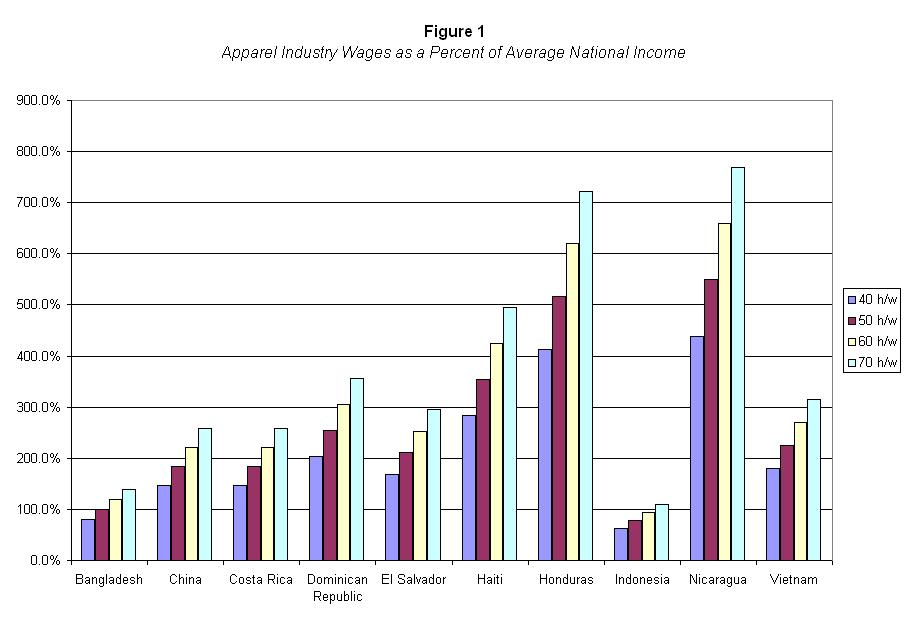
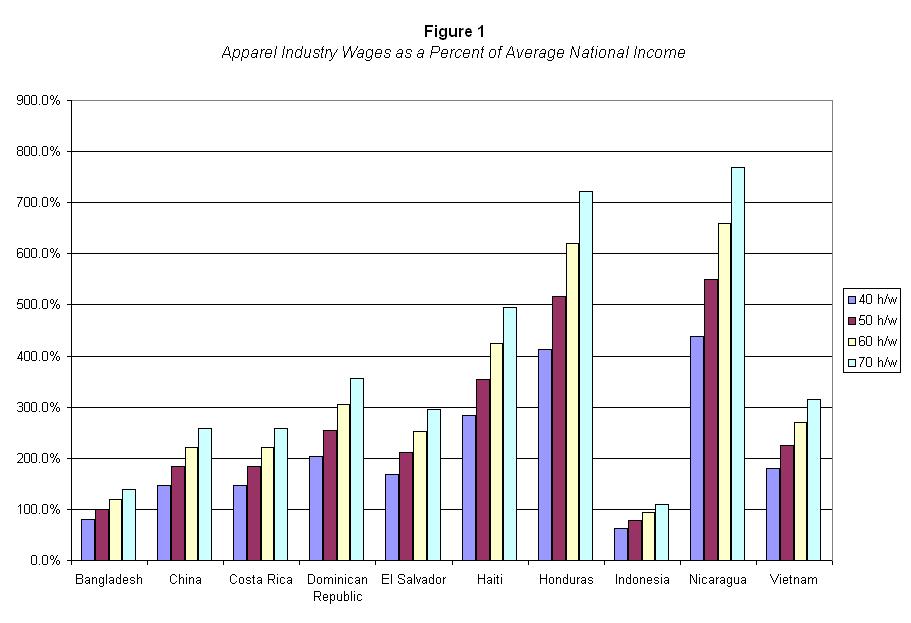
We obtained apparel industry hourly wage data for 10 of the countries accused of using sweatshop labor. We compared the apparel industry wages to average living standards in the country where the factories were located. Figure 1 summarizes our findings.
Figure 1. Apparel Industry Wages as a Percent of Average National Income
ZOOM
Working in the apparel industry in any one of these countries results in earning more than the average income in that country. In half of the countries it results in earning more than three times the national average.
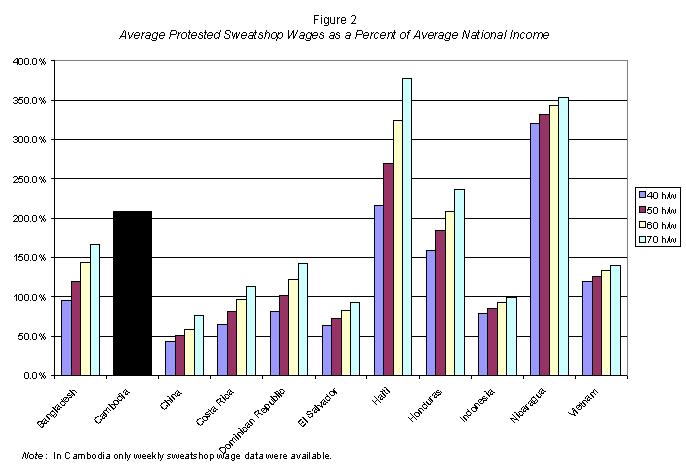
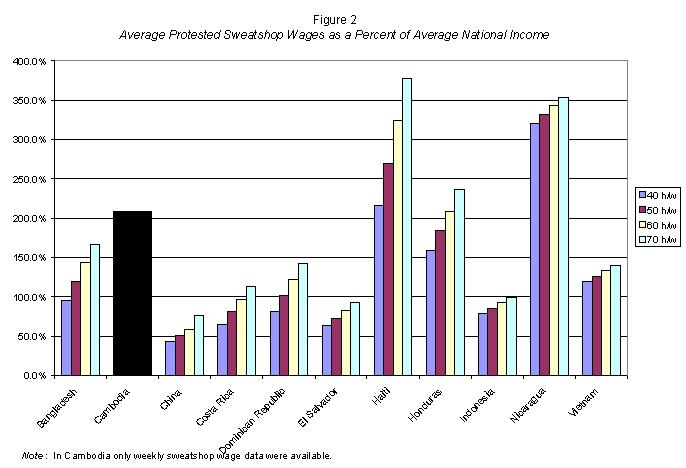
Next we investigated the specific sweatshop wages cited in U.S. news sources. We averaged the sweatshop wages reported in each of the 11 countries and again compared them to average living standards. Figure 2 summarizes our findings.
Figure 2. Average Protested Sweatshop Wages as a Percent of Average National Income
ZOOM
From “In Praise of Cheap Labor,” by Paul Krugman. Slate Magazine, March 1997:
A country like Indonesia is still so poor that progress can be measured in terms of how much the average person gets to eat; since 1970, per capita intake has risen from less than 2,100 to more than 2,800 calories a day. A shocking one-third of young children are still malnourished—but in 1975, the fraction was more than half. Similar improvements can be seen throughout the Pacific Rim, and even in places like Bangladesh. These improvements have not taken place because well-meaning people in the West have done anything to help—foreign aid, never large, has lately shrunk to virtually nothing. Nor is it the result of the benign policies of national governments, which are as callous and corrupt as ever. It is the indirect and unintended result of the actions of soulless multinationals and rapacious local entrepreneurs, whose only concern was to take advantage of the profit opportunities offered by cheap labor.
Even in specific cases where a company was allegedly exploiting sweatshop labor we found the jobs were usually better than average. In 9 of the 11 countries we surveyed, the average reported sweatshop wage, based on a 70-hour work week, equaled or exceeded average incomes. In Cambodia, Haiti, Nicaragua, and Honduras, the average wage paid by a firm accused of being a sweatshop is more than double the average income in that country. The Kathy Lee Gifford factory in Honduras was not an outlier—it was the norm.
Because sweatshops are better than the available alternatives, any reforms aimed at improving the lives of workers in sweatshops must not jeopardize the jobs that they already have. To analyze a reform we must understand what determines worker compensation.
What Determines Wages and Compensation?
If a Nicaraguan sweatshop worker creates $2.50 per hour worth of revenue (net of non-labor costs) for a firm then $2.50 per hour is the absolute most a firm would be willing to pay the worker. If the firm paid him $2.51 per hour, the firm would lose one cent per hour he worked. A profit maximizing firm, therefore, would lay the worker off.
From Nicholas D. Kristof, The New York Times, 14 January 2004:
And so I think what Americans don’t perhaps understand is that in a country like Cambodia, the exploitation of workers in sweatshops is a real problem, but the primary problem in places like this is not that there are too many workers being exploited in sweatshops, it’s that there are not enough. And a country like Cambodia would be infinitely better off if it had more factories using the cheap labor here and giving people a lift out of the unbelievably harsh conditions in the villages and even in the urban slums.
Of course a firm would want to pay this worker less than $2.50 per hour in order to earn greater profits. Ideally the firm would like to pay the worker nothing and capture the entire $2.50 of value he creates per hour as profit. Why doesn’t a firm do that? The reason is that a firm must persuade the worker to accept the job. To do that, the firm must offer him more than his next best available alternative.
The amount a worker is paid is less than or equal to the amount he contributes to a firm’s net revenue and more than or equal to the value of the worker’s next best alternative. In any particular situation the actual compensation falls somewhere between those two bounds.
Wages are low in the third world because worker productivity is low (upper bound) and workers’ alternatives are lousy (lower bound). To get sustained improvements in overall compensation, policies must raise worker productivity and/or increase alternatives available to workers. Policies that try to raise compensation but fail to move these two bounds risk raising compensation above a worker’s upper bound resulting in his losing his job and moving to a less-desirable alternative.
What about non-monetary compensation? Sweatshops often have long hours, few bathroom breaks, and poor health and safety conditions. How are these determined?
Compensation can be paid in wages or in benefits, which may include health, safety, comfort, longer breaks, and fewer working hours. In some cases, improved health or safety can increase worker productivity and firm profits. In these cases firms will provide these benefits out of their own self interest. However, often these benefits do not directly increase profits and so the firm regards such benefits to workers as costs to itself, in which case these costs are like wages.
A profit-maximizing firm is indifferent between compensating workers with wages or compensating them with health, safety, and leisure benefits of the same value when doing so does not affect overall productivity. What the firm really cares about is the overall cost of the total compensation package.
Workers, on the other hand, do care about the mix of compensation they receive. Few of us would be willing to work for no money wage and instead take our entire pay in benefits. We want some of each. Furthermore, when our overall compensation goes up, we tend to desire more non-monetary benefits.
For most people, comfort and safety are what economists call “normal goods,” that is, goods that we demand more of as our income rises. Factory workers in third world countries are no different. Unfortunately, many of them have low productivity, and so their overall compensation level is low. Therefore, they want most of their compensation in wages and little in health or safety improvements.
Evaluating Anti-Sweatshop Proposals
For more on incentives facing lobbyists, listen to the EconTalk podcast Bruce Yandle on Bootleggers and Baptists.
The anti-sweatshop movement consists of unions, student groups, politicians, celebrities, and religious groups. Each group has its own favored “cures” for sweatshop conditions. These groups claim that their proposals would help third world workers.
Some of these proposals would prohibit people in the United States from importing any goods made in sweatshops. What determines whether the good is made in a sweatshop is whether it is made in any way that violates labor standards. Such standards typically include minimum ages for employment, minimum wages, standards of occupational safety and health, and hours of work.
Such standards do nothing to make workers more productive. The upper bound of their compensation is unchanged. Such mandates risk raising compensation above laborers’ productivity and throwing them into worse alternatives by eliminating or reducing the U.S. demand for their products. Employers will meet health and safety mandates by either laying off workers or by improving health and safety while lowering wages against workers’ wishes. In either case, the standards would make workers worse off.
The aforementioned Charles Kernaghan testified before Congress on one of these pieces of legislation, claiming:
Once passed, this legislation will reward decent U.S. companies which are striving to adhere to the law. Worker rights standards in China, Bangladesh and other countries across the world will be raised, improving conditions for tens of millions of working people. Your legislation will for the first time also create a level playing field for American workers to compete fairly in the global economy.
From David R. Henderson, “The Case for Sweatshops.” Weekly Standard, 7 February 2000:
The next time you feel guilty for buying clothes made in a third-world sweatshop, remember this: you’re helping the workers who made that clothing. The people who should feel guilty are those who argue against, or use legislation to prevent us, giving a boost up the economic ladder to members of the human race unlucky enough to have been born in a poor country. Someone who intentionally gets you fired is not your friend.
Contrary to his assertion, anti-sweatshop laws would make third world workers worse off by lowering the demand for their labor. As his testimony alludes to though, such laws would make some American workers better off because they would no longer have to compete with third world labor: U.S. consumers would be, to some extent, a captive market. Although Kernaghan and some other opponents of sweatshops claim that they are attempting to help third world workers, their true motives are revealed by the language of one of these pieces of legislation: “Businesses have a right to be free from competition with companies that use sweatshop labor.” A more-honest statement would be, “U.S. workers have a right not to face competition from poor third world workers and by outlawing competition from the third world we can enhance union wages at the expense of poorer people who work in sweatshops.”
Kernaghan and other first world union members pretend to take up the cause of poor workers but the policies they advocate would actually make those very workers worse off. As economist David Henderson said, “[s]omeone who intentionally gets you fired is not your friend.” Charles Kernaghan is no friend to third world workers.
Conclusion
Not only are sweatshops better than current worker alternatives, but they are also part of the process of development that ultimately raises living standards. That process took about 150 years in Britain and the United States but closer to 30 years in the Japan, South Korea, Hong Kong, and Taiwan.
When companies open sweatshops they bring technology and physical capital with them. Better technology and more capital raise worker productivity. Over time this raises their wages. As more sweatshops open, more alternatives are available to workers raising the amount a firm must bid to hire them.
The good news for sweatshop workers today is that the world has better technology and more capital than ever before. Development in these countries can happen even faster than it did in the East Asian tigers. If activists in the United States do not undermine the process of development by eliminating these countries’ ability to attract sweatshops, then third world countries that adopt market friendly institutions will grow rapidly and sweatshop pay and working conditions will improve even faster than they did in the United States or East Asia. Meanwhile, what the third world so badly needs is more “sweatshop jobs,” not fewer.


Chris Blattman actually carried out some randomised controlled experiments with sweatshops in Ethiopia and published a paper in 2016 on the results. (The paper refers to these as "industrial jobs" but Blattman elsewhere has described them as "sweatshops".) They found that, contrary to traditional economic thinking, workers who got jobs in sweatshops were not necessarily better off than those who did not.
Most who got sweatshop jobs quit within just a few months, leaving the sector entirely. Those who stayed experience higher rates of serious health problems and disability compared to the control group. Income effects after a year did seem to be slightly higher for those in sweatshops compared to the control group, but not statistically significant.
The paper concludes:
Usual caveats apply about this being a limited study in Ethiopia, and more studies would be needed to see if the results generalise. But it is nevertheless an important study that challenges the traditional economic narrative of "sweatshop jobs are better than no jobs".
It seems like even if workers are indifferent between the sweatshop jobs and the informal jobs, it could still be the case that the introduction of sweatshop jobs into the labor marketplace results in improvements for workers' conditions. For example, it could drive up the wages of informal labor.
Thanks for the comment, Ian! Strongly upvoted, and agreed.
Wouldn't traditional economic thinking basically predict that the equilibrium for wages in industrial jobs be at the point where workers are indifferent to them? As in, there's no incentive for the wages in industrial jobs to be any higher than the level which is just high enough to compensate for the downsides (e.g. health risks) compared to the informal labour market? (I'm not an economist, and maybe this depends on what's considered "traditional".)
Good point. The study undermines the traditional economic narrative that sweatshop jobs are clearly better than workers' alternatives - e.g. it would challenge this statement in the original post:
But it doesn't go so far as to show that sweatshops are clearly worse than workers' alternatives, either, which is what sweatshop opponents often claim. So it seems to be a middle-of-the-road finding that supports your idea that the Ethiopian labour market was actually more efficient than people had previously assumed. It's still notable because it challenges conventional wisdom on both sides of the debate.
The study had a third "entrepreneurship" condition that involved giving people $300 plus some business training. Unsurprisingly (imo), participants under that condition did better than both the sweatshop and control conditions. So while I don't think boycotting companies that use sweatshops is likely to be a very effective way of doing good, I don't think going out of your way to support sweatshops is likely to be worthwhile, either - there are likely to be better ways to promote economic development.
Agreed! I recommend donating to the High Impact Philanthropy Fund (HIPF) from the Centre for Exploratory Altruism Research (CEARCH) to increase human and animal welfare as cost-effectively as possible. Joel Tan, CEARCH’s founder and managing director, guessed on 28 May 2025 donating to HIPF was 9 to 15 times as cost-effective as donating to GiveWell's top charities, for which the mean cost of saving a life from 2021 to 2023 was 4.13 k$/life. Belows is some context about CEARCH's cost-effectiveness estimates.
Thanks for the comment, Hugh! Strongly upvoted, and agreed.
Blattman discusses this on the Rationally Speaking podcast
Thanks for sharing! Strongly upvoted. I like the study randomised people to receiving job offers instead of being placed into jobs. The opportunity to reject the offer makes it more like the real world.
Here is how the authors describe the effects on income.
I guess the effect was slightly positive, but that the study was underpowered to detect it. The authors also note the workers think the increased health risks are worth it.
Nitpick. There is a "not" missing at the end.
Thanks for the nitpick, I've fixed it in my post. Agree that the randomisation element is very useful.