I think a very important consideration for thinking about factory farming in the long term is that raising animals to provide animal food products for humans is only one reason why humans raise animals in factory farms. There are other reasons, and there might be new reasons. For now, those reasons include raising animals to be sold as pets, feed for pet animals, animals used in research, materials (fur, fibre, medical materials, semiconductor materials, organs for humans, cells), and remote-controllable animal cyborgs (one that I worry a lot about).
And factory farming for these reasons could also expand intergalactically.
Thanks for writing this! I appreciate you flagging:
Here, I’m conditioning on humans as we know them continuing to exist. I take no position on how likely this is to happen, but it seems to me like this is the outcome that EAs are pushing for when trying to reduce existential risk from AI.
I am not aware of anyone who works on AI safety who would say that this is what they are pushing for, with the exception of people who are pushing for a complete pause in AI development.
The rest of us are generally resigned to biological humans disappearing once we have transformative AI [edit: this was unclear, see update], even under the most optimistic scenarios. I expect that this is a major way in which the AI safety people I know (including Matt) find arguments like this and Bentham's Bulldogs' uncompelling.
Nitpick but I think it’s unlikely that biological humans will completely disappear and I’m an AI safety person. The sota literature is ofc Pantheon season 2 where a few humans choose not to be uploaded.
Fair. "In good timelines some humans continue to exist despite not really being a major force analogous to how the Amish exist today but aren't really a major force" is probably the modal view amongst people I talk to.
Wow that's super interesting, and not what I would have expected. I appreciate you making this explicit.
My first reaction is that you and I are talking to different groups of people. I frequently encounter the claim that AI will "solve cultivated meat" and so we shouldn't worry about farmed animals as long as AI doesn't kill everyone. That's what I was mainly reacting to here. I don't work in AI safety though, so I wouldn't be surprised if the group of people you talk to has thought about it more than the group of people I talk to.
My second reaction is that I don't understand how biological humans disappearing is different than the disastrous x-risk scenarios that I associate EAs as trying to avoid. Like it seems like EAs are worried about AI scheming in ways that would cause them to make a power grab against humanity's interest. If instead humans disappear for other (perhaps less violent) reasons, how is that then consistent with AI safety?
Maybe the answer is that humans would be succeeded by some other form of life that are sufficiently similar to humans that it would be better for that form of life to exist than squiggles?
If that's the claim (which I actually find plausible), then I agree animals would no longer be farmed. However, it seems like this would fall into the bucket of "not actionable unless you work directly on AI," so it seems like it might be practically useful to act as if this wasn't going to be the case?
(Also, this claim feels at odds with what I understood your perspective to be from the shallow review you did a while ago. I haven't had a chance to go back and more carefully read that piece, and maybe on a closer reason it will all look consistent. But I'm just flagging that I still can't fully model your perspective)
During the century we're in right now, we will develop technologies that cause us to transition to a state in which humans as we know them are no longer the main force in world events. This is our last chance to shape how that transition happens.
Whatever the main force in world events is (perhaps digital people, misaligned AI, or something else) will create highly stable civilizations that populate our entire galaxy for billions of years to come. The transition taking place this century could shape all of that.
I think it's very unclear whether this would be a good or bad thing.
There are some people (e.g. Evitable) who are trying to stop this transition, but I think more AI safety people would self-describe their work as "shap[ing] how that transition happens."
However, it seems like this would fall into the bucket of "not actionable unless you work directly on AI," so it seems like it might be practically useful to act as if this wasn't going to be the case?
I think there's a decent chance that AI won't actually be very transformative (or at least won't be transformative soon) and therefore it's reasonable to bet your career plans on that assumption. But, to the extent you think AI is actually going to be a big deal, I would suggest considering working on it!
Reading the comments of this post has really given me a sense of 'the way animal advocates are thinking about AGI or Transformative AI (myself included) seems quite different to the way AGI-pilled folks in AI safety think about what AGI or Transformative AI'. I'd love for someone to write a post or quick take on what they think folks in animal advocacy misunderstand about the potential of Transformative AI.
I have observed the same sharp distinction as @ElliotTep: EAs not focused on animal welfare accept that TAI will end factory farming with something like Matt Reardon's 99% certainty, while most focused on animal welfare (myself included) feel the risk of factory farming being perpetuated into the future is unacceptably high. This is probably a mix of several factors:
Animal welfare people having some bias to think our work is still important
Animal welfare people having a lower threshold for unacceptably high risk of this particular outcome
EAs outside animal welfare having less firsthand experience of frustration at the ways humans today seem to favor meat from tortured animals over cultivated meat
Animal welfare people having thought less about what extremely weird posthuman futures look like and how strongly TAI might pull in that direction
EAs outside animal welfare being overly confident about the extremely weird posthuman future
I'm focused on animal welfare and have been for 12 years. But I've also read my Greg Egan and think it is less likely than not that biological humans will continue to exist into the far future. But I still believe that ensuring AI ends factory farming rather than perpetuating it should be a top focus area for EA. I might try to think through this and write something better, but off the cuff reasons:
It's possible biological substrates are necessary for consciousness/sentience. My credence on this is maybe 15% which I consider very low given our cluelessness about consciousness. If silicon platforms can't support consciousness, then Von Neumann probes will probably carry gene sequences to other planets to seed biological civilizations. Low probabilities of galaxy-scale factory farming still look very important!
Maybe the weird posthuman future will get the rest of the lightcone and leave earth for biologicals. In that case it could be a thousand years before digital minds colonize the nearest star system. That's a lot of time where factory farming could still represent a share of conscious experience within an order of magnitude of today's. Any model that discounts future beings even just due to uncertainty about our ability to affect their welfare seems likely to make factory farming remain a top priority.
What Matt calls efficient many would call “weird” and hence undesirable. I’m not sure we have a reason to think AI will mitigate this rather than amplify it.
In case you haven't seen it, one argument for why AI might amplify (or at least lock-in) traditions was given by Buck here: Christian homeschoolers in the year 3000.
Thanks for flagging this, and for generally engaging here. That's a sobering and generally depressing piece... It seems like Buck and I are definitely gesturing at similar things. This passage in particular stuck out to me:
But I don't think that's how most people actually work. For most people, if they have a choice between an object-level belief that is core to their identity and a meta-level principle like "believe what you'd believe if you were smarter and more informed," they will choose the object-level belief. Tell a devout Christian that superintelligent AI analysis suggests their faith is unfounded, and they won't abandon their faith, they'll abandon the AI (perhaps just for the competing AI that is just as good, and happy to tell them otherwise). Tell them that their children will be more successful at reaching reflective equilibrium if exposed to diverse viewpoints, and they'll question your definition of success, not their approach to parenting.
I was envisioning a similar dynamic playing out with meat consumption. You can argue to someone that a superintelligent AI analysis says that that cultivated meat is "the same" as real meat and it's even better in various ways, but if they have a specific attachment to a bucolic / naturalistic vision of animal husbandry ("my meat came from happy animals living in a pasture and had one bad day") then they might just cling to that. Perhaps in a superabundant world, AI will even be able to provide this to them.
My version of Matt's critique that you quoted is something like:
Imagine you're running a mining company, and you want to start mining Venus. You could either embark on a massive terraforming project to make Venus habitable by biological humans who can work in your mining colony, or you could just build a bunch of robots who can naturally withstand Venus' climate, think faster than a human, make better decisions than a human, etc. etc. What do you do?
Obviously you are going to choose to send the robots, and the robots aren't going to want to eat meat, so you don't need to worry about factory farming on Venus.
I don't think this argument is bulletproof. For example, ports in the U.S. are required to pay human dock workers to sit around and do nothing after their jobs had been automated. I could imagine some sort of analogous regulatory capture in the future which would require mining companies to send humans to other planets even when robots would be more efficient. Preventing this kind of lock-in is one of the few interventions targeting a post-singularity world that I feel positive about.
Interesting post. I wonder if the bigger question isn't whether consumers choose cultivated meat, but whether producers do. If it can eliminate disease outbreaks, antibiotic use, biosecurity risks, slaughterhouses, and other costs and risks, the economics may eventually drive adoption.
Consumer sentiment is important, but I agree that producer incentives, assuming it's technically possible, surprisingly support adoption! Same with government adoption, with incentives like food security.
What about the argument that cultivated meat would be so much cleaner? None of the bacterial contamination that sickens and kills so many people (e.g., campylobacter, salmonella, E. Coli, listeria), and none of the drug residues (in the U.S., USDA + FDA allow 100 different veterinary drugs in meat at trace amounts)? That feels to me like a strong value proposition, no? Much cleaner, healthier, and safer meat--curious what you think.
Aside: I talk about this in my new book, Meat, see meatbook.org.
That's the type of thing that could be a value proposition, but I think that in the worlds we're talking about those issues will be largely solvable for conventional meat. Plus, that kind of pitch hasn't worked that well so far on getting people to feel positively towards cultivated.
BLUF:
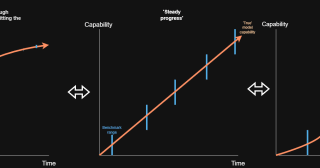
* To determine whether AI is ‘improving exponentially’, ‘hitting the wall’, or any other claim which involves a quantity or magnitude (e.g. ‘This model was a big leap/small increment’). We need a good y-axis: an interval scale of AI capability which means +1 unit always represents the same degree of ‘how much better’, in the same way +1 degree Celsius is always the same amount of ‘how much hotter’.
* Yet there is no good y-axis for AI capability. All our...
Public service announcement
1. Applications are now open for our first ever round of the Charity Entrepreneurship Incubation Program dedicated exclusively to animal welfare. Learn more about what’s different this round here and apply...
Summary
* The animal welfare movement has already seen an influx in funding and should prepare for the possibility of more.
* The EA Animal Welfare Fund is encouraging those working in animal advocacy to actively set aside time and resources now to concretely plan for scaling sustainably, and we’ll support you in doing that.
* We’re requesting advocates set concrete ambitious goals and submit plans t...
Bentham’s Bulldog recently argued that AI won’t definitely make factory farms obsolete. I agree, but I’d go further and argue that by default AI won’t make factory farms obsolete. However, I think it’s possible (though not guaranteed) that AI could make factory farms a lot more humane.
He throws out an 80% chance of cultivated meat being developed, and a 70% chance of it displacing factory farms contingent on it being developed. In particular, I think 70% is too optimistic.
An 80% chance of cultivated meat being developed contingent on TAI seems reasonable to me, insofar as it's possible to forecast such things right now. We currently have no feasible technical roadmap for cultivated meat to be able to create all of the myriad kinds of animal products that people consume today. However, one could plausibly think that TAI means that any technology that’s consistent with the laws of physics will become possible. Cultivated meat will be possible in these worlds, and some additional superset of these worlds.
However, I’d put a much lower chance of it being adopted in a significant way. To make a very vibesy forecast, I think there's maybe a 40% chance that cultivated meat (or some other technical paradigm that doesn’t involve living beings, like bodyoids) is a majority of meat production in the future, contingent on it being developed. Multiplying these two likelihoods together gives a 32% chance that AI will make factory farms obsolete.
Here, I’m conditioning on humans as we know them continuing to exist. I take no position on how likely this is to happen, but it seems to me like this is the outcome that EAs are pushing for when trying to reduce existential risk from AI.
My disagreement with Bentham’s Bulldog stems from the idea that the worlds in which cultivated meat are possible are also ones in which animal protein is significantly cheaper. Therefore, people will choose whichever they want more, and we have no evidence people will want cultivated meat more.
The worlds in which cultivated meat are possible are also ones in which animal protein is significantly cheaper
The order of events for AI takeoff is roughly as follows: 1) recursive self improvement, 2) country of geniuses in a datacenter / automate all white-collar work, 3) industrial explosion 4) material abundance / post-scarcity 5) singularity.
Given that cultivated meat is an industrial technology in the world of atoms, it will most likely become possible in steps 3 and 4.
The reasonscultivated meat will become possible are that the entire manufacturing process will be run by robots, equipment, material and facilities upstream in the supply chain will become cheap to produce, and AI will give us a deeper understanding and ability to control biology.
These are all things that will affect the price of animal protein as well. During the industrial explosion, traditional animal husbandry will also go through an AI transformation that will lower its costs. Husbandry will become more automated and the cost of facilities and equipment will go down. Just as AI helps us understand the cell better for cell culture, it will also help animal breeders understand livestock genetics and health better.
In the limit of technological capability, I expect the price of animal-based meat and cultivated meat to be fairly similar to each other, but both extremely cheap relative to societal wealth. The cost of both will primarily be driven by the cost of the primary feedstock (like corn and soy). Fixed costs of equipment and facilities will fall, and be amortized over huge volumes.
It’s hard to forecast which production paradigm will be cheaper. I suspect that there will be variation based on product category and meat type. For example, the theoretical argument for why cultivated meat might someday be cheaper than animal meat is because animals waste energy doing things that we don’t care about, like growing bones or thinking. However, this inefficiency can be measured through the feed conversion ratio, which is lower for smaller animals. For example, shrimp have a feed conversion rate of under 2, which means their total metabolic waste is fairly small. Cultivated shrimp may therefore never be cost competitive with conventional shrimp. But it may be competitive for something like beef, especially more expensive cuts.
People will choose whichever they want more, and we have no evidence people will want cultivated meat.
That said, relative differences in cost might not matter that much, since both will be extremely cheap relative to consumer purchasing power. If I were a millionaire and could eat animal-based meat for a year for $10, or cultivated meat for a year for $10.25, the cost would not be decision-relevant to me at all. I would choose whichever one I want more.
I can think of two reasons why people might want to eat cultivated meat over animal-based meat:
They’re persuaded by moral arguments
Cultivated meat has some additional value proposition over animal-based meat. For example, it’s healthier or tastes better. (In a previous post, I talked about AI-pilled cultivated meat development focusing on increasing the consumer value proposition, and this is what I meant).
On the moral arguments - It’s nice to think about AI making the world more ethical, and there are plausible mechanisms by which this would happen, e.g. AI having superhuman persuasion and animal-friendly ethics. But I don’t think we have much evidence that people actually have fundamental values that would say animal farming is wrong. As Bentham’s Bulldog points out, only 13% of current consumers would prefer cultivated meat if it existed today, and only a very narrow subset of people think eating animals is fundamentally wrong. We shouldn’t assume that once cultivated meat is cost-competitive that people will switch because it’s the “right thing to do.”
In fact, we seem to have substantial evidence that people won’t want to eat cultivated meat. Current humans have a strong naturalistic preference when it comes to food, particularly animal products (as demonstrated by the rise of the MAHA movement). It seems equally plausible that AI could empower and expand these kinds of preferences, making it more difficult for a weird unnatural technocratic solution like cultivated meat to succeed.
Objections
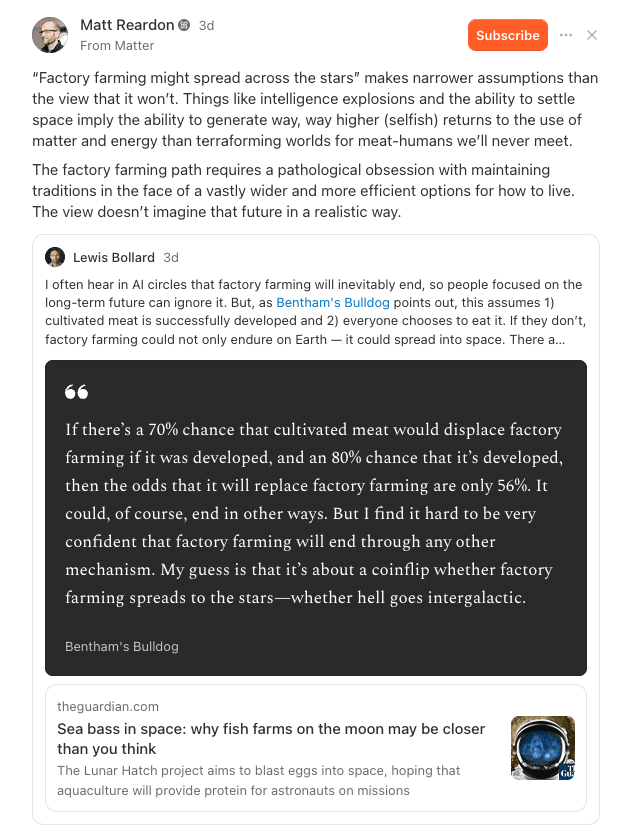
Matt Reardon offers one defense of the view that factory farming will be made obsolete by AI:
Addressing each claim in turn:
“Factory farming might spread across the stars” makes narrower assumptions than the view that it won’t.
I’m not sure why this would be true. In order to claim that people will stop eating meat by default, you have to assume that future humans will be different from current humans.
Things like intelligence explosions and the ability to settle space imply the ability to generate way, way higher (selfish) returns to the use of matter and energy than terraforming worlds for meat-humans we’ll never meet.
Returns according to what value system? It seems that if we succeed at aligning AI to human values, then the value system we’re talking about is fairly likely to be one in which humans want to eat meat. In fact, you could make a similar argument about today’s economy – why waste so much energy growing animals when we could all just eat soybeans directly?
The factory farming path requires a pathological obsession with maintaining traditions in the face of a vastly wider and more efficient options for how to live.
People demonstrate many obsessions with tradition that seem to defy “efficiency” and “reason.” Matt may think these are pathological, but that’s relative to his own value system that I, but relatively few others, share. What Matt calls efficient many would call “weird” and hence undesirable. I’m not sure we have a reason to think AI will mitigate this rather than amplify it.
I don’t mean to pick on Matt, he’s just the only person I’ve seen to try to defend the view publicly. I would love for others who hold this view to articulate their reasoning so we can get to the bottom of this important question!
AI could make factory farming significantly more humane
To not be totally pessimistic, I think it’s also possible that AI could make factory farming significantly more humane, perhaps even to the level where animals have net positive lives.
The fundamental reason that animals are treated poorly on factory farms is because to treat them well costs money, and someone has to pay for it. As wealth increases, the relative value of this cost will decrease. The industrial explosion and the ensuing material abundance will give us flexibility to afford many things which are now considered luxuries, and animal welfare could be one of them.
This is a silver lining in this generally pessimistic forecast, although it’s certainly not inevitable. There are lots of things we could already do for animal welfare that are insignificant costs that we don’t do, and Bentham’s Bulldog’s vision of torture chambers spreading throughout the galaxy is certainly a realistic possibility that’s sobering to consider.
But as the cost of animal welfare goes towards epsilon, it could in theory be possible to structure society in a way that this externality is always mitigated (e.g. welfare regulations, or robust AI monitoring and certification schemes). Engel's law is an empirical principle stating that as wealth increases, food expenditures as a share of total expenditures go down, but total food expenditures go up. Given that we do currently have lots of evidence that people value animal welfare to some extent, this presents a theory of change for animals that doesn’t rely on future humans having different preferences or better morals from current humans.
A major uncertainty I have is how economic incentives will change in a world of massive material abundance. Will we still see “race to the bottom” dynamics for things that generate negative externalities, even if the cost of eliminating those externalities falls to epsilon? Or is there any mechanism by which they’d be solved by default once the costs get sufficiently low? I’d love someone to try to investigate this question more deeply.

I think a very important consideration for thinking about factory farming in the long term is that raising animals to provide animal food products for humans is only one reason why humans raise animals in factory farms. There are other reasons, and there might be new reasons. For now, those reasons include raising animals to be sold as pets, feed for pet animals, animals used in research, materials (fur, fibre, medical materials, semiconductor materials, organs for humans, cells), and remote-controllable animal cyborgs (one that I worry a lot about).
And factory farming for these reasons could also expand intergalactically.
Yes this is a good point. I think about this a lot.