Wonderful post as usual! I've been thinking about these concepts for a while and folks might be interested in seeing this segment of a presentation I gave characterizing two potential scenarios for the future of animal ag based on who gets the first mover advantage.
A note on capital availability:
On April 30, 2026 in the US, the House passed H.R. 7567, the Farm, Food, and National Security Act of 2026. Buried inside is a provision that raises the Environmental Quality Incentives Program cost-share from 75% to 90% for what the bill calls "precision agriculture technology."
"(8) Increased payments for precision agriculture practices. — Notwithstanding paragraph (2), the Secretary may increase the amount that would otherwise be provided for a practice under this subsection to not more than 90 percent of the costs associated with adopting precision agriculture practices and acquiring precision agriculture technology for the purpose of implementing conservation practices."
The bill also creates a new low-interest loan program of up to $500,000 per farmer for hardware, software, and connectivity, and directs the FCC to expand broadband to unserved farmland.
But the kicker is that the 75% cost-share has existed for years and covers every animal we care about: Chickens. Pigs. Cows. Farmed fish. So essentially the federal government has quietly been offering to pay three quarters of the cost of installing this technology and most people advocating to change incumbent systems are not even aware of this potential pathway to helping animals.
One of my wishlists is for a group that specifically helps precision ag companies that are more welfare-oriented to coordinate to beat out the ones that don't care about welfare and thus shape which systems get prioritized.
Interesting post! I'd just push back on this statement: "Historically, animal agriculture has not been particularly disruptable. Extremely high capital requirements, low possibility of differentiation, and a commodity market has made it so that there very little churn in which companies are dominant."
I'd argue that the transition toward factory farming to begin with was one of the fastest and most pervasive disruptions imaginable. The system we have today looks nothing like it did 100 years ago, or even 75. And it can look radically different again much faster than that, I truly believe.
Fair point! It might have been more accurate to say "industrialized animal agriculture has not been particularly disruptable." My claim is that once animal agriculture went through it's industrial transformation (small family farms -> CAFOs) then it wasn't particularly disruptable.
Incumbents Might Be Replaced During AI Takeoff, Including in Animal Agriculture
I used an LLM to help draft this post and it likely contains >10% AI-generated text, but I’ve edited/rewritten it extensively and endorse it.
TL;DR
It’s unclear how much the intelligence explosion will directly affect agriculture, because it's one of the least cognitive-labor-intensive industries. But the industrial explosion that may follow could make even animal agriculture susceptible to disruptive innovation (possibly the only time in history that's true). This suggests that during AI-takeoff current incumbents could be replaced by AI-native startups. Given this, advocates should weigh influencing current companies less, take AI-native ag startups (and disrupting the industry themselves) seriously, and treat "AI-pilled" alternative protein as a distinct strategy.
Disruptive Innovation
We're possibly at the early stages of an intelligence explosion, which many believe will radically change the economy. How exactly the transition will work is less clear.
There are two broad possibilities: one is that current companies (e.g. Tyson in the context of animal agriculture) will navigate the AI-transition, adopt new technologies, become AI-native in the relevant ways, and continue to dominate their respective industries in the future. The other is that a separate AI-native startup will directly compete against incumbents via disruption innovation.
Disruptive innovation, as described in Clayton Christensen’s The Innovator’s Dilemma, is a theory that is often discussed but seldom deeply understood. It is a description of how it’s possible for new startups to outcompete powerful incumbents. On its face, incumbents in an industry should always win – they have more money, more relationships, and more expertise. However, we observe it as an empirical fact of the world that large innovations are often pioneered by startups. The theory explains how this is possible.
The conditions of disruptive innovation are as follows:
An industry has powerful incumbents whose position is reinforced by structural advantages — scale, capital investments, supplier relationships — that make it prohibitively difficult for new companies to enter.
Something changes about the environment (usually a technological change, but it can also be things like changes in consumer demand) that enable a different operating model.
New startups exploit this change, usually first finding an initial foothold in a niche market with specific needs that the incumbent is large to take seriously or properly serve.
The startup’s model is 1) superior in some important ways given the recent change of environment, and 2) sufficiently different from the incumbent model that it’s difficult for the incumbent to adjust. This difficulty goes deeper than just “old companies are dumb and slow.” There are structural reasons why incumbents struggle to change:
Capital investments that assume the old operating model. E.g. Billions of dollars in facilities and equipment designed around specific production methods.
Long-term contracts with suppliers and customers that lock in the current supply chain structure.
Organizational processes and culture optimized for the current paradigm. Especially in highly competitive commodity markets, selection pressure pushes companies toward maximum efficiency at the current process, not robustness to environmental change. Optimizing for flexibility means accepting a competitive disadvantage against rivals who don't — so companies rationally choose not to.
The startup scales rapidly and aggressively to minimize the amount of time the incumbent has to react.
Once the startup reaches scale, their superior operating model allows them to outcompete the incumbent.
From this, we can identify some ingredients that make an industry more susceptible to disruption:
High speed of environmental change (increasing technological capability) relative to the ability of incumbents to react (which itself is variable based on the specific industry).
High difference between the operating model unlocked by the environmental change and the current model.
High competitive advantages of the new operating model.
Availability of scaling capital. Larger disruptions tend to happen when financing is available to fund rapid scale-up — e.g., in lower interest rate environments.
Without these ingredients, a new technology is what Christensen calls a "sustaining innovation" — if the incumbent is able to react and adopt the new technology, it often reinforces their advantages rather than undermining them. With thee ingredients, disruption becomes possible, though not guaranteed. You still need a competent, aggressive, and well-financed startup, and you need the incumbent to not outperform expectations.
AI-pilled agriculture
When and how might this play out in an industry like animal agriculture? Historically, animal agriculture has not been particularly disruptable. Extremely high capital requirements, low possibility of differentiation, and a commodity market has made it so that there very little churn in which companies are dominant. Alternative proteins seemed like they potentially had a shot, but have now stalled.
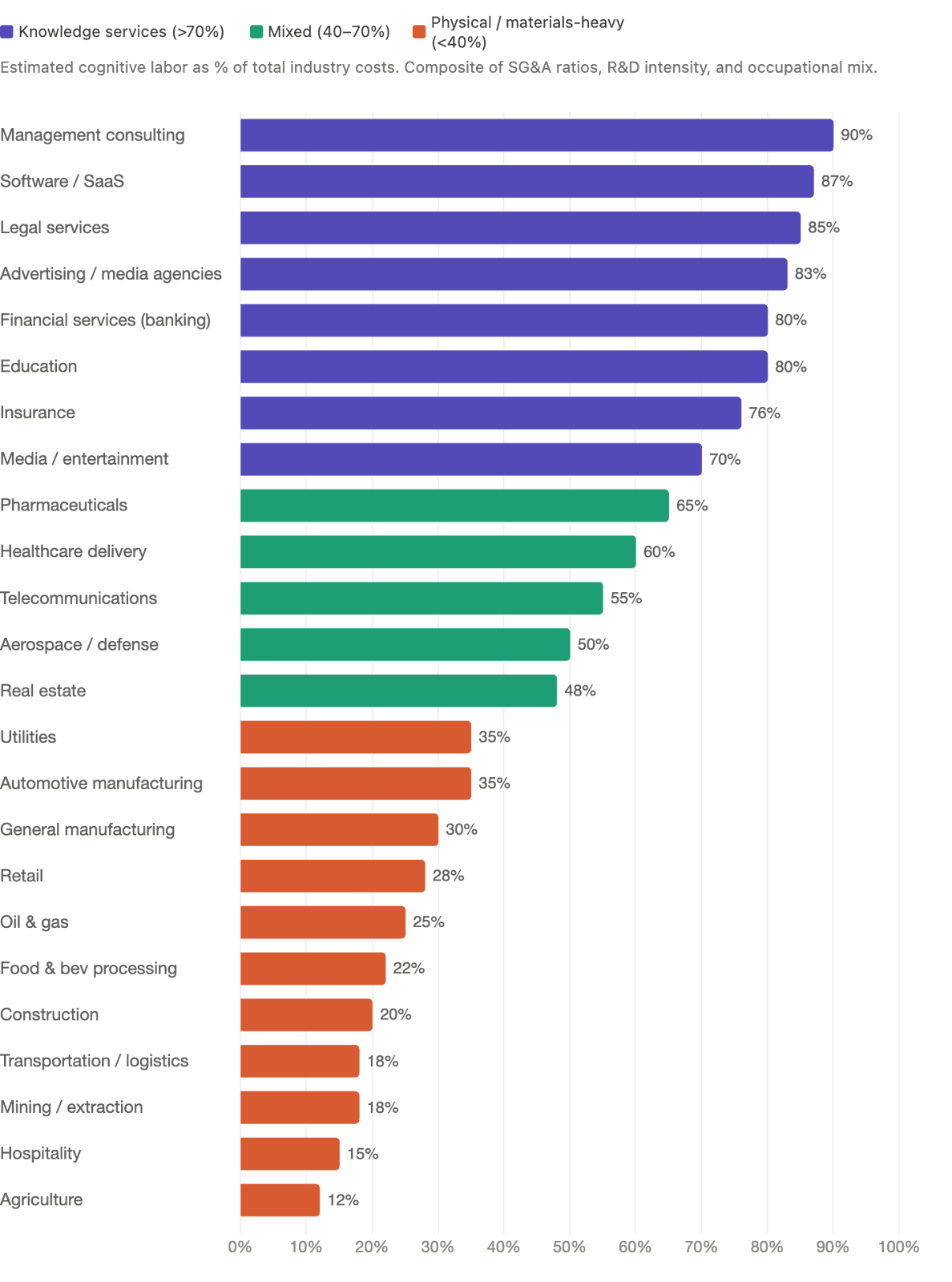
On one strand of thinking, AI won’t necessarily have a disruptive effect on agriculture. The argument goes: AI will cause an intelligence explosion that will radically transform how cognitive labor is done. Therefore, the effects of AI will be largest on industries where cognitive labor is the most important. Of all industries in the world, agriculture might be the literal last in this regard – It mostly involves people and machines in the physical world doing things.
This was made by Claude without much checking, don’t take it too literally
However, after the intelligence explosion, there may be an industrial explosion, a period of rapidly accelerating growth in physical production capacity, driven by a positive feedback loop: robot factories build more and better robot factories. If this happens, it will transform the world of atoms just like the intelligence explosion transformed the world of bits. This is when we could see disruptive innovation dynamics in something as deeply entrenched as agriculture.
Let’s return to the four ingredients for disruptive innovation discussed above. Clearly 1 will be met. If agriculture is currently the least disruptable in normal times, it’s also probably the least able to respond to disruptive innovation in abnormal times. Industries like agriculture are generally slow moving and ossified, having not changed much since agriculture initially industrialized. They’ll find it extremely difficult to respond and adapt to this disruption.
Ingredients 2 and 3 could be met if we think "transformative" AI will really be transformative, although the details are difficult to think through.
Ingredient 4 — availability of scaling capital — is less clear. It will depend on what happens to financial markets during AI takeoff. On the one hand, significant demand for compute and power could increase the cost of capital, as could the fact that many industries may become disruptable around the same time. On the other hand, if AI itself greatly increases societal wealth, there could be a glut of capital looking for places to go.
Therefore, it seems like agriculture could be disruptable during the industrial explosion. This doesn’t mean that they necessarily will be disrupted, but it means that the conditions are right for a competent and aggressive startup to feasibly compete with companies like Tyson. This might look like a new wave of alternative protein innovation, but this isn’t guaranteed (e.g. if consumer demand never materializes). It could also be some kind of AI and robotics native agriculture that provides a strong value proposition at a lower price.
Understanding the theory of disruptive innovation can help reconcile two seemingly contradictory beliefs about the world:
AI will radically transform society very quickly
Most incumbent firms and institutions move very slowly and are hesitant to change the way they do things
In many cases, disruptive innovation may be the way in which AI and robotics proliferates the quickest into society.
In fact, I expect AI to be a bigger disruptive force for physical-world industries than digital-world industries, because:
For digital industries, technological change will happen faster, but these industries are generally faster to adapt (cognitive labor is easier and faster to change than physical infrastructure).
I expect operating models of robotics-native physical world startups to be more different from current models than AI-native digital world startups.
Practical Ramifications
I'm describing a dynamic that could occur during AI takeoff, assuming the industrial explosion is slow enough for such things to actually play out. What happens afterwards is anyone's guess. Maybe thinking about these kinds of dynamics is futile given that they’re a precursor to something unfathomably weird. But many are struggling to figure out what to do in the face of such a radical incoming transformation, and thinking about what takeoff will actually look like gives us something to at least hook onto.
To make a stronger but more speculative claim – AI takeoff may be the only period in historywhen industrialized agriculture is disruptable. One of the ingredients of disruptive innovation is rapid technological change. If we model technological progress as a sigmoid, where we get a period of rapid progress followed by a period of stability (e.g. we eventually exhaust the feasible tech tree), then AI takeoff might be the last time when the conditions for disruptive innovation are met. After takeoff, agriculture might settle into a new equilibrium with new incumbents. The question is who those new incumbents will be, and what they'll optimize for.
I think there are a few practical takeaways from all this:
The period of change during AI takeoff will be one in which the way that industries work will be particularly moldable. This is true of animal agriculture, and many other industries as well. Insofar as advocacy is oriented towards changing the way that industries work, advocates should take new AI-native startups seriously and engage early and often. If advocates have the opportunity to influence these startups while the startups are small and in need of resources, that could end up being much more effective than lobbying existing incumbents with established supply chains. Advocates should also consider trying to be the ones disrupting existing industries, to maximize influence over the future supply chain.
The marginal importance of influencing current institutions goes down in proportion to the ability of those institutions to survive AI takeoff. The theory of disruptive innovation suggests that companies are particularly unstable institutions, so the importance of changing practices of current companies should go down on the margin.
If one is working on alternative protein as a potentially disruptive technology, I think there are two broad ways of thinking about strategy. One is to model alternative proteins as a traditional hype cycle, where we’ve gone through the trough of disillusionment, and are now on the slope of enlightenment. Under this model, the right strategy is to patiently take on practical research projects that address the bottlenecks identified during the initial period of hype. This would probably be the right strategy in more normal times. The second strategy is to focus on “AI-pilled” alternative protein development, where the goal is to get the best position to compete against animal agriculture during the AI transition. I don’t know exactly what this would look like but, some preliminary ideas could be:
Focusing research bandwidth on generating large robust datasets, as opposed to answering specific questions.
Worrying relatively less about costs, under the assumption that the industrial explosion will push material and equipment costs toward zero, and future factories will be run by autonomous robots. Instead, focus on increasing the consumer value proposition as much as possible.
Edit: The match seems to now be over - the funds were expended in around 35 minutes. But many of these charities are great and should be supported regardless!
***
On October 22nd starting at 10:00am Pacific Time, Every.org is matching donations to select animal welfare organizations at a 2:1 rate, up to $2,000 per donor per nonprofit (so if you give up to $2,000, they will contribute up to $4,000 and the nonprofit will get up to $6,000). The first donation a donor makes to each el...
Crossposted to Less Wrong
‘Like most of life’s dangers, the dangers of artificial intelligence are not easily identified from the armchair.’
J Dmitri Gallow
Epistemic status
I’m not an expert in this field, and herein I make some sweeping generalisations educated guesses about the overall...


Wonderful post as usual! I've been thinking about these concepts for a while and folks might be interested in seeing this segment of a presentation I gave characterizing two potential scenarios for the future of animal ag based on who gets the first mover advantage.
A note on capital availability:
On April 30, 2026 in the US, the House passed H.R. 7567, the Farm, Food, and National Security Act of 2026. Buried inside is a provision that raises the Environmental Quality Incentives Program cost-share from 75% to 90% for what the bill calls "precision agriculture technology."
"(8) Increased payments for precision agriculture practices. — Notwithstanding paragraph (2), the Secretary may increase the amount that would otherwise be provided for a practice under this subsection to not more than 90 percent of the costs associated with adopting precision agriculture practices and acquiring precision agriculture technology for the purpose of implementing conservation practices."
The bill also creates a new low-interest loan program of up to $500,000 per farmer for hardware, software, and connectivity, and directs the FCC to expand broadband to unserved farmland.
But the kicker is that the 75% cost-share has existed for years and covers every animal we care about: Chickens. Pigs. Cows. Farmed fish. So essentially the federal government has quietly been offering to pay three quarters of the cost of installing this technology and most people advocating to change incumbent systems are not even aware of this potential pathway to helping animals.
One of my wishlists is for a group that specifically helps precision ag companies that are more welfare-oriented to coordinate to beat out the ones that don't care about welfare and thus shape which systems get prioritized.