Comments
(I work at EA Funds)
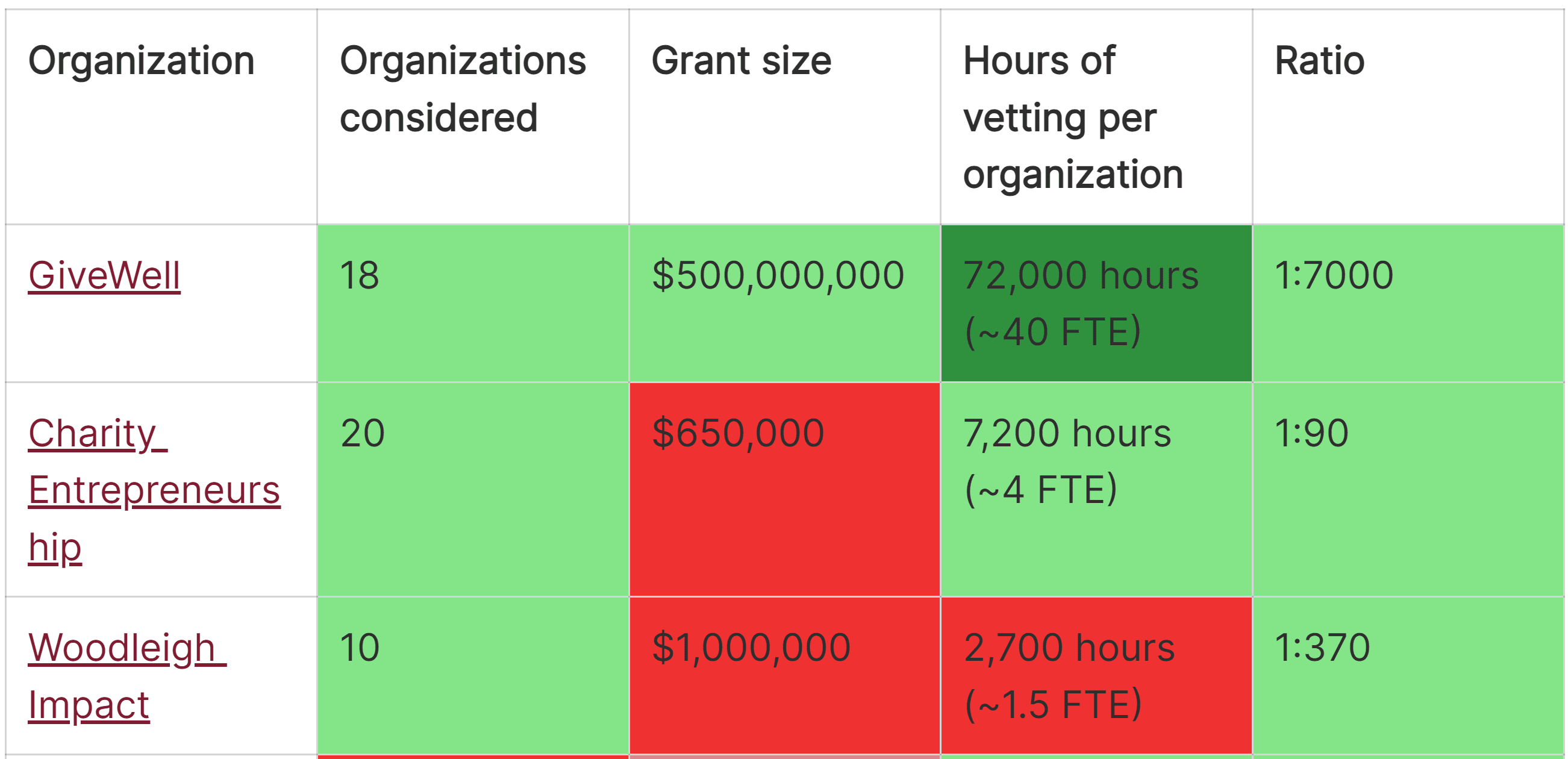
- Charity Entrepreneurship (CE) produces an in-depth report for each organisation it incubates (see CE’s research).
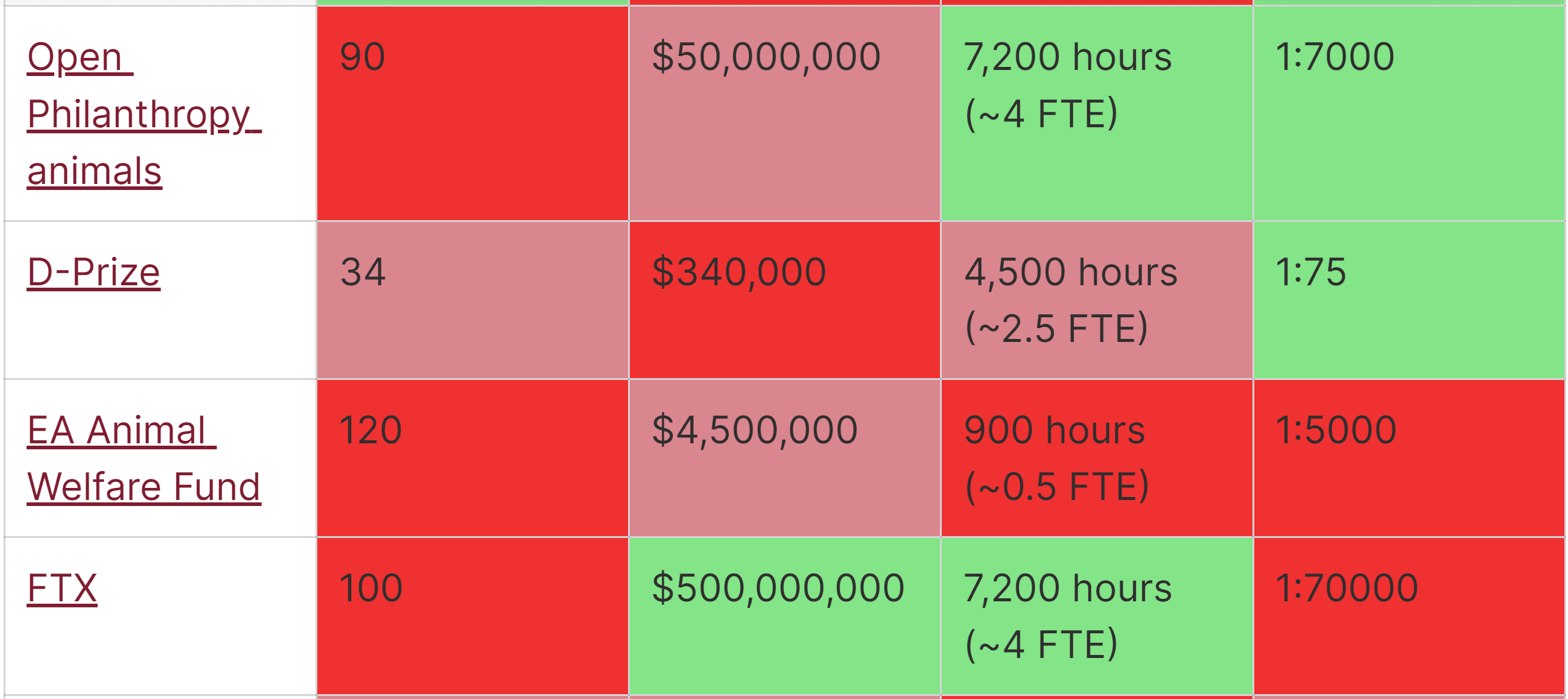
- Effective Altruism Funds has write-ups of 1 sentence for the vast majority of the grants of its 4 funds.
These seem like pretty unreasonable comparisons unless I'm missing something. Like entirely different orders of magnitude. For context, Long-Term Future Fund (which is one of 4 EA Funds) gives out about 200 grants a year.
If I understand your sources correctly, CE's produces like 4 in-depth reports a cycle (and I think they have 1-2 cycles a year)? So 4-8 grants/year[1]
I would guess that EA Funds gives out more grants (total number, not dollar amount) than all the other orgs in your list combined except OP[2].
Of course it's a lot easier to write in-depth reports of 8 grants than for 400! Like you could write a report every month and still have some time left over to proofread. [3]
- ^
I think they also have more employees.
- ^
I'm more confident if you exclude SFF, which incidentally also probably gives out more grants than all the other orgs combined on this list if you exclude OP and EA Funds.
- ^
When LTFF "only" gave out 27 grants in a cycle, they were able to write pretty detailed reasoning for each of their grants.

I think it's a travesty that so many valuable analyses are never publicly shared, but due to unreasonable external expectations it's currently hard for any single organization to become more transparent without occurring enormous costs.
If open phil actually were to start publishing their internal analyses behind each grant, I will bet you at good odds the the following scenario is going to play out on the EA Forum:
Several things would be true about the above hypothetical example:
Criticism shouldn’t have to warrant a response if it takes time away from work which is more important. The internal analyses from open phil I’ve been privileged to see were pretty good. They were also made by humans, who make errors all the time.
In my ideal world, every one of these analyses would be open to the public. Like open-source programming people would be able to contribute to every analysis, fixing bugs, adding new insights, and updating old analyses as new evidence comes out.
But like an open-source programming project, there has to be an understanding that no repository is ever going to be bug-free or have every feature.
If open phil shared all their analyses and nobody was able to discover important omissions or errors, my main conclusion would be they are spending far too much time on each analysis.
Some EA organizations are held to impossibly high standards. Whenever somebody points this out, a common response is: “But the EA community should be held to a higher standard!”. I’m not so sure! The bar is where it’s at because it takes significant effort to higher it. EA organizations are subject to the same constraints the rest of the world is subject to.
More openness requires a lowering of expectations. We should strive for a culture that is high in criticism, but low in judgement.
I think you are placing far too little faith in the power of the truth. None of the events you list above are bad. It's implied that they are bad because they will cause someone to unfairly judge Open Phil poorly. But why presume that more information will lead to worse judgment? It may lead to better judgment.
As an example, GiveWell publishes detailed cost-effectiveness spreadsheets and analyses, which definitely make me take their judgment way more seriously than I would otherwise. They also provide fertile ground for criticism (a popular recent magazine article and essay did just that, nitpicking various elements of the analyses that it thought were insufficient.) The idea that GiveWell's audience would then think worse of them in the end because of the existence of such criticism is not credible to me.
Agreed. GiveWell has revised their estimates numerous times based on public feedback, including dropping entire programmes after evidence emerged that their initial reasons for funding were excessively optimistic, and is nevertheless generally well-regarded including outside EA. Most people understand its analysis will not be bug free.
OpenPhil's decision to fund Wytham Abbey, on the other hand, was hotly debated before they'd published even the paragraph summary. I don't think declining to make any metrics available except the price tag increased people's confidence in the decision making process, and participants in it appear to admit that with hindsight they would have been better off doing more research and/or more consideration of external opinion. If the intent is to shield leadership from criticism, it isn't working.
Obviously GiveWell exists to advise the public so sharing detail is their raison d'etre, whereas OpenPhil exists to advise Dustin Moskovitz and Cari Tuna, who will have access to all the detail they need to decide on a recommendation. But I think there are wider considerations to publicising more on the project and the rationale behind decisions even if OpenPhil doesn't expect to find corrections to its calculations useful
The non-reputational costs matter too and it'd be unreasonable to expect enormously time-consuming GiveWell and CE style analysis for every grant, especially with the grants already made and recipients sometimes not even considering additional funding sources. But there's a happy medium between elaborate reasoning/spreadsheets and a single paragraph. Even publishing sections from the original application (essentially zero additional work) would be an improvement in transparency.
As a critic of many institutions and organizations in EA, I agree with the above dynamic and would like people to be less nitpicky about this kind of thing (and I tried to live up to that virtue by publishing my own quite rough grant evaluations in my old Long Term Future Fund writeups)
Thanks for the thoughtful reply, Mathias!
I think this applies to organisations with uncertain funding, but not Open Philanthropy, which is essentially funded by a billionaire quite aligned with their strategy?
Even if the analyses do not contain errors per se, it would be nice to get clarity on morals. I wonder whether Open Philanthropy's prioritisation among human and animal welfare interventions in their global health and wellbeing (GHW) portfolio considers 1 unit of welfare in humans as valuable as 1 unit of welfare in animals. It does not look like so, as I estimate the cost-effectiveness of corporate campaigns for chicken welfare is 680 times Open Philanthropy's GHW bar.
On the one hand, I agree it is important to be mindful of the time it would take to improve decisions. On the other, I think it would be quite worth it for Open Philanthropy to have the main text of the write-ups of its millionaire grants longer than 1 paragraph, and to explain how they prioritise between human and animal interventions. Hundreds of millions of dollars are at stake in these decisions. Open Philanthropy also has great researchers which could (relatively) quickly provide adequate context for their decisions. My sense is that transparency is not among Open Philanthropy's priorities.
Transparency also facilates productive criticism.
There's a lot of room between publishing more than ~1 paragraph and "publishing their internal analyses." I didn't read Vasco as suggesting publication of the full analyses.
Assertion 4 -- "The costs for Open Phil to reduce the error rate of analyses, would not be worth the benefits" -- seems to be doing a lot of work in your model here. But it seems to be based on assumptions about the nature and magnitude of errors that would be detected. If a number of errors were material (in the sense that correcting them would have changed the grant/no grant decision, or would have seriously changed the funding level), I don't think it would take many errors for assertion 4 to be incorrect.
Moreover, if an error were found in -- e.g., a five-paragraph summary of a grant rationale -- the odds of the identified error being material / important would seem higher than the average error found in (say) a 30-page writeup. Presumably the facts and conclusions that made the short writeup would be ~the more important ones.
What you say is true. One thing to keep in mind is that academic data, analysis and papers are usually all made public these days. Yes with OpenPhil funding rather than just academic rigor is involved, but I feel like we should aim to at least have the same level of transparency as academia...
What if, instead of releasing very long reports about decisions that were already made, there were a steady stream of small analyses on specific proposals, or even parts of proposals, to enlist others to aid error detection before each decision?