Comments
Where EA movement building money goes: a first map from public grant records

10


This is a first map of where public grant money for effective altruism movement building went between 2021 and 2025. By movement building, I mean community building, effective careers, and effective giving. Community building includes the MEAROs (meta EA regional organisations): the national, regional and city orgs, such as EA Germany, EA Netherlands, or EA NYC.
It uses public records only, nothing in it was checked with funders beforehand, and corrections would be much appreciated. I did this research with significant assistance from Fable 5.2. There are probably mistakes, but I figured if I publish this, people can help me spot them.
In brief: $240M was awarded over the five years, about $48M a year, and Coefficient Giving supplied 89% of it. For context, all the EA grantmaking I can track over the same years comes to $5.1 billion, so movement building is about 5% of it.
In recent years, movement building has been split into three broad categories (community building, effective careers, and effective giving), and the balance between them has shifted. Community building's share fell from 79% of awards in 2021 and 2022 to 45% in 2023 to 2025, as careers and giving grew. Within community building, CEA received 80% to 82% of awards in 2023 and 2024, and MEAROs 15% to 16%, counting what CEA passed on to them.
Some figures I needed are not public: what CEA passes on to each MEARO each year, CEA's spending by programme since 2023, one authoritative amount for each Coefficient grant, and national orgs' income and spending in a common format. These would be the most useful to have. The full list is under What I could not find, and eight national and city orgs' own figures, EA Netherlands included, are in the spreadsheet.
Everything here can be checked and rebuilt. The data, the coding of every grant and a list of what I could not find are in this spreadsheet. The code that rebuilds the spreadsheet, the charts and every figure in this post is on GitHub.
This is for Funding Strategy Week. To think well about how to fund the movement, it helps to know how resources have been spent so far and how that is changing over time. That is what this post attempts for movement building. The last full mapping, CEARCH's EA Meta Funding Landscape Report, covers 2021 to 2023.
Three things have changed since. EA Funds merged into CEA in July 2025. CEA is moving the evaluation of its Community Building Grants to EA Funds. Coefficient is scaling its Effective Giving & Careers fund. The way this money is allocated is being redesigned, and there is no shared baseline to redesign it against.
I co-direct EA Netherlands, which is funded through this system. My interests are set out at the end, and the description below is kept separate from my own view of what it means.
From 2021 to 2025, $240M was awarded for EA movement building. The chart shows who funded it, which area it went to and who received it.
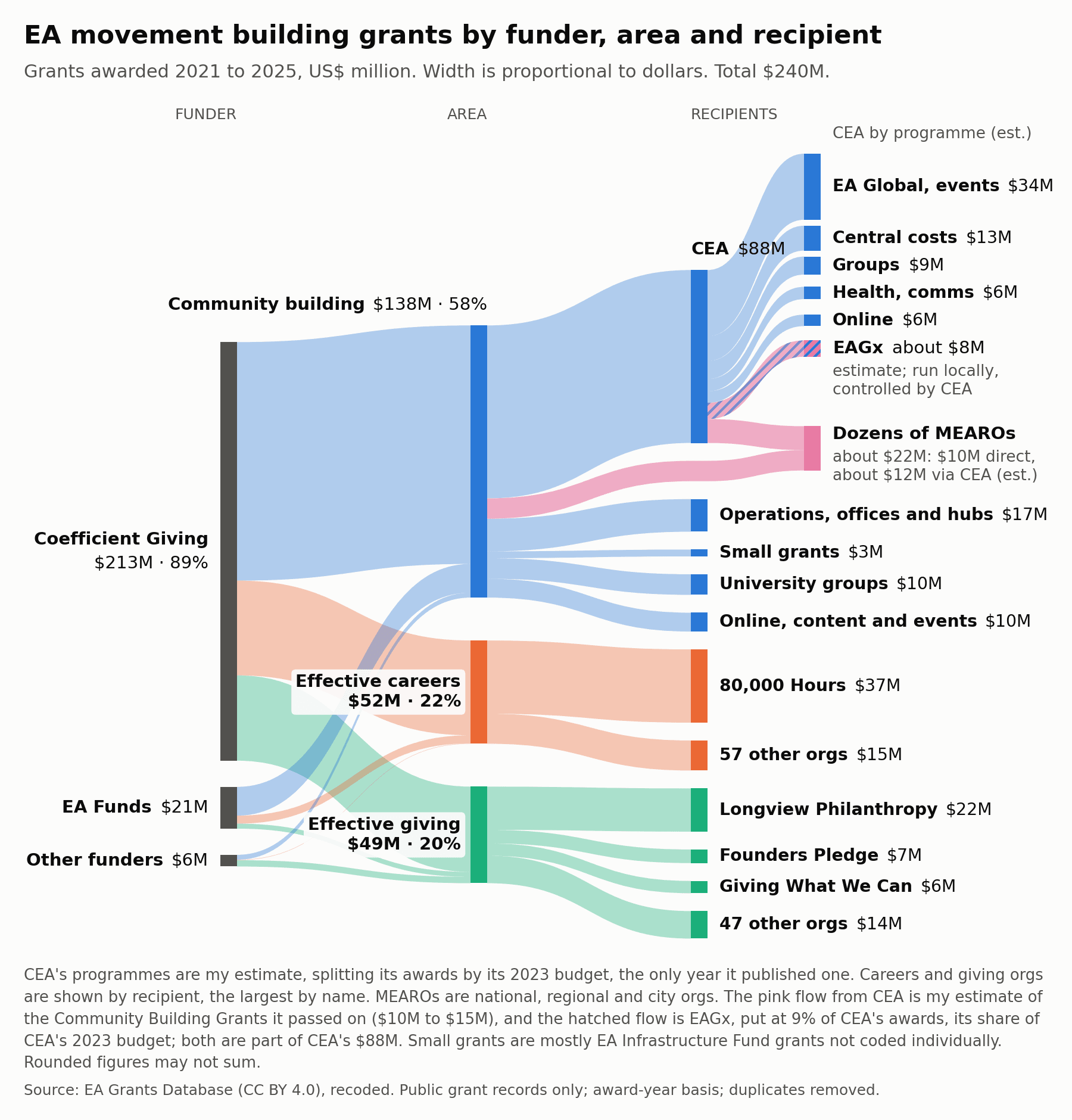
Coefficient Giving supplied $212.6M of the $239.7M, EA Funds $21.2M and other funders $5.9M. Coefficient also funded EA Funds, so its real share is higher.
Community building received $138.2M (58%), effective careers $52.4M (22%) and effective giving $49.0M (20%). Four organisations, CEA, 80,000 Hours, Giving What We Can and their then-parent Effective Ventures, received 63% of the total.
I split movement building three ways because the three do different jobs. Community building finds people and keeps them engaged with EA ideas and actions. Effective careers help people put their working lives into high-impact work. Effective giving helps people direct their money. Each has its own organisations and its own ways of measuring success, and funders increasingly treat them apart: Coefficient now runs a dedicated Effective Giving & Careers fund.
In the chart, the pink flow from CEA to MEAROs is my estimate of the Community Building Grants CEA passed on to them: $10M to $15M over the five years, with the workings in the spreadsheet. The hatched flow is EAGx, about $8M by my estimate. Local organisers run these conferences, but CEA largely controls them: it chooses the dates and the host country and plays a key role in shaping the programme. The rest of CEA's $88M I split by its 2023 budget, the only year it published one: about $34M for EA Global and other events, $13M of central costs, $9M for groups, $6M for community health and communications and $6M for online work. That split is my estimate too.
Movement building is about 5% of the EA grantmaking I can track: $240M of $5.1 billion over 2021 to 2025.
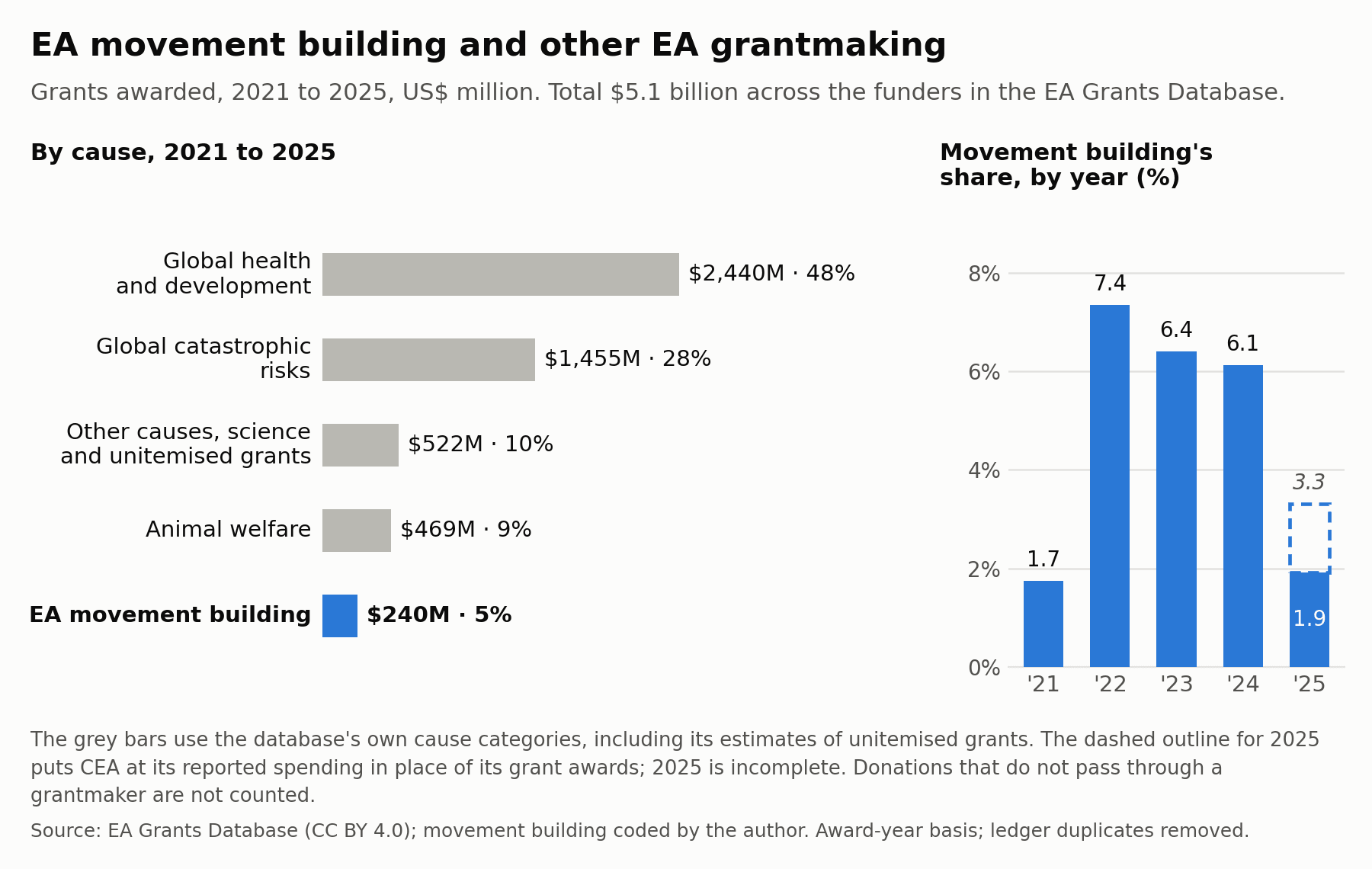
The $5.1 billion is every grant in the EA Grants Database for those years, by the database's own cause categories. Global health and development received $2.4 billion (48%), global catastrophic risks $1.5 billion (28%) and animal welfare $0.5 billion (9%). The effective giving ecosystem's own rough estimate for 2025 is similar: of about $2 billion moved, about half went to global health, 30% to catastrophic risks and 10% to animal welfare.
Movement building's share was 7.4% in 2022 and about 6% in 2023 and 2024. In 2025 it was 1.9% on awards, or 3.3% with CEA at its reported spending. Money moved gives a second yardstick: Lucas Moore's 2026 update estimates the effective giving ecosystem moved about $1.2 billion in 2024, and movement building awards that year were about 6% of it.
Awards peaked at $71M in 2022 and were $63M to $67M in 2023 and 2024.
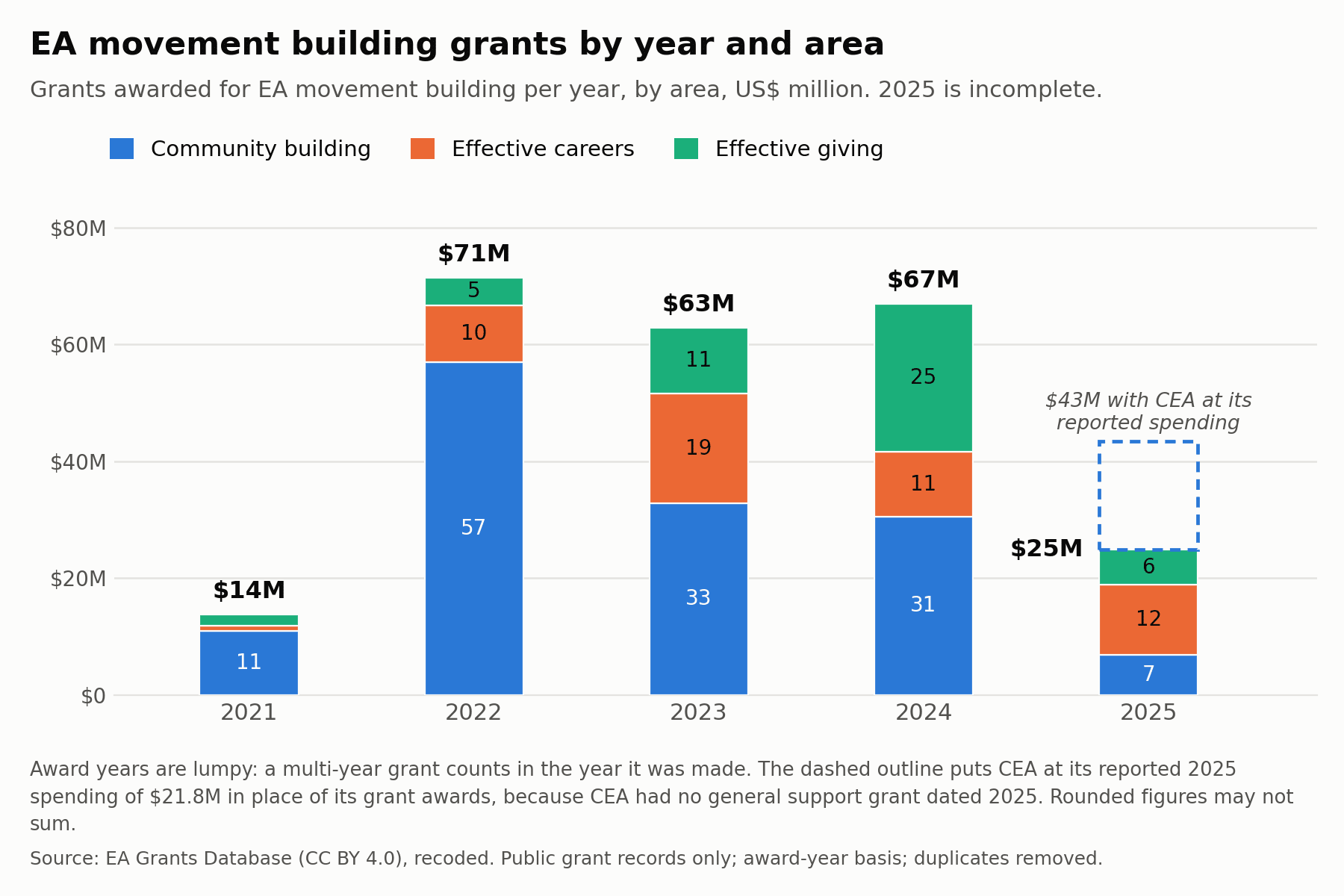
2025 looks low because CEA had no general support grant dated that year, though it reports spending $21.8M. With CEA at that figure, 2025 comes to about $45M. I'm surprised by the drop in 2025, so I might have missed something. Maybe it's just because grants haven't been published yet.
Amounts sit in the year a grant was awarded, so a multi-year grant lands in one year. 2022 is understated, because FTX Future Fund grants are not in the data. 2025 and 2026 will rise as funders publish.
Community building fell from 79% of awards in 2021 and 2022 to 45% in 2023 to 2025.
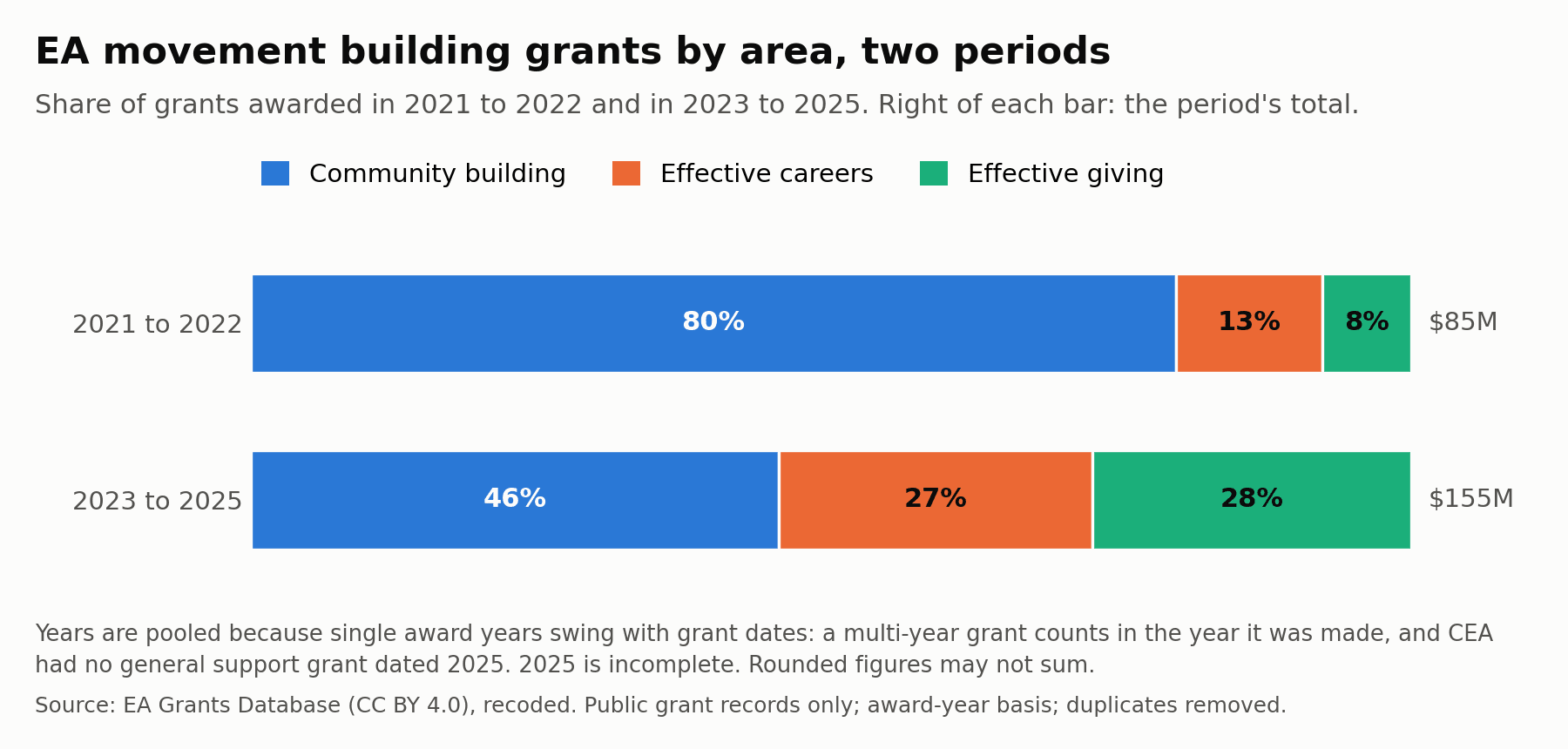
Over 2023 to 2025, effective careers took 27% and effective giving 28%. I pooled the years because single years swing with grant dates: careers took 30% of 2023's awards and giving 38% of 2024's.
Coefficient's Effective Giving & Careers fund is behind much of the growth. It awarded $7.6M in 2023, $9.2M in 2024, $11.4M in 2025 and $36.8M in 2026 to date. Award years hit giving orgs hardest: Longview's and Giving What We Can's large grants are dated just either side of 2025.
From 2023, careers and giving orgs took about half of each year's awards, and Coefficient supplied over 90%.
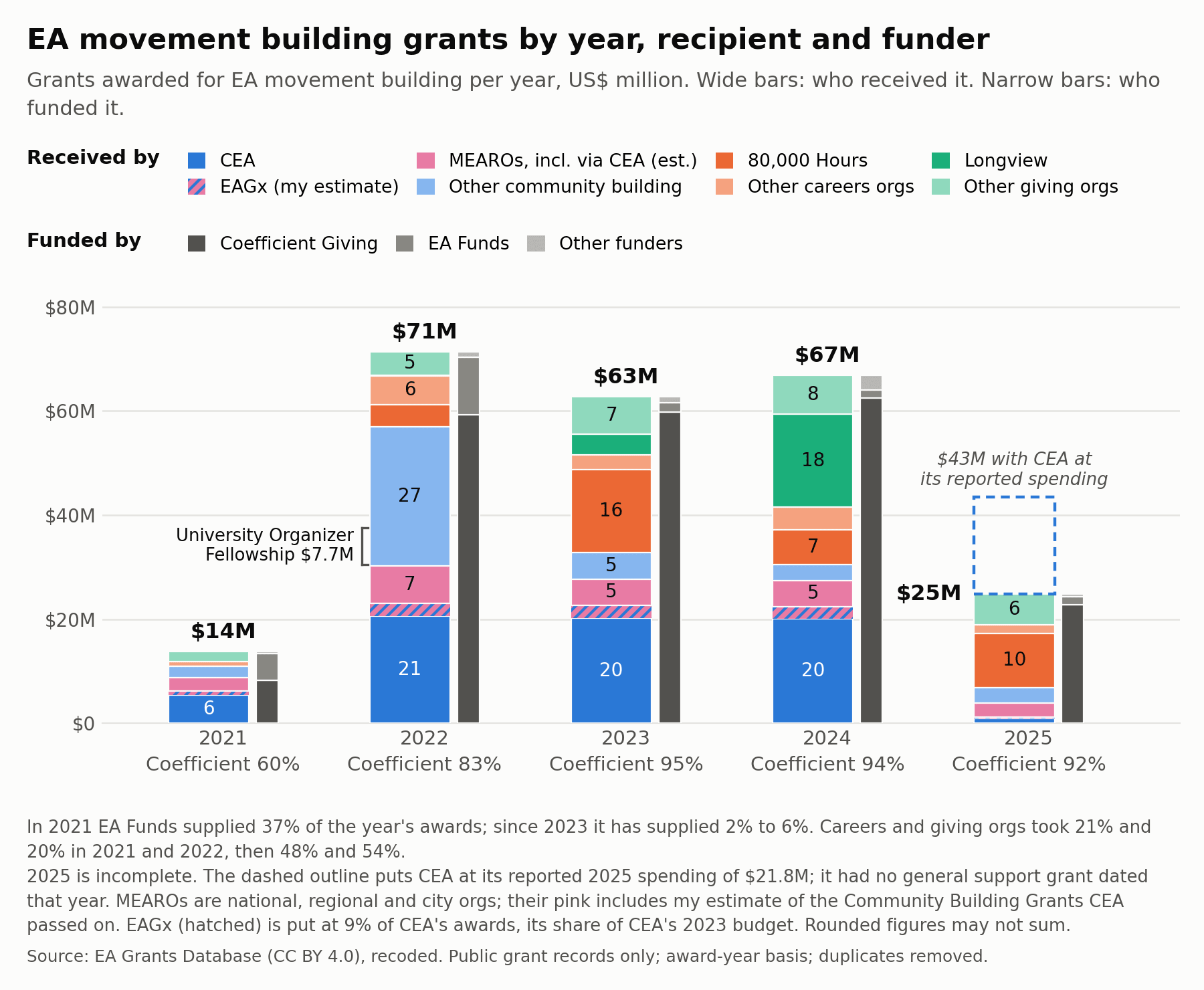
EA Funds supplied 38% of 2021's awards and 2% to 6% a year since 2023.
The $27M of other community building in 2022 is mostly five grants: Coefficient's $7.7M University Organizer Fellowship, one record with no breakdown by country; $7.6M of Effective Ventures' general support; $1.8M for EV's office space; $1.8M for EA-related translation projects; and $0.7M for Asterisk magazine. The other $7M is many smaller grants for offices, content, events and small projects. EV hosted CEA, 80,000 Hours, Giving What We Can and others, so I split its $11.4M general support across the three areas in proportion to those projects' own grants in 2022 and 2023.
Three grants for buildings are not counted: Wytham Abbey ($23.2M, 2021) and a Harvard Square coworking office ($8.9M in 2022 and $7.6M in 2023). Coefficient files them under capacity building for global catastrophic risks, and my judgement is that they mostly served that work. Counting them would add $39.7M.
In 2023 and 2024, CEA received 80% to 82% of community building awards. MEAROs received 15% to 16%, counting what CEA passed on to them.
In the chart, the MEAROs' pink includes my estimate of what CEA passed on to them. The hatched slice is EAGx, which local organisers run but CEA largely controls. CEA has split out EAGx only in its 2023 budget, where it was 9%, so I put it at 9% of CEA's awards each year.
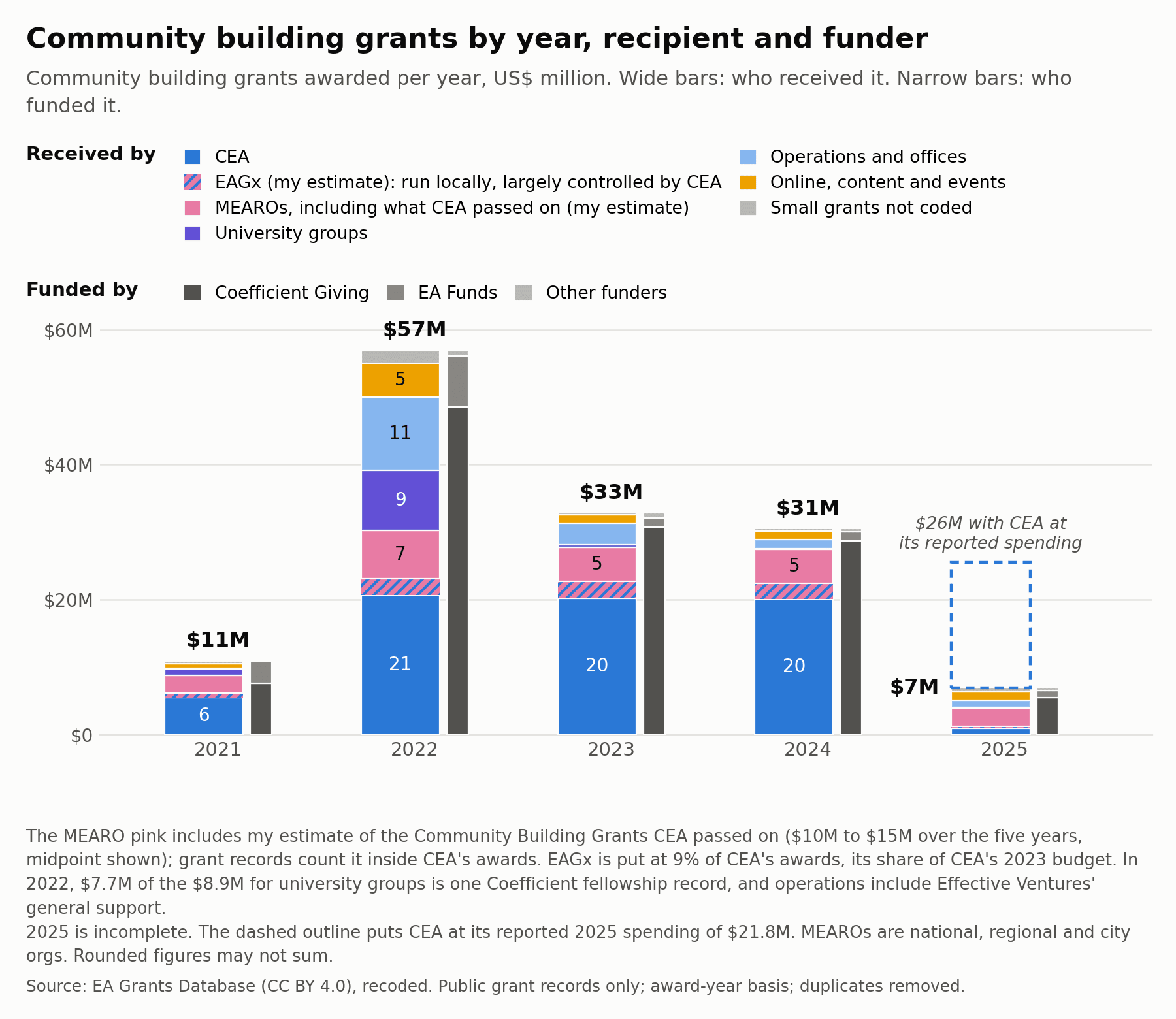
Grants to MEAROs directly came to $10.4M over the five years. Most of their money comes through CEA's Community Building Grants, which CEA does not itemise. From the few totals it has published, $1.32M in 2020, over $2.5M a year in April 2024 and a 22% fall in 2025, I estimate them at $10M to $15M over 2021 to 2025.
The rest of community building is mostly operations, offices and hubs ($17M), university groups ($10M, of which $7.7M is one 2022 fellowship record) and online content and events ($10M).
Grant records say little about activities. CEA's 2023 budget is the one breakdown I found: of $31.4M, $15.4M was for events, including $9.5M for EA Global and $3.0M for EAGx, and $6.9M for groups.
EA Funds became part of CEA in July 2025, and CEA is moving the evaluation of Community Building Grants to EA Funds during 2026. MEAROs' two main sources of grants will then be assessed in one place, which could make funding them simpler and more joined up.
80,000 Hours received 71% of effective careers awards: $37.2M of $52.4M.
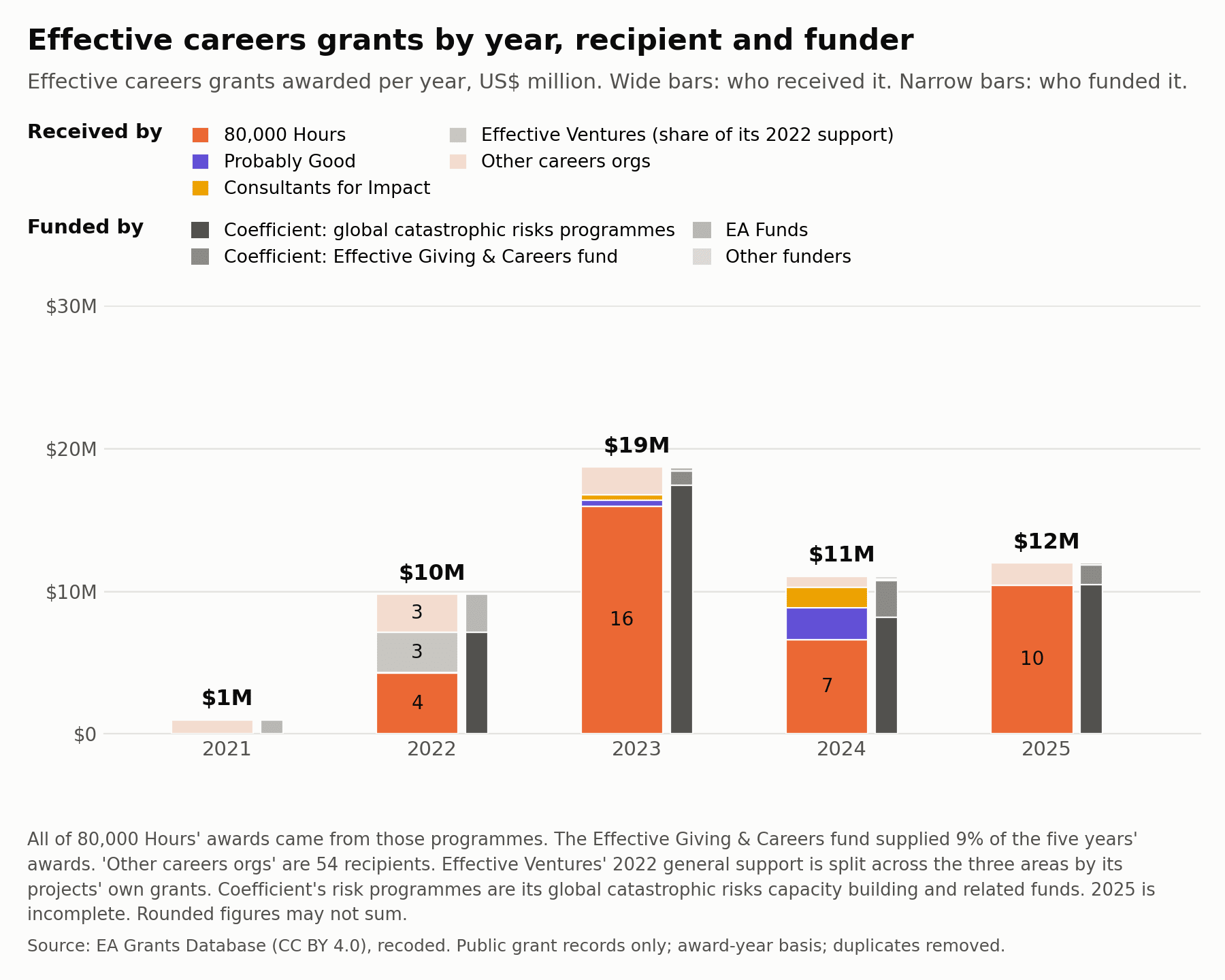
All of 80,000 Hours' awards came from Coefficient's global catastrophic risks programmes, which funded 82% of effective careers in all. Coefficient's Effective Giving & Careers fund supplied 9%, to smaller orgs such as Probably Good, Magnify Mentoring and High Impact Professionals. EA Funds supplied most of the little there was in 2021 and 2022.
Longview Philanthropy received 45% of effective giving awards: $22.0M of $49.0M, most of it in 2024.
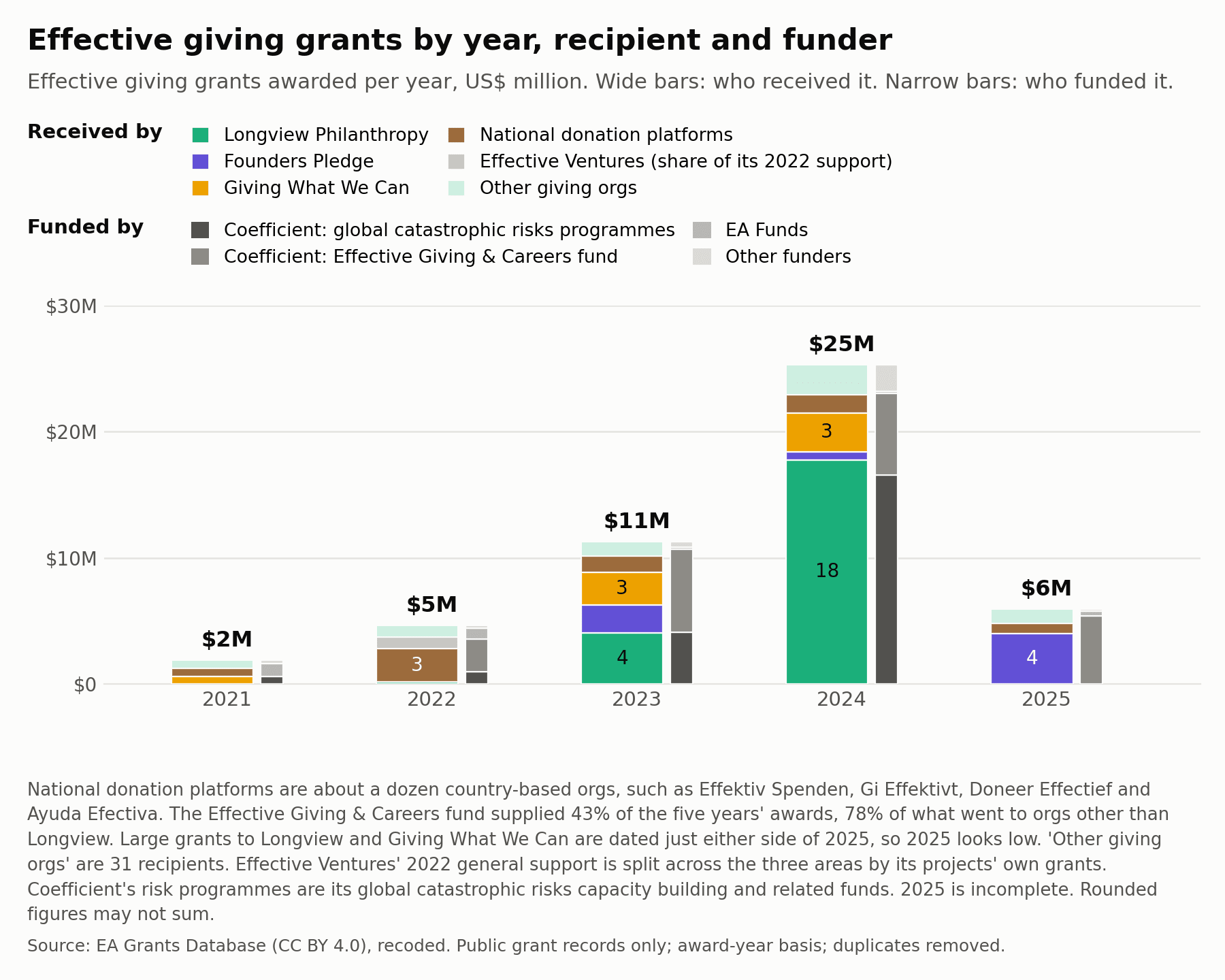
94% of Longview's awards came from Coefficient's global catastrophic risks programmes. The Effective Giving & Careers fund supplied 43% of effective giving, and 78% of what went to orgs other than Longview, such as Founders Pledge, Giving What We Can and Effektiv Spenden. Single years are lumpy: large grants to Longview and Giving What We Can are dated just either side of 2025.
National donation platforms, about a dozen country-based orgs such as Effektiv Spenden, Gi Effektivt, Doneer Effectief and Ayuda Efectiva, received $6.8M (14%). Most of it, $5.3M, came from the Effective Giving & Careers fund, and $1.2M from EA Funds.
| Area | What is in it | 2021 to 2025 |
|---|---|---|
| Community building | CEA, MEAROs, university groups, EA events and content, small EA Infrastructure Fund grants, offices, operations and fiscal sponsorship | $138.2M |
| Effective careers | Careers and talent orgs | $52.4M |
| Effective giving | Effective giving orgs | $49.0M |
| EA movement building | All three | $239.7M |
Field-building for a single cause, such as AI safety fellowships and courses, is not counted.
The ledger has 1,516 records from the EA Grants Database, refreshed on 20 November 2026, that funders file under meta, capacity building, effective giving and careers, or the EA Infrastructure Fund. Recipients above about $300k and all small EA Infrastructure Fund grants were coded by hand, which covers 96% of the dollars. I dropped 65 duplicate records ($115M) and $25.5M of grants to EA Funds for regranting, and left $446M of out-of-scope grants in the ledger but uncounted. Not in the data: FTX Future Fund grants, unpublished grants, individual donors and funders that publish nothing, so the totals are a lower bound.
To check or change the coding, open the spreadsheet's Ledger tab: every grant is a row, with its code and the reason for it. Change a code and the summary tables recalculate. The repository rebuilds everything from the database snapshot with one command, ./build.sh. That includes checking that the grant pool matches the selection rule and testing the 220 figures quoted in this post against the rebuilt data. If you think a grant is coded wrongly, tell me which one in the comments.
As I mentioned in the summary, this was nearly all done by Fable 5.2, and I haven't done much by way of checking. Mistakes are mine.
So you can check the coding, here is where the best-known recipients sit, 2021 to 2025. Every grant, with the reason for its code, is in the Ledger tab.
| Org | Counted as | Counted | Not counted, and why |
|---|---|---|---|
| Centre for Effective Altruism | Community building | $88.2M | $8.9M for the Harvard Square office in 2022 (a building, out of scope) |
| Effective Ventures | Split across all three areas | $34.5M, including $15.3M paid for CEA's work | $30.9M for Wytham Abbey and the Harvard Square office; $1.2M of research |
| 80,000 Hours | Effective careers | $37.4M | None |
| Longview Philanthropy | Effective giving | $21.9M | $4.7M of research grants, for example on AI hardware and nuclear risk |
| Founders Pledge | Effective giving | $6.9M | None |
| Giving What We Can | Effective giving | $6.2M | None |
| Probably Good | Effective careers | $2.7M | None |
| Arcadia Impact | Community building (a MEARO and a university group) | $2.5M | $7.7M of AI safety field-building |
| Ambitious Impact | Not counted | None | $2.4M: it incubates new charities, so I left it out |
| Effektiv Spenden | Effective giving, plus its Berlin coworking space under community building | $2.4M | None |
| EA Funds, running costs | Community building (operations) | $1.2M | Its regranting money is counted once, at the grants it made |
| CEEALAR (EA Hotel) | Community building (offices) | $0.8M | None |
| MATS, BlueDot Impact, Atlas Fellowship, Non-Trivial | Not counted | None, except $0.4M to Non-Trivial | $94.5M: field-building for a single cause, mostly AI safety |
| Constellation, Lightcone Infrastructure | Not counted | None | $37.7M: offices and hubs for a single cause |
| Rethink Priorities, Global Priorities Institute | Not counted | None | $12.9M: research |
Nothing here was checked with the holder before publication. If a figure exists, tell me where and I will correct the post.
A note for the EA Grants Database, which made this post possible: the 65 duplicate records I dropped are counted in its totals. They are listed in the spreadsheet's Duplicates tab.
This is my reading, and you can use everything above without agreeing with it.
My interests. I co-direct EA Netherlands. We receive Community Building Grants and EAGx funding through CEA, and have had grants from the EA Infrastructure Fund and Coefficient Giving, so I have a stake in how this money is allocated.
Limits.
Corrections. Comment here. I will log each change, update the numbers and keep a dated changelog at the foot of this post.
Thanks. To Brian Foerster for the EA Grants Database, to CEARCH for the 2024 baseline, and to the authors of the Historical EA Funding Data posts.