I have just published my new book on s-risks, titled Avoiding the Worst: How to Prevent a Moral Catastrophe. You can find it on Amazon, read the PDF version, or listen to the audio version.
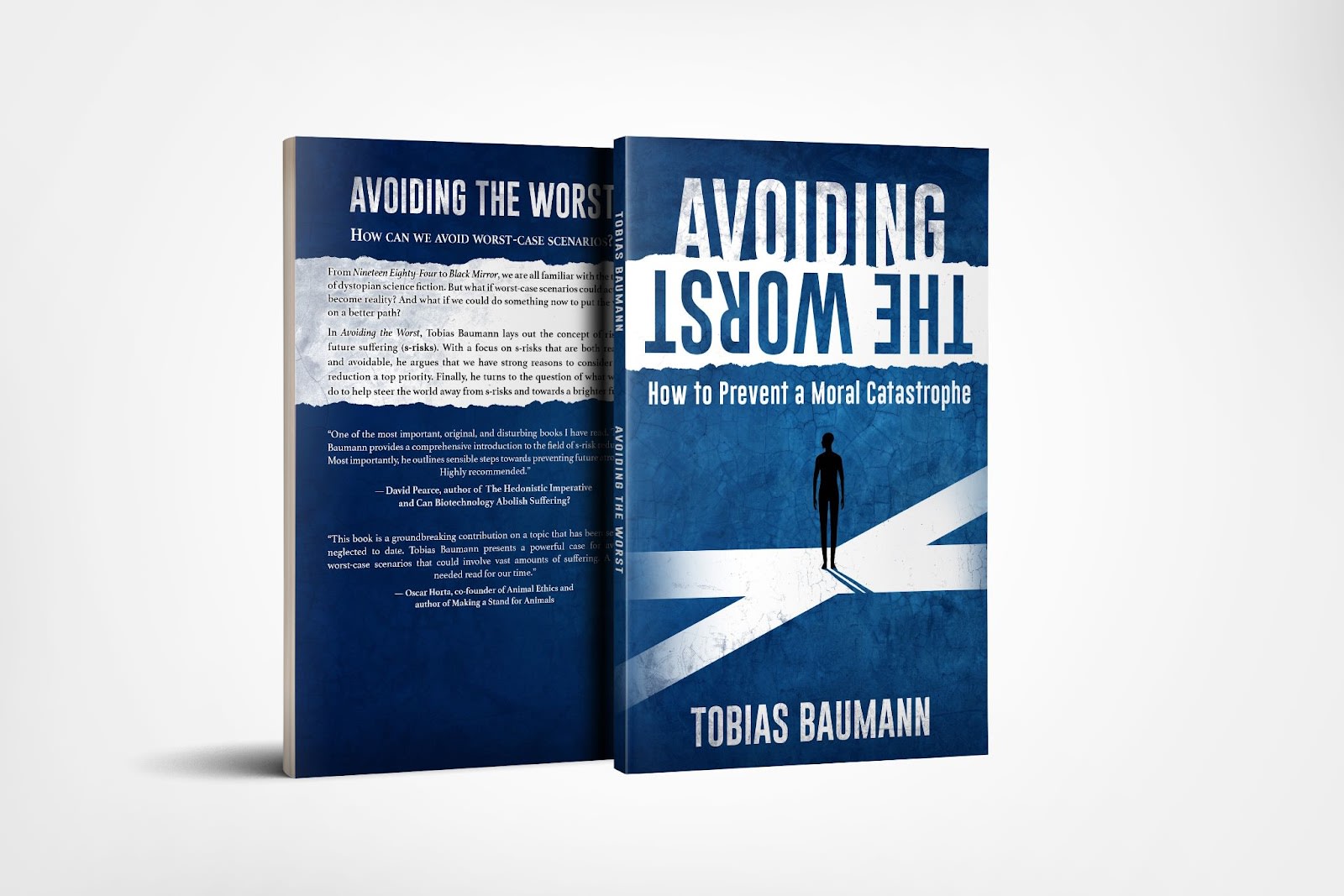
The book is primarily aimed at longtermist effective altruists. I wrote it because I feel that s-risk prevention is a somewhat neglected priority area in the community, and because a single, comprehensive introduction to s-risks did not yet exist. My hope is that a coherent introduction will help to strengthen interest in the topic and spark further work.
Here’s a short description of the book:
From Nineteen Eighty-Four to Black Mirror, we are all familiar with the tropes of dystopian science fiction. But what if worst-case scenarios could actually become reality? And what if we could do something now to put the world on a better path?
In Avoiding the Worst, Tobias Baumann lays out the concept of risks of future suffering (s-risks). With a focus on s-risks that are both realistic and avoidable, he argues that we have strong reasons to consider their reduction a top priority. Finally, he turns to the question of what we can do to help steer the world away from s-risks and towards a brighter future.
For a rough overview, here’s the book's table of contents:
Part I: What are s-risks?
Chapter 1: Technology and astronomical stakes
Chapter 2: Types of s-risks
Part II: Should we focus on s-risks?
Chapter 3: Should we focus on the long-term future?
Chapter 4: Should we focus on reducing suffering?
Chapter 5: Should we focus on worst-case outcomes?
Chapter 6: Cognitive biases
Part III: How can we best reduce s-risks?
Chapter 7: Risk factors for s-risks
Chapter 8: Moral advocacy
Chapter 9: Better Politics
Chapter 10: Emerging technologies
Chapter 11: Long-term impact
And finally, some blurbs for the book:
“One of the most important, original, and disturbing books I have read. Tobias Baumann provides a comprehensive introduction to the field of s-risk reduction. Most importantly, he outlines sensible steps towards preventing future atrocities. Highly recommended.”
— David Pearce, author of The Hedonistic Imperative and Can Biotechnology Abolish Suffering?
“This book is a groundbreaking contribution on a topic that has been severely neglected to date. Tobias Baumann presents a powerful case for averting worst-case scenarios that could involve vast amounts of suffering. A much needed read for our time.”
— Oscar Horta, co-founder of Animal Ethics and author of Making a Stand for Animals
Congratulations on the book!
Apart from the utterly horrifying & well-known Black Mirror episode 'White Christmas', another viscerally compelling depiction of s-risks was the Iain M. Banks 'Culture' novel 'Surface Detail' (2010), in which a futuristic society with a strong religious fundamentalist streak uploads recently-dead minds into digital virtual hells just to torment them for subjective millennia -- mostly in order to intimidate the living into righteousness.
Maybe you mention it, but if you're not familiar with it, it's one of the more plausible depictions of Things Going Very Wrong Indeed, in terms of net sentient utility.
My go-to is this (warning: horrifying) 1 minute comic. I credit it for me viscerally getting just how important s-risks are.
There's always factory farm footage too. Dominion and Earthlings are the best for this.
I think it's no surprise that people who were previously in animal welfare end up going into s-risks. It makes you realize how very plausible massive scale suffering is, even if there are no malevolent actors.
Oh no. Very horrifying!
Not entirely clear why the sadistic robots would do such a thing.
One thing I liked about the novel 'Surface Detail' was that the sadists imposing the suffering had at least some kind of semi-plausible religious rationale for what they were doing -- which makes the whole scenario more psychologically plausible and therefore all the more terrifying.
Yeah, I agree it's not clear why they'd do it. I give the comic writer some slack though, since it's hard to fit that much into a comic.
Couple reasons that I can think of off the top of my head that that could happen:
Honestly though, I think the most probable s-risks are the incidental ones (covered in Tobias's book and also this blog post here). Basically, something where suffering is a side-product, like factory farming or slavery. I also put highest odds it would be for digital minds, since I think the future will be predominantly digital minds.
But it'd be very hard to make a comic about digital minds that would be emotionally compelling, which is why I like the comic (although "like" is a bit of a strong word. More, "found incredibly psychologically scarring but in a way that helps me remember what I'm fighting for")