A few comments, some of which you may be intending to cover in updates
First of all we actually have a pretty decent idea of what happens in GNSS-denied environments because localised GNSS jamming is a thing,[1] It's especially a thing in combat zones, which means that people and infrastructure affected typically have other problems[2]
Because GNSS denial is a thing, militaries have alternative PNT systems to aid them in combat. So actively disabling GNSS satellites is a pretty extreme measure that mostly hurts civilians, including in about 250 countries not currently at war with you. And if it involves use of anti-satellite weapons or EMPs, probably takes out a whole bunch of other space infrastructure too[3]
As it's a pretty extreme measure that annoys everyone worldwide without even offering you a decisive advantage in a local conflict, it's most likely to happen during escalation of a great power conflict. Great power conflicts mean that sectors like maritime would be experiencing COVID level downturns already. The "solar storm" is more interesting because it might be largely unexpected (and would also likely impair a lot of non-GNSS comms stuff)
But costs of nuisance level GNSS jamming in borderlands between states not actually at war (say, the Baltic...) has a scaled down version of this impact which I guess might be underestimated...
current generation GNSS satellites are in fairly empty medium earth orbits and can be disabled without kinetic weapons, but this doesn't rule out collateral damage and likely won't be the case for future GNSS (in part because they want more redundancy even though the system(s) just work.
Definitely agree that shooting down GPS satellites (or satellites of any kind, really) is a really agressive move that would make all countries super mad at you, thus probably only happens in a pretty serious "all or nothing" great-power conflict!
I'll try to talk more about the military dynamics around GPS in my later post, although I'm not an expert. My impression is that although militaries do indeed have lots of backup systems, none of them is perfect and some systems (like many existing drones and guided bombs) do rely exclusively on GPS, so losing GPS would still be a big problem even though the military has done a lot of work to try and ensure that it wouldn't be a totally overwhelming catastrophe.
yeah, agree there are some military subsystems that would go down (and alternative PNT options have their own drawbacks). But it's not a particularly decisive advantage: to take the topical example if Russia took out global GNSS it wouldn't seriously harm the defensive posture of Ukranian front line troops that have been experiencing local GNSS jamming and finding alternative ways to get drones to work for years now, and would disrupt a bunch of Russian based logistics and civilian systems further from the front line nearly as much as it did to Kyiv's. So it wouldn't even significantly help them advance in Ukraine, even before the likely response from NATO and China was considered...
Very quickly cargo ships would be queuing up for days and even weeks as ports are not able to process their containers. From this perspective, the 1 to 2 days of navigation delay due to the loss of GPS becomes insignificant because it does not matter if a ship is a day late arriving at a port if it will need to queue for a week before being unloaded.
Why would losing GPS prevent processing?
But $1.8 trillion (about $5B/day for a year) for COVID for US economy seems like a good rough estimate.
Even COVID can be considered an existential risk if it prolongs the time of perils. What's your estimate of the global economic impact over a year?
Executive summary: Losing GPS would not be an existential risk but would create a worldwide economic disaster roughly comparable in magnitude to the Covid-19 pandemic, most plausibly triggered by great-power war, AI cyberattacks, or (less likely as a permanent threat) a solar storm.
Key points:
The author identifies three main ways GPS could be brought down entirely—great-power war (anti-satellite missiles, co-orbiting sabotage satellites, or jamming satellites), hacking by superhuman AI, and possibly an unprecedented solar storm—while noting solar storms top out at about 4x as powerful as Carrington and likely couldn't permanently disable the radiation-hardened satellites.
The author estimates GPS directly contributed about 1.5% of US GDP in 2017 (per NIST), which Claude extrapolates to roughly 2%–3% in 2026, while the value destroyed by suddenly losing GPS would be significantly larger.
In an outage, the author expects the cell network to collapse over days, logistics/deliveries and port shipping to grind to a halt, and traffic to snarl cities, while the power grid would become more fragile but probably not collapse and agriculture would be impaired but still functional.
The author reconciles NIST's ~$1 billion/day (2017) estimate and the UK study's implied ~$7.5–11 billion/day to suggest an extended outage might cost the US economy roughly $2 billion–$5 billion per day in 2021, scaling to maybe $4B–$10B per day in 2026.
The author estimates Covid-19 cost the US at least $5 billion per day (about $1.8 trillion over a year), and judges that losing GPS would feel "approximately Covid-19-scale-ish" though more purely economic in character.
The author notes outage length would depend on the cause—days for a solar storm or mild cyberattack, years if satellites were destroyed by missiles—and stresses GPS would likely fail amid a larger crisis (war, solar flare, or AI cyberattacks) whose effects would compound the loss.
This comment was auto-generated by the EA Forum Team. Feel free to point out issues with this summary by replying to the comment, andcontact us if you have feedback.
Commercial planes would probably get lost a little bit more often?? (The original incident that motivated the USA to opening up GPS for civilian use was in 1983 when "Korean Air Lines Flight 007 was shot down when it mistakenly entered Soviet airspace".) But it's not like planes NEED GPS in order to find their way -- commercial aviation is (rightfully) obsessive about safety and redundancy, so planes have lots of ways to stay oriented (even in storms / at night / etc), including: - Inertial navigation systems: per claude, "Every airliner carries ring-laser-gyro or fiber-optic inertial platforms that track position by integrating acceleration from a known starting point. They need no external signal at all. They drift — on the order of a couple nautical miles per hour of unaided flight — but modern aircraft run multiple IRUs and blend them, and over a typical flight the drift is manageable and bounded by periodic updates." - A variety of old-school navigation systems that the FAA specifically requires be kept in place precisely as a GPS backup, including for instance "VOR" beacons which are basically radio-signal landmarks scattered across america, emitting simple radio signals that planes can measure their distance & bearing to. (I assume all other developed countries also maintain similar navigation backups.) - Ground-based flight controllers (ie the people who hang out in those airport control towers) have access to radar systems and thus can see exactly where all the planes are, and help guide planes even if the planes themselves get confused about their position.
You might think "sure, there are backups, but mightn't you still end up with overloaded systems if everyone suddenly has to switch to using unfamiliar backups?" But it must be the case that aviation is (like the finance industry which has resilient backups for all their precision-timing needs) sufficiently paranoid that their backup systems are actually up to the task of smoothly taking over -- the UK study looked at aviation but considered that the consequences of a 7-day outage would be negligible. Overally, the situation might be a little bit like the situation with the power grid -- the power grid doesn't need GPS for any of its normal functioning, but GPS timing information is an important tool for debugging / monitoring / maintaining the power grid, so the system gets more fragile without it. The civil aviation system in theory should be almost unaffected by the loss of GPS, but in practice you've lost one layer of your multilayered swiss-cheese-defense against accidents, so accidents are going to go up slightly.
Of course, for unmanned drones (which in many cases only have GPS), a GPS outage would be disastrous.
For military rather than civilian aviation, I think the airplanes themselves would probably find their way around fine in most circumstances, but GPS-enabled weapons (like JDAM guided bombs) obviously wouldn't work, and the situation on the ground (tanks, vehicles, logistics stuff) would probably get messy in the same way that civilian ports & logistics stuff would get jammed up.
How bad would it be if GPS satellites were shot down?
Losing GPS isn’t an X-risk, but would create a huge disaster on the scale of Covid-19 or bigger.
Hi! From 2020 - 2023 I was one of the early employees at Xona Space Systems, a company working on essentially a next-generation version of GPS. I ended up learning a lot about how GPS works and what it’s used for, and (due to my personal interest in effective altruism) ended up doing some research into what would happen if today’s GPS systems suddenly failed. This post is the product of that research. I discuss:
What could kill GPS: it would be a tempting early target in a war between superpowers, or it could possibly be taken down by superhuman AI’s cyber-hacking capabilities. On the bright side, it’s probably safe from even very large solar storms.
If GPS was destroyed, how bad would this be? I describe all the major areas in civilian life that would be disrupted (mostly summarizing some government reports).
Then I try to crunch some very rough, vague numbers. It looks like losing GPS would (by itself) be an economic hit to the USA perhaps equivalent to a few billion dollars a day. On a very broad, vibes-based level, this might feel approximately as disruptive and frustrating as the Covid-19 pandemic, albeit it would be a disaster with a very different character. Of course, GPS probably wouldn’t be destroyed in isolation, but in the larger context of a terrible and destructive great-power war, so everything would in fact be much worse.
This post got too long, so I split it in half. If people like this one, then I hope to finish up a second post wherein I’ll discuss:
GPS isn’t just for civilian life! The whole reason it would be such a tempting target in warfare is that it also has extreme military usefulness. I describe the various military functions of GPS (JDAMs, yes, but also they were originally quite important for atomic warfare), and speculate a little bit about the military strategy of who wins versus loses if all the GPS systems get blown up. Trying to quantify this side of things is too hard, so I don’t.
There are assorted things we could do as a civilization to better mitigate the risks of losing GPS. I list a few of them. The US military is mostly but not completely on the ball here, IMO. Boosting the resilience of civilization’s access to navigation signals definitely isn’t, like, a new EA cause area or anything. But nevertheless I think the dynamics around GPS might be useful for to know about, for people who are thinking about issues related to great-power competition, geopolitics, nuclear war, AI-2027 style takeoff scenarios, etc.
“Whoa, GPS comes from space?? I thought it was just a thing in my car…”
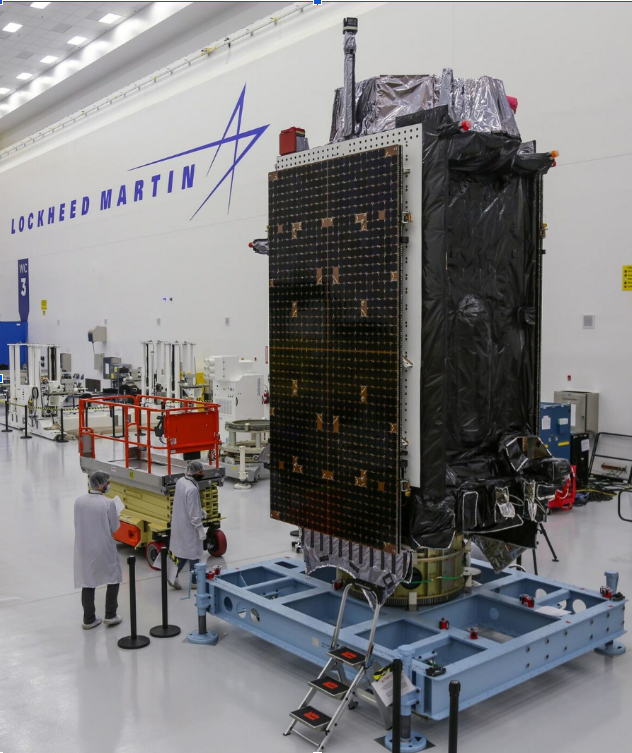
a GPS III satellite under construction
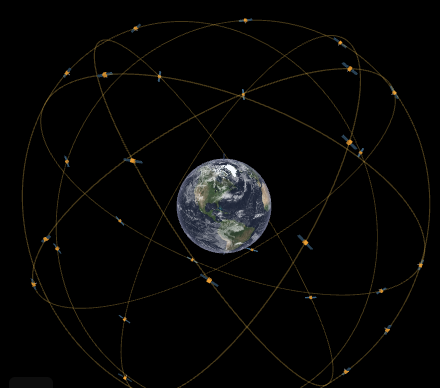
The Global Positioning System is a constellation of about thirty large space satellites created by the United States Air Force in the 1980s. These satellites provide very accurate position, navigation, and timing (PNT) information to anyone with a GPS receiver. It does this by broadcasting super-accurate timing signals -- each satellite has no less than four atomic clocks on board -- which your GPS radio receiver can use to triangulate your position. For much more on the technical details, check out this unbelievably well-made and interactive explainer website (which is now part of the onboarding experience for all new hires at Xona!)
The constellation looks like this
GPS was originally created for its military utility, which we’ll talk more about later. But it’s most notable today for its usefulness throughout many areas of civilian life. Beyond enabling countless everyday smartphone apps like google maps, uber, etc, it’s also crucial for all sorts of transportation and logistics tasks, construction, shipping, precision agriculture, etc. Basically any industry where lots of physical stuff moves around, is an intensive user of GPS. Plus, unexpectedly, the cellphone network and power grid are also significantly dependent on the super-accurate timing signals from GPS!
Overall, GPS is a pretty big deal -- the detailed NIST study described here assessed that, in 2017, GPS was directly contributing about 1.5% of US GDP compared to an alternative scenario where GPS was never created and everybody had to get their positioning/timing information some other way. The world economy is getting more GPS-intensive all the time; Claude thinks that the most reasonable way of extrapolating the data in that report would give a figure of about 2% - 3% of GDP in 2026.
And that’s “counterfactual value contributed by GPS versus a world where we never built it” -- by contrast, the value that would be destroyed by suddenly losing GPS in real life would be significantly larger. This UK study tries to look at how bad a GPS disruption would be, and (once you translate all the results to account for the fact that the UK’s economy is much smaller than the USA’s) it foresees an economic impact from suddenly losing GPS that’s perhaps 5x - 10x bigger than NIST’s reckoning of the counterfactual benefits of the system. So that all adds up to maybe, like, an impact equivalent to 15% of the GDP of all rich-world countries? Maybe more?? Seems bad!
To be clear, there are multiple satellite-navigation constellations
So far I’ve just been saying “GPS”. But, because of the importance of GPS for both military and civilian life, any superpower worth its salt wants to have its own satellite-navigation constellation (“GNSS constellation”) under its sovereign control. The original US system is called GPS; Russia’s system is called Glonass; Europe’s is Galileo, China’s is Beidou. Japan and India also have partial satellite-navigation systems, each consisting of around seven satellites that enhance the accuracy of satellite navigation signals over Japan and India respectively. But in this post I’ll just talk about GPS, because:
The US and Chinese systems are the most militarily relevant, both because those satellite constellations themselves have the highest performance / the most advanced military features, and also because those countries have the most advanced militaries generally.
The US system is the most economically significant by a wide margin -- a lot of receivers (especially older ones that might be built into critical infrastructure) only listen to GPS, even though it’s perfectly possible to build a receiver that listens to GPS, Galileo, and Glonass at the same time (eg, your phone can probably pick up all three, using Galileo and Glonass signals to slightly refine the accuracy of its position data).
Many of the scenarios that could cause GPS to fail (hacked by advanced AI, shot down in a war between superpowers, unprecedented solar storm) could easily lead to several of these systems failing at once (eg, a Chinese or Russian attack on GPS might also target Galileo, and the US might then retaliate by taking down Beidou and Glonass). The USA’s system is also probably the toughest to kill -- it’s likely more radiation-hardened than Galileo and others, likely the most cybersecure of all the constellations, plus the US military would probably be better able to defend it than China or Russia could defend their systems, etc.
Since original GPS is both the toughest to kill, and the most essential for the world economy, and most crucial for maintaining the current global balance of power, I am going to mostly keep talking as if there is only one GPS system.
My former employer, Xona Space Systems, has an IMO innovative and credible plan for a kind of next-gen GPS system that would be different in many ways from traditional GPS -- stronger signals, higher precision, more satellites, lower orbits, with each individual satellite much smaller and cheaper than traditional GPS sats (somewhat like a Starlink or OneWeb constellation, but for navigation). Such a system, and the fact that it’s being developed by a private company trying to turn a profit rather than a superpower military seeking battlefield advantage, means that Xona’s system will have some unique properties compared to traditional GPS constellations. But Xona’s constellation doesn’t actually exist yet, so we’ll mostly ignore it for now -- I’ll talk more about it in the section on potential risk-mitigation steps in Part 2 of this essay.
What could kill GPS?
There are lots of *local* threats to GPS -- for example, Russia and Ukraine do extensive electronic warfare that jams GPS signals throughout much of eastern Ukraine. More mundanely, occasionally stuff will happen like the time some trucker installed an overpowered GPS jammer in his truck to block the GPS tracking devices put in the truck by his employer, and the trucker accidentally shut down the entire port of Newark when the jammer started interfering with harbor operations. GPS signals are easily jammable because they are very weak. (They’re actually *quieter* than the ambient background radio noise on earth’s surface, which seems like it ought to make the signals literally impossible to detect! But it’s barely doable using some fancy math / radio magic, explained in the later parts of that aforementioned interactive website). It’s also possible to “spoof” GPS signals, broadcasting a fake signal that can be used to steer unsuspecting drones, planes, and ships off course (or to cheat at Pokemon Go). [1] But these are all local issues, certainly not civilization-threatening.
Also, sometimes individual GPS satellites fail (for normal “aerospace engineering is hard” reasons) and need to be replaced. But the GPS system is designed with redundancy in mind, and could even survive the failure of several satellites at once.
But how could the entire GPS system could be brought down? There seem to be three main possibilities:
Great-power war
As I describe later on, GPS was originally created by the Air Force because it has a variety of incredibly valuable military applications. If you’re a superpower and you want to launch a big surprise attack on another superpower, disabling their GPS satellites would be an aggressive but potentially appealing move to include in your opening strikes.
The most obvious way to destroy a GPS constellation would be to launch precision anti-satellite missiles capable of reaching all the way up to Medium-Earth Orbit (MEO, about 20,000 kilometers above the earth’s surface) where such satellites live. This requires bigger missiles than are needed for taking out Low-Earth-Orbit spy satellites (which orbit below 500 kilometers), but is perfectly within the capabilities of both the USA and China. Today’s GPS satellites do not really have defenses against any kind of physical attack, nor could they likely maneuver quickly enough to dodge such a missile.
As an alternative to missiles, you could launch your own satellites that could maneuver alongside GPS satellites and sabotage them in various ways. This has various pros and cons versus missiles:
It’s not exactly stealthy (basically, everything in space can be tracked by radar all the time) but it’s more ambiguous / deniable / hard-to-attribute than a missile launch.
On the downside, a co-orbiting satellite is more expensive and finicky than missiles.
An attack by co-orbiting satellites might take years to set up, but you could then hope to disable all GPS satellites simultaneously at the push of a button, whereas a missile-attack campaign would have to unfold over many hours, probably days.
An attack by co-orbiting satellites could avoid creating a destructive shrapnel cloud (which might even harm your own navigation satellites!) and could potentially be reversible.
China, the USA, and Russia do all sorts of cloak-and-dagger shenanigans with co-orbiting satellites all the time, so this kind of thing is definitely an existing technology.
Perhaps the least-destructive and least-aggro option would be to launch your own satellites capable of simply blaring out radio noise on GPS frequencies, jamming GPS indefinitely on a continental or potentially worldwide scale. Russia apparently already has this capability; perhaps China and the US do as well. Of course, if you started doing this, other superpowers might then try to shoot down your jamming-satellites using missiles, but that would be a big escalation.
Fortunately, all these methods of attack are limited to countries with advanced space & missile programs, so it is not like any random tiny rogue nation can threaten to destroy GPS.
Hacking by superhuman AI???
People sometimes worry about whether it’s possible to hack GPS and disable the satellites. The usual response to this is something like “Cyberattack is always possible in principle, but GPS is a hardened military system resistant to intrusion, thus would require great resources that perhaps only the strongest cyber powers possess, and maybe not even then.” But nowadays with Claude Mythos discovering troves of zero-day exploits in countless pieces of critical software, this scenario has probably become more relevant! This method has some unique aspects compared to the more kinetic approaches described above:
It’s more deniable and harder-to-attribute than anything described above.
It’s a less aggro move than any of the options above, so if you had this capability, you might feel there was a lower threshold for pulling the trigger on using it.
Depending on how access to AI hacking capability shakes out, it could potentially be pulled off by smaller powers who lack advanced space and missile programs.
It’s the kind of thing a rogue AI could possibly do by itself even if it didn’t have much in the way of real-world resources.
Although satellite navigation systems pride themselves on their extremely high uptime and reliability, there have been a variety of mundane bugs and screwups over the years resulting in things like the wrong timing data being sent from GPS for a few hours, or even a weeklong outage in Europe’s Galileo constellation in 2019. So, it is certainly not inconceivable that GPS could be at least temporarily disabled by sophisticated hacking. One hopes that Project-Glasswing-style AI cyberdefense initiatives will be able to stay ahead of any such hacking attempts.
An unprecedented solar storm, maybe
Solar storms produce a lot of radiation that can fry satellites. Fortunately, navigation satellites are already extremely radiation-hardened, far beyond what’s required for most satellites, for two reasons:
They are already designed to spend decades hanging out in MEO, the most toxically radioactive part of earth orbit.
GPS satellites were originally designed to operate through an atomic war (more on this later), including nuclear weapons being detonated in space and generating EMP effects that would fry most normal satellites.
Probably the only satellites more rad-hardened than GPS are deep-space NASA missions to Jupiter, like Juno and Europa Clipper. Consequently, per this RAND report, although radio interference from a Carrington-scale solar-storm would likely render GNSS temporarily inoperable for several days, they lean against the idea that it could permanently disable GPS satellites? The report says that ‘an unpublished but publicly disclosed FEMA report from 2010—Mitigation Strategies for FEMA Command, Control, and Communications During and After a Solar Superstorm—found that, in such an event, there was a “possible” loss of enough GPS satellites to reduce the constellation below the 24 usually required, a less-dramatic and less-consequential failure (Emerson, 2017).’ That doesn’t sound too bad, IMO -- sounds more like degraded, less-accurate-than-usual, occasionally-patchy capacity rather than the whole system being destroyed.
This EU study seems to concur; they say that the direct effects on ground-based electrical infrastructure from a Carrington Event would be far worse than the effects on satellite infrastructure, such that it’s basically not worth bothering to put effort into solar-storm mitigation for satellites while there’s still so much important work to do on the ground. (And, to reiterate, MEO GPS constellations are more resilient to solar storms compared to all other satellite infrastructure.)
But everyone just anchors on the Carrington event! I wondered: is this a mistake? Are people neglecting the possibility of outlier mega-storms that might be, say, 10x stronger than Carrington, even if they’re 10x less likely? Turns out, not really! Solar storms can get somewhat worse than Carrington, although more powerful storms become exponentially rarer. Per this paper, a storm as bad as the Carrington event or worse has about a once-in-100-years probability, while an event 2x as powerful as Carrington or worse has about once-in-500 years probability, so that’s 2x more powerful but 5x less likely. More importantly, solar storms from stars like our Sun are thought to top out at about 4x as powerful as Carrington -- so there isn’t some long tail of increasingly-powerful but decreasingly-likely storms. 4x as bad as Carrington is simply as bad as it gets (and these are incredibly rare).
Other stuff
Another way that a solar storm can harm satellites is that all the extra solar energy puffs up the highest layers of the atmosphere, increasing drag on low-earth-orbit satellites such that they can reenter the atmosphere and burn up. This would be killer for many earth-observation telescopes, among others. But GPS is 20,000km high instead of 400km, so this problem isn’t relevant.
You might be thinking “what about kessler syndrome, where orbital debris from a few satellites snowballs and takes out everything in orbit?” But kessler syndrome is vastly more likely in LEO (where there are thousands of satellites zooming around in a relatively small volume of space a few hundred kilometers above earth’s service) than in MEO (where there are only a few dozen satellites spread over a much vaster area of space). Kessler syndrome in LEO wouldn’t affect MEO -- the only way you end up with significant debris danger in MEO is if someone is already deliberately blowing up GPS satellites, in which case your main problem is that you are at war, not that you also have to deal with some space debris.
In the lore of the movie “The Matrix”, humanity at one point does some kind of geoengineering to darken the skies, hoping to starve their robot enemy of solar power. In some kind of Terminator-style robot war where humanity is fighting against rogue AI, I could imagine nations deliberately shutting off GPS to try and disproportionately hurt the robot / drone armies that might be even more reliant on it than humans are. But this would be intentional, thus not exactly a “threat to GPS” per se.
What would break in the aftermath of losing GPS?
This section is based on summary of two helpful and extensive resources:
First, a 2019 study by the NIST, which attempts to tally up the counterfactual benefits of GPS to the economy, sector by sector, from 1984-2017.
Second, a 2021 UK study specifically focused on the effects of a short-term GPS outage of seven days.
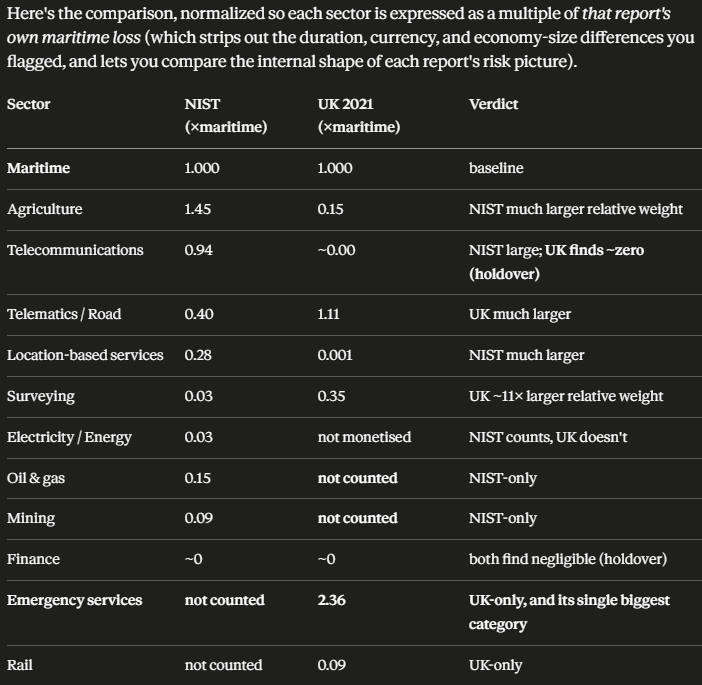
The UK study paints a good picture of all the short-term chaos, but not which things would recover versus which would stay broken (or get worse) as an outage dragged on past the seven-day window. The NIST study repeatedly uses the idea of a 30-day outage as a thought experiment, but only in service of their overall goal of estimating counterfactual financial benefits to the private sector. This results in some big discrepancies – the UK report states that the worst impacts would be from gnarled traffic gridlocking major cities and degradation of emergency services, while the NIST report only briefly considers those same issues and doesn’t incorporate them into their overall estimates, instead acknowledging that their numbers are a conservative estimate. Still, by putting the two reports together, a general vision of the potential disaster emerges.
In summary: people's phones would basically turn to bricks -- not just in that Google Maps would stop working, but the actual entire cell network would collapse over a few days. Logistics/deliveries of all kinds (amazon, the postal service, rideshare services, et cetera) would get insanely backed up and stop working, shipping in major ports would similarly grind to a halt, and there would be mild but widespread economic pain in other industries. Traffic chaos would snarl the roads of most cities, at least initially. In the future, the performance of self-driving cars and other autonomous systems would be much degraded, or perhaps stop working altogether.
On the bright side, the power grid would become more fragile but probably not actually collapse. Agriculture would be somewhat impaired but would basically still be able to get the job of growing food done.
Impact on the cell network & smartphones
4G LTE and 5G cellphone networks would go down as cell towers lost precision timing over the first few days. Would this just mean that much of smartphone functionality is crippled, but leave basic texting and calling intact? Or would the intense network congestion (squeezing all our modern cellphone use onto 3G and 2G networks) cause even the most basic services to fail? Unfortunately, nobody knows, since a catastrophic national failure of the cellphone system has never happened before. According to the NIST report, "one expert thought that wireless networks would fail completely after about 2 weeks, while several others thought that some service (most likely voice and text service only) would still remain at the end of 30 days."
Internet services are a different story and much less GPS-dependent than the cell network. So, even if the cell network collapsed completely, we’d still be able to connect via wifi -- it wouldn’t be a total communications blackout of the sort that towns sometimes experience after hurricanes or earthquakes.
Obviously, all location-based apps that directly use GPS information would lose their functionality: Google Maps, Uber, searching for nearby attractions/restaurants, etc.
Impact on the power grid
Power networks would be at higher risk of problems, but wouldn't be instantly thrown into cascading failures:
Per NIST: “Most published studies conclude that widespread grid failures are not to be expected from a major disruption of the GPS signal (NERC, 2012). The electrical system is highly distributed, and the existing SCADA system could be engaged quickly to serve as an adequate backup system for any GPS-supported functions. This capability reduces the likelihood that a large-magnitude event such as widespread cascading outages would occur. However, the loss of GPS would affect system monitoring operations and effectiveness, leading to a slightly increased probability of adverse events. The impact would be similar to the retrospective scenario (but more short-lived) and would lead to the following impacts over the 30-day GPS outage period: 1. increased time to identify, trace, and mitigate/correct faults; 2. increased probability and duration of small-scale outages; and 3. increased probability (albeit low) of large-scale blackouts. Long-term impacts such as infrastructure damage are unlikely.”
“As described in detail in the previous sections, the primary way in which utilities are currently employing time stamps is to perform post-event and forensic analyses to understand the behavior of the grid and prevent future equipment and power failures. Beyond time stamps, utilities are also leveraging PMU data to tune up models and develop more accurate generation estimates. With these applications as a backdrop, the main consequences of losing GPS would almost solely be reflected in an increase in the difficulty of managing the system and responding to outages efficiently and in a timely manner. While problematic, the consequences derived from a scenario in which time stamp and modeling applications are not present pose no existential risk to the electric grid. In other words, generators will not trip off, and T&D operations will not stop functioning if GPS satellite communications fail unexpectedly.”
Impact on maritime industries
Maritime navigation would become much harder, such that operations at all large ports would come to a standstill:
“Increased transit time and increased caution close to shore will result in unexpected delays that have economic impacts associated with late delivery of commodities. However, our analysis indicated that the greatest bottleneck for the import and export of commodities would be the interruption of port logistics. Very quickly cargo ships would be queuing up for days and even weeks as ports are not able to process their containers. From this perspective, the 1 to 2 days of navigation delay due to the loss of GPS becomes insignificant because it does not matter if a ship is a day late arriving at a port if it will need to queue for a week before being unloaded.”
“Commercial fishing would have greatly decreased yields, and many would not attempt to fish.”
Claude says that wild-caught marine fish supply about 3% of humanity’s protein intake, and 1% of all food calories. ALLFED seems to think it’s not a real food-supply disaster until we face a shock that takes away 5% of calories globally, so even if yields went literally to zero, this would be bad but not a total catastrophe. We’d still have aquaculture, which actually accounts for more than half of all seafood consumed globally.
Impact on travel and logistics
UPS, Amazon, Uber, and essentially all other delivery and taxi companies use GPS directions to direct their employees along optimized package delivery routes each day. In the absence of GPS, drivers and dispatchers would have to rely on local knowledge and static maps. Given the daily volume of packages that they deliver, such a disruption would basically create an instant disaster, particularly if an outage occurs during a busy season.
An exception to this would be mail services like USPS, plus utilities like trash collection, which run standardized routes (the same routes every day or week) that drivers learn well.
Roads would become significantly more dangerous and much more congested as drivers were forced to consult maps, signs, memorized waypoints, etc, rather than relying on navigation. This would result in snarled traffic in all major cities, major time losses, excess fuel consumption from all the idling cars, etc.
Not mentioned in either report, but this would naturally get worse in future scenarios where autonomous Waymo-style cars are more common, as precise GPS locations are a key sensor input to most self-driving cars, and losing it would probably render self-driving cars totally unable to navigate anywhere.
911 services would become congested because calls no longer pass GPS data to them. The UK report models that even after surging additional capacity into emergency response, response times would be generally much slower and 3% of 911 calls might simply get dropped.
The UK study thinks that this is a very big deal: “applications in emergency services, maritime, and road together account for 87.6% of the total economic loss” for their 7-day outage scenario. This is partially because, unlike NIST who are just tallying up economic benefits to the private sector, the UK is making a more utilitarian calculation taking into account the value of life, which surfaces the immense value of the emergency medical services that would possibly collapse in an extended GPS outage. But on the other hand, 7 days isn’t enough time for the cellphone network to fully collapse, so the UK study misses that and other slow-rolling problems.
Impacts on other industries
There would be widespread economic pain in industries like oil & gas, mining, and construction, etc. These wouldn’t be catastrophic, in part because it would mostly impair the construction of new projects, not the ongoing process of pumping oil and extracting ore from existing wells / mines.
Precision agriculture and robotic tractors would be impaired, but farmers would still be able to plant. Nevertheless, agriculture is such an important industry that even a small impairment adds up to a big loss in absolute terms.
There would be myriad smaller covid-esque disruptions to supply chains generally, in addition to the large specific impact on the industries mentioned earlier.
Would the stock market collapse due to lack of precision timing?? Fortunately, they are actually completely on the ball and 100% prepared: “The financial services sector uses GPS to time stamp financial transactions. GPS’s timing capability allows exchanges and trading houses to cost-effectively time stamp every transaction request received in keeping with the precision required by financial regulations. In the event of a 30-day GPS outage, financial markets would need to adjust, but operations would be minimally affected. Most exchanges and sizable trading houses have rubidium or cesium clocks that can provide sufficient holdover to continue operations. Although the financial services sector views the falsification of GPS signals, or spoofing, as a significant concern because it can affect data reliability, sector representatives do not view an observable loss of GPS for 30 days as having a substantial economic impact.”
Reckoning an overall cost per day
Losing GPS sounds pretty bad, but how bad would it be exactly? The best way to compare the risk of GNSS failure to other kinds of disruption is to make an overall estimate of the total economic costs. Fortunately, our two studies do just that. Unfortunately, they disagree significantly.
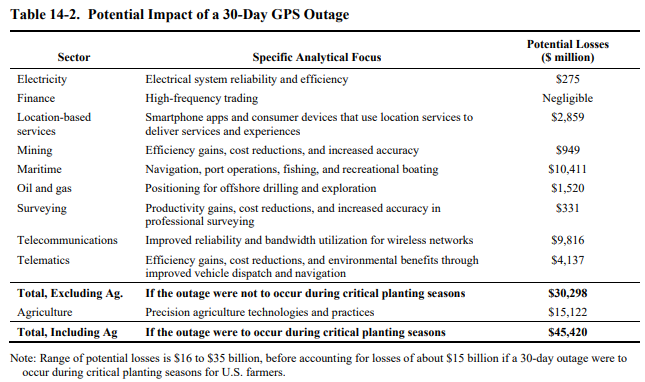
The 2017 NIST report says that a 30-day GPS outage would potentially cost the US economy around 1 billion per day.
That estimate applies to the world of 2017, but our economy's dependence on GPS has been growing very rapidly every year since 2010. We would like to update these estimates for the more GPS-intensive world of 2026.
Meanwhile, the 2021 UK study’s 7-day outage scenario cites a cost to the UK economy of 1 billion pounds per day. This is actually a WAY higher estimate of the damages, since Britain’s economy and population are both way smaller than the USA. If you multiply the 2021 UK study’s estimate by the ratio between US and UK GDP (7.5x), or by the population ratio (5x), you get a predicted impact on the USA’s economy of between 7.5 billion dollars and 11 billion dollars per day.
Why the discrepancy between the NIST report’s 1 billion versus the UK report’s implied ~10 billion?
Well, for starters, the NIST study is from 2017 while the UK report is from four years later. The economy is very rapidly becoming more GPS-intensive. Helpfully, the 2021 UK report is actually a follow-up to an earlier UK report conducted in 2017! They say that “overall, compared to the 2017 iteration of this report, the total economic benefits have increased by 102%, more than doubling in magnitude. A majority of this change is due to increases in the Emergency Services and Road sectors. In each sector an increase in device penetration (smartphones, satnavs, and insurance telematics devices) explain much of the growth.” However, although the benefits have doubled, the costs of GPS outage in their report have only increased by about 6% -- increased outage costs from the fact that society is now much more GPS-intensive are apparently being offset by the fact that some sectors have greater resilience to an outage than they did in 2017 (although looking at the numbers I am not totally convinced -- eg they think drivers would be less impaired by a GPS outage today versus in 2017??).
So maybe we should try to bring the NIST estimate into 2021 by raising it by somewhere between 6% and 102%. (Plus 11% for inflation between 2017 and 2021, I guess.) But this still doesn’t solve most of the gap.
The biggest difference is coming from the fact that the UK report makes something closer to a utilitarian calculation that includes various measurements of human welfare (eg the various costs of dropped 911 calls, lost hours spent in traffic), whereas NIST is just tallying up more direct economic benefits to private businesses. On the other hand, the NIST report’s month-long outage scenario catches potentially serious impacts on the cell network and on agriculture that the UK report’s brief weeklong outage. Here is the NIST report’s table summarizing their outage scenario, followed by a screenshot of some claude analysis comparing the two reports:
Overall, I’m tempted to think that a true picture of the cost of permanently losing GPS would look worse than either report suggests -- it’s certainly reasonable to expect emergency services to drop 3% of their calls like the UK report models, but in a longer-than-seven-days scenario it seems crazy to ignore the fact that agriculture and the cell network would be seriously impaired.
On the other hand, a longer outage would tend to see a lower average cost to the crisis in terms of billions of dollars per day. One-time costs can only hit one time, and the longer a crisis dragged on, the longer people would have to find ways of routing around problems and bottlenecks.
So maybe overall, an extended GPS outage in 2021 might cost the US economy something like 2 billion to 5 billion per day?
To bring that estimate five years forward into 2026, we have to wonder if the economy’s ‘GPS-intensiveness” has doubled yet again, just like it did in the years 2017 - 2021 (per the UK report), or in the years from 2014 - 2017, or the years 2010 - 2013 (per NIST). Seems plausible that it might have! So that would maybe be like $4B - $10B per day for the US economy in 2026? And the further into the future you imagine losing GPS, probably the worse it gets, since the world economy will continue to get more GPS-intensive via more use of technologies like drones, autonomous vehicles, precision farming, cellphone networks, et cetera.
Hard to say, but this feels approximately Covid-19-scale-ish
As a rough guess, it looks like Covid-19 cost the United States at least 5 billion per day in the year from March 2020 to March 2021:
$0.6 trillion in welfare losses from the 750,000 premature deaths the US suffered in the first year of the pandemic. On average, each death robbed its victim of about 8 “quality-adjusted life years” that they might have otherwise lived to enjoy, valuing each QALY at the common value of $100,000.
Other factors are harder to account for: the emotional toll of social-distancing isolation, business and school closures, the drawbacks of falling ill even if you don’t die (from annoying flu-like symptoms to “long covid”), various silver linings like advancements in technology spurred by the urgency of the crisis.
But $1.8 trillion (about $5B/day for a year) seems like a good rough estimate.
Of course, the details of losing GPS would look nothing like the details of the covid-19 pandemic. Instead of roads in major cities lying eerily empty, they’d be paralyzed by gridlock. Instead of relying on computer technology (zoom calls, etc) to adapt to changing circumstances, it would be the unexpected failure of a ton of computer technology that causes constant problems. And while Covid-19 was a fairly even mix of economic and health damage, the loss of GPS services would be a more purely economic hit. (Although the frustration and anger of millions of people lost at confusing intersections and stuck in traffic on snarled roads and unable to get their packages delivered, certainly might rival the difficulties of social isolation and business/school closures of the covid era.)
Like Covid, the loss of GPS would be a worldwide disaster, not something specific to the United States (although perhaps especially intense in rich countries generally, which I expect are the most GPS-intensive economies).
How long would an outage last?
Naturally, outage length would depend on the nature of what killed GPS:
A solar storm or mild cyberattack might result in a mere days-long outage.
Whereas if all the satellites were destroyed by missiles then we’d have to live without GPS for the several years it would take to manufacture and launch replacement satellites.
An intermediate case might occur if one nation’s satellite system (eg, Russian Glonass or European Galileo) had been spared in the fighting, in which case civilian life would gradually return to normal as we upgrade all our old infrastructure with receivers capable of picking up the signals of the surviving constellation.
Conversely, if one of the other non-GPS satellite systems was disabled, this might have world-shaking geopolitical implications in the context of a military conflict, but the economic damage would be pretty limited, since to my knowledge there are only a few non-military systems that rely exclusively on Glonass, Galileo, or Beidou -- almost everything can receive GPS plus something else.
Remember: you’re still at war with China, or Russia, or AI, or possibly the Sun!
Keep in mind that GPS likely wouldn't be going down in isolation — it would probably collapse as part of a larger crisis, either a great-power war, an exceptionally powerful solar flare (which would destroy many other satellites as well, and damage electrical grids on the ground), or perhaps a wave of AI-assisted cyberattacks. So the negative impacts of suddenly losing GPS — a shock to supply chains and the routines of daily life roughly comparable in magnitude to the covid-19 pandemic — would be overlaid on top of the unrelated effects of the larger crisis. For example, the fact that the electrical grid has now become harder to monitor / debug / repair thanks to the loss of precision GPS timing information, might not play well with the fact that your adversary (whether China, AI, or The Sun) is at that very moment probably doing everything they can to sabotage and destroy your electrical grid.
* * *
Okay, thanks for reading! If you liked this post, let me know, and stay tuned for part 2, covering GPS’s military utility and some of the ways that civilization could try to obtain more robust, resilient access to positioning and timing services. You can sign up for my substack, Nuka Zaria, if you want to be notified when I publish it!
Xona’s proposed navigation system, with stronger signals and various encryption/verification mechanisms, would help address these local issues somewhat; there are also other solutions that generally involve using backup, non-satellite-based navigation systems.
Crossposted to Less Wrong
‘Like most of life’s dangers, the dangers of artificial intelligence are not easily identified from the armchair.’
J Dmitri Gallow
Epistemic status
I’m not an expert in this field, and herein I make some sweeping generalisations educated guesses about the overall...
TL;DR: EA has traditionally deprioritized climate change as a cause area. But a new report from Rethink Priorities, an EA research institute, suggests that specific Earth systems risks driven by climate change could have mortality impacts comparable to major global health burdens, on top of the known damages of climate change.
The report finds that research and governance work on ‘Earth Systems Stabilization’ to establish whether safe options to address th...




A few comments, some of which you may be intending to cover in updates
Interested to see the followup
Similarly, people working with navigation systems prone to spoofed location results (maritime navigation) have to find workarounds
though electronic warfare can affect neutral neighbours and overflying aircraft too...
current generation GNSS satellites are in fairly empty medium earth orbits and can be disabled without kinetic weapons, but this doesn't rule out collateral damage and likely won't be the case for future GNSS (in part because they want more redundancy even though the system(s) just work.
Definitely agree that shooting down GPS satellites (or satellites of any kind, really) is a really agressive move that would make all countries super mad at you, thus probably only happens in a pretty serious "all or nothing" great-power conflict!
I'll try to talk more about the military dynamics around GPS in my later post, although I'm not an expert. My impression is that although militaries do indeed have lots of backup systems, none of them is perfect and some systems (like many existing drones and guided bombs) do rely exclusively on GPS, so losing GPS would still be a big problem even though the military has done a lot of work to try and ensure that it wouldn't be a totally overwhelming catastrophe.
yeah, agree there are some military subsystems that would go down (and alternative PNT options have their own drawbacks). But it's not a particularly decisive advantage: to take the topical example if Russia took out global GNSS it wouldn't seriously harm the defensive posture of Ukranian front line troops that have been experiencing local GNSS jamming and finding alternative ways to get drones to work for years now, and would disrupt a bunch of Russian based logistics and civilian systems further from the front line nearly as much as it did to Kyiv's. So it wouldn't even significantly help them advance in Ukraine, even before the likely response from NATO and China was considered...