Comments
59
TL;DR
As far as we know, the CCF is the most rigorous attempt to prioritize between causes under moral uncertainty, but it’s limited. For now, it can allocate money only to 8 philanthropic funds spanning three cause areas. It recognizes the value of saving lives, boosting incomes, and reducing suffering in people and in farmed animals. But its underlying model is blind to other types of value, such as personal liberty, for example. Furthermore, it can’t yet fully represent some perspectives, such as a particular concern with presenting the very worst futures (S-risk).
You may believe that views and cause areas not captured by the model – S-risks, for example – are worthy of consideration. Should you ignore the CCF? We don’t think you should. There is a simple giving strategy that allows all donors to benefit from the strengths of the CCF, without falling prey to its limitations.
To borrow terms from investing, a “sleeve” is an independently run part of a larger strategy, often based on a single vision. The “core” is the reliable, diversified main body of the portfolio.
We suggest that you make the CCF the “core” of your giving. It acts as a diversified foundation that performs well across a range of views. The CCF is built on almost a decade of RP's cause prioritization research, and it gives weight to a range of views on the key uncertainties in effective altruism's main cause areas. That makes it a solid core for your giving.
Each worldview that can’t be represented in the CCF could become a “sleeve” in your giving portfolio. If you think that S-risks are a concern, you could allocate some of your giving to the best S-risk work you can find; if some of your credence lies in the idea that preserving nature is supremely important, add a sleeve for environmental giving.
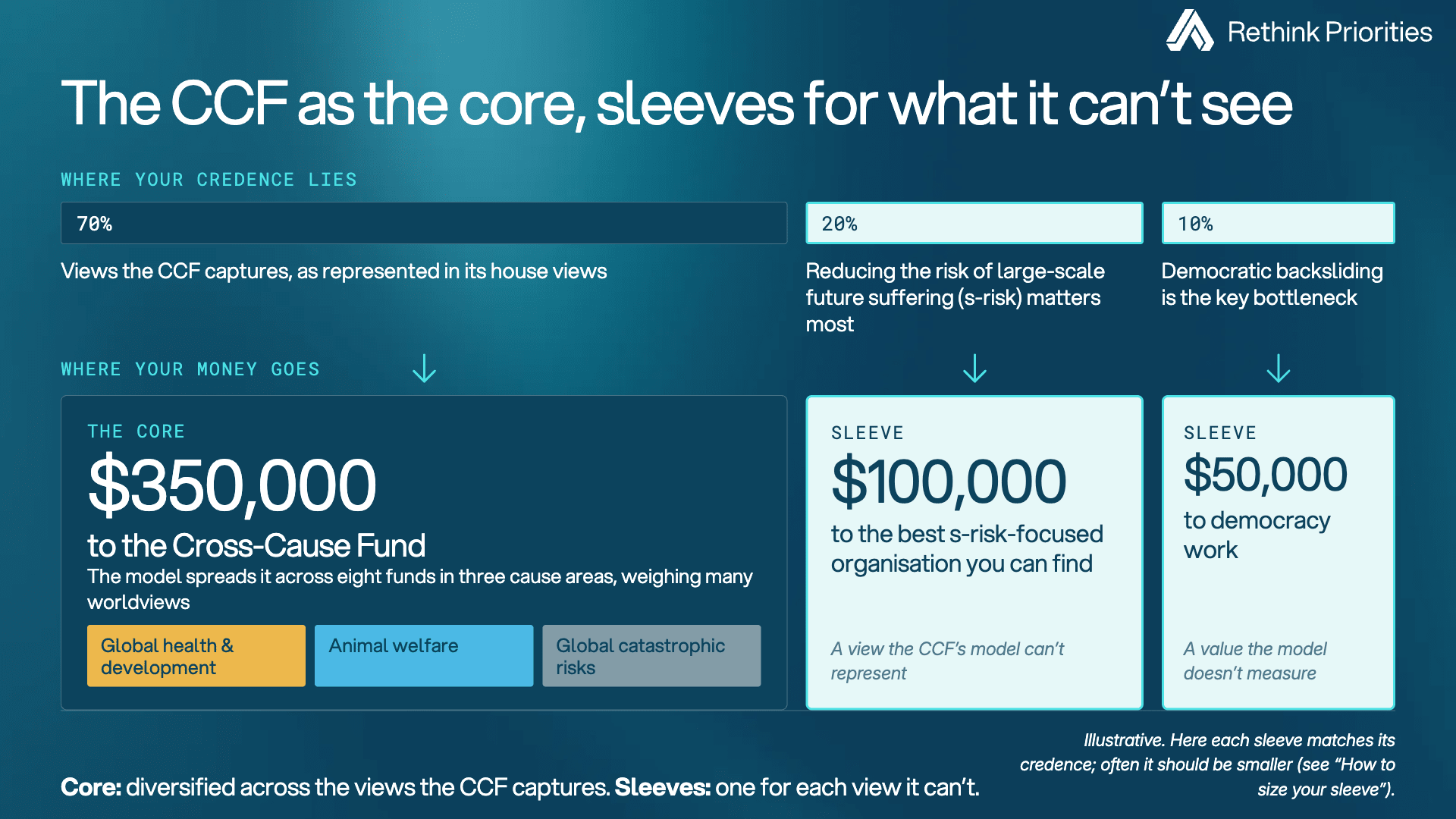
As a rule of thumb, the size of your core and sleeves should reflect your credence in the corresponding views of the world.
For example, suppose a donor plans to give $500,000.
We think this is a good rule of thumb, but there are a couple of reasons why you might give your 'sleeves' a larger or smaller share than their share of your credence.
Below are some considerations we believe you should keep in mind when selecting the size of, and choosing specific opportunities to put into your sleeve:
What exactly is the CCF blind to? We realize it’s hard to infer what the CCF can’t do, so we provide an overview here.
For starters, it currently can only allocate money to Global Health and Development, Animal Welfare, and Global Catastrophic Risks. We’re working on adding more cause areas in 2027.
The underlying model can capture a range of different views about what matters and how we should conceptualize impact. It can incorporate moral weights to compare human and farmed-animal suffering, and different types of human benefits (life years, disability averted, income). It can represent risk aversion, discounting work with a risk of having no impact or doing harm. It can also capture different attitudes about how much we can influence the far future.
Overall, we think this gives the CCF a strong toolkit for making trade-offs between its three cause areas.
There are things, however, that the CCF can’t or, de facto, doesn’t currently represent:
You don’t need to know the CCF inside-out to use the “core and sleeves” approach. We’d advise you to consider how much credence you place in the views above, and build your sleeves accordingly.
The CCF is an ongoing project which we are constantly updating and improving. But it will never be perfect: there will always be views that can’t be represented in the underlying model, and causes which aren’t included.
Despite this, we think that virtually all donors can benefit from the CCF’s rigorous approach to prioritizing between causes. As the “core” of your portfolio, the CCF can provide assurance that your giving is high-impact under a broad range of views of the world. You can always add a “sleeve” whenever you think one of the CCF’s blind spots has a claim on a slice of your portfolio.
DONATE THROUGH THE CROSS-CAUSE FUNDThis post was written by Stan Pinsent and David Moss. Thank you to Elisa Autric and Urszula Zarosa for feedback and editing.