Comments
Centre for Effective Altruism and Ambitious Impact (formerly Charity Entrepreneurship) are probably named the wrong way around in terms of what they actually do and IMO this feeds into the EA branding problem.
Why do I think this?
"Effective" Altruism implies a value judgement that requires strong evidence to back up - like launching charities aiming to beat GiveWell benchmarks and raising large amounts of money from donors who expect to see evidence significant returns in the next 3 years or shut down.
- IMO this is very friendly to a wide business-friendly and government audience
"Ambitious Impact" implies more speculative, less easy to measure activities in pursuit of even higher impact returns. My understanding is that Open Philanthropy split from GiveWell because of the realisation that there was more marginal funding required for "Do-gooding R&D" with a lower existing evidence base.
Why do we need "Do-Gooding R&D"?
So we can find better ways to help others in the future.
To use the example of a pharmaceutical company, why don't they reduce the prices of all their currently functional drugs to help more people? So, they can fund their expensive hit-based R&D efforts. There's obviously trade-offs, but it's short sighted to pretend the low hanging fruit won't eventually be picked.
So what?
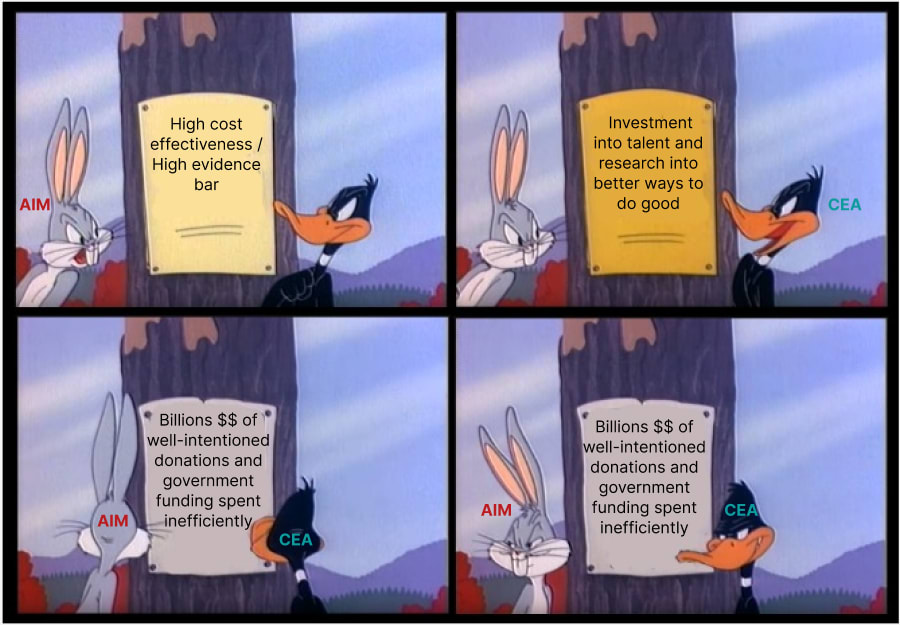
IMO AIM has outcompeted CEA on a number of fronts (their training is better, their content (if not their marketing) is better, they are agile and improve over time). Probably 80% of the useful and practical things I've learned about how to do effective altruism, I've learned from them.
The AIM folks I've spoken to are frustrated that their results - based on exploiting cost-effective high-evidence base interventions - are used to launder the reputation of OP funded low evidence base "Do-gooding R&D." I think before you should get to work on "Do-Gooding R&D", you should probably learn how the current state of Do-Gooding best practices.
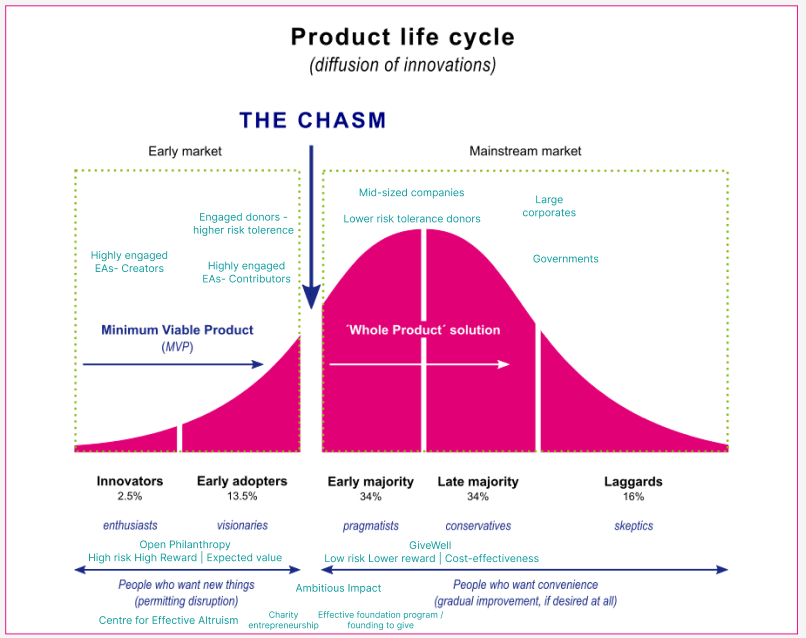
If we think about EA brand as a product, I'd guess we're in "The Chasm" below as the EA brand is too associated with the "weird" stuff that innovators are doing to be effectively sold to lower risk tolerance markets.
- This is bad because lower risk tolerance markets (governments etc) are the largest scale funders.
AIM should be the face of EA and should be feeding in A LOT more to general outreach efforts.Too strong a take - see this reply to Lorenzo's comment
Concrete suggestions
- I'm not suggesting they swap names, its likely locked in at this point BUT I think they have more in common than they think and are focussing too much on where they differ.
Looking atwhere CEA people actually donate, it looks like they are hedging the higher risk nature of their work with donations to interventions with clearer returns.Retracted - too strong a take as highlight by this comment - One solution would be a merger since there are lots of synergies but they are too far away from each other in terms of views on cost effectiveness and funding independence to do so (yet)
- I think they should be collaborating more, maybe coworking in the same office sometimes?
My wider take is that EA should become a profession (post building on this one incoming if I can ever actually finish it) so there is better regulation of individuals enabling us to have internally facing competition/innovation/R&D based on shared principles while generating externally facing standards that can be used by non-insiders and allow us to scale what works.
We shouldn't be internally fighting for a bigger slide of the existing pie, we should be demonstrating value externally so we can grow the size of the pie.



I just loved this from @Kelsey Piper on Twitter 🥺🥺 it's so true and I never appreciated it before EA.
I really appreciate you all 🙏🏻
https://x.com/KelseyTuoc/status/2031989126522945761?s=20
--
My ancestors buried half their children. All mine are alive. My ancestors' house had a dirt floor. Mine is wood. I have indoor plumbing, I have hot water, I have never in my life hauled a full bucket half a mile and I probably never will. Do you know how rare it is, in human history, for small children to wear shoes? Mine have multiple pairs. I can speak to my relatives who live thousands of miles away, for free, at any time. Video, if we want video. With machine translation, if we speak different languages.
The original Library of Congress had 740 books in it. I have more than that. If I run out of books in my home my local public library has 350,000. If I want to take a hundred books with me on vacation, they all fit on a device that fits in my purse.
I have heat in the winter and AC in the summer and a washing machine and I have never, ever, ever had to scrub a dress clean by hand in the stream. I can look up recipes from more than a hundred different countries and I've tried dozens of them. I ride a clean and modern train across my city for $4, or take a robot taxi if I'm out too late for the train. I donate $40,000 every year to the cause of getting healthcare to the world's poorest people and even after the donations I never have to think about whether I can afford a book, or a pair of shoes, or a cup of coffee.
There is a great deal more to fight for, of course. I hope that our descendants will look back on our lives and list a thousand ways they're richer. Maybe we ourselves will do that, if some of the crazier stuff comes true.
But the abundance is all around you and to a significant degree you aren't feeling it only because fish don't notice water.