
All Comments
Let me put my argument another way, without mention of truth, since I think getting into theories of truth is kind of overcomplicating things.
You want to use some kind of no sharp cut-offs claim to do work for you, in ruling out certain moral theories. But very normal reasoning from no sharp cut-off claims like your "give 2 systems" etc, plus claims we definitely want to accept like "0 grains is not a heap" or "a non-conscious non-living, mindless object isn't a moral patient" leads to conclusions we definitely don't want to accept. This is fairly strong ...
Hi Jo. Great post.
...The big, undetermined, crucial considerations are: as I learn more, new, previously unconsidered effects are likely to outweigh the positive impacts I was evaluating; what trade-offs to make between pain intensity and duration; and how much to weigh different animals. The first consideration, I try to “cover” by updating over time if a new effect becomes sufficiently[21] evidenced. For the other two considerations, I try to cover them with a portfolio, but when that is not possible, I consider multiple options worthwhile under my procedur
the same questions can be raised for any philosophical question whatsoever.
I assume you didn't mean to restrict this to philosophical questions only, since the disagreement between Anti-Richard and you on nuclear war is largely empirical.[1]
If you tell me that jumping off a cliff would probably mean death, there are no/few Anti-Richards out there who will say the opposite. And there's a very good reason for that: the corpses of such anti-Richards are stacked at the bottom of the cliff. Evolution selected against them and in favor of your "jump --> death...
I’m glad to see more discussion on what to do if maximality does not give action guidance. I think identifying degrees of justification is very compelling. However, I’m sceptical of this being possible to do the way it is done in this post.[1]
I understood this post as working on the assumption that there is something meaningful to be extracted from the representor besides unanimity. In such a case, maximality indeed would fail to use that information and I think that any plausible permissibility rule would need to use it. Below is my reasoning for not gra...
What do you think about AI 2040's idea of giving all people an equal slice of the lightcone and allow them to sell theirs? The endowment would extremely roughly give everyone a cut of the Dyson swarm the size of the earth, a star in the Milky Way, and a galaxy. But since the star would typically take thousands of years to reach, it might be better to allow people to sell their galaxy, star, and slice of the Dyson swarm separately. Then the people who value the long-term future could buy most of the stars and galaxies.
This is just my perspective coming from a different industry, albeit a safety-critical one. In my work, I've dealt with safety and operational issues that affected not just my organization but others across the industry. In those situations, the people responsible for similar issues at different orgs would come together in what we called industry working groups. We would meet on a set cadence to discuss what we were seeing, work through technical and operational questions, compare our experiences and interpretations, understand different approaches, etc. T...
Hi Luke. Thanks for the great post.
I wonder whether you have any thoughts on how to integrate considerations related to welfare comparisons across species into WAWS. I think this is needed to assess whether effects on non-target animals can be neglected. I link some related posts in the 1st paragraph here.
EA groups have been and continue to be overpowered.
Running an EA group is among the most impactful things you can do when you are at University.
The other day my previous co-organizer sent me a list of 15 (!) people who were in our EA group who are doing exciting and important GCR work.
In the interest of getting this quick take out, I am not reaching out to everyone to see if I can list their name/quote them but I want to stress the “exciting and important” aspect of this. Some of these people are perhaps within the top 10 people affecting American AI poli...
Why should I trust you any more than Anti-Richard? Why should you trust you any more than Anti-Richard?
You're asking for a procedural answer to a substantive question, which simply isn't possible. I can't emphasize enough that the same questions can be raised for any philosophical question whatsoever. Why trust induction over counter-induction? Why accept anti-suffering moral views rather than pro-suffering moral views? One can always ask skeptical questions, and the only possible answers rely upon contestable judgment calls. There's no purely procedural r...
Thank you for all of your hard work and dedication to growing the community. I finished the CEA Bootcamp earlier this year and it helped me gain clarity on my career growth. I wish you success in your future career journey. Thank you for impacting mine and many others with your dedication and hard work. Oh, and also, the Peter Wilderford quarterly review. I downloaded it and plan to use it for my own growth metrics.
They just need to be upskilled on the AI safety component, which I believe could be done to a reasonable degree with maybe a week’s worth of reading and a weekend-long workshop.
I'm pretty skeptical of this. Then again, it depends on the actual role. Maybe for an ops person you just want them to understand the basics and then they can pick up the rest over time.
It’s a bit unreasonable to ask someone established to quit their job, take a massive pay cut, and join a weird three-month thing with no guarantee of a stable job on the other side.
It's not clear to ...
I do not think a statement like "Vasco is tall" is true or false
I meant logically/mathematically true or false, which is a property of logical/mathematical statements, not sentences in natural language.
The standard way of running the sorites, with the toy example of "heap" is:
A. 1 grain of sand is not a heap of sand.
B: For any number n, if n grains don't make a heap, then n+1 grains don't make a heap.
Conclusion, 1 million grains of sand don't make a heap.
Here is how I would think about this. The statement "N grains of sand make up a heap of sand" is not l...
Thanks for the clarifications. They made sense to me.
My understanding is that GWs pure time preference is similar to ours and that any differnece in effective discounts is related to how they treat uncertainty over the future, but I have't looked into this.
Here are the details (linked here) about GW's discount rate of 4 %. Pure time preference does not contribute to this.
...We considered five reasons to assign a discount rate.
- Increases in consumption over time meaning marginal increases in consumption in the future are less valuable. We chose a rate of 1.7%
One more attempt: what if collective decision-making is really a learning problem?
I have noticed that I have become unusually invested in this problem.
Partly because I believe I see a solution, and partly because I seem to keep failing to articulate what I see in a way that makes it possible for other people to see it too.
So I want to try one more time.
This time I will start from my own profession.
I work as an infectious disease modeller and epidemiologist in a national public health institute. Ultimately, my job is about reducing disease burden in popula...
Thanks for developing on this, Richard. I think we can now identify more fine-grained cruxes than we did in our previous discussion, a bit.
Philosophical cluelessness, by contrast, commits one to the much stronger claim that nobody can (realistically) form any reasonable judgments or expectations about this question, no matter how carefully they investigate it. That’s an extremely strong skeptical claim!
You're claiming that you have a truth-tracking expectation of whether doing action A rather than B has an overall positive impact, considering, impartially,...
Also, on the topic of econ papers with much bigger effects than I was expecting: a very simple savings exercise gives maize farmers in Zambia ~1 month more of expenses to use during the hungry season, and this lets them then have a better harvest the next year.
Eyal Frank (the guy behind the vultures paper) also has a paper finding pretty large effects from decreasing bat populations on infant mortality in the same vein- the channel here is that the bats eat insects that otherwise farmers use insecticide to treat, and the insecticide causes infant mortality (he doesn't say how but I think it's birth defects?). He also has one on killing sparrows leading to the Great Famine in China, but the solution to that problem is "don't put Mao in charge of your economy" which doesn't seem very relevant in a modern context.
I...
We must settle for merely establishing to our own satisfaction that we can reasonably maintain our beliefs in the face of the skeptic’s contrary arguments.
It's nice to have access to your cluster of reasons for disagreeing with cluelessness. However, I'd have been most interested in seeing a post where you make a compelling argument for how the DiGiovanni cluelessness argument pattern-matches radical skepticism, or other arguments that philosophers find intriguing on the surface but generally flawed.
I do think that a crux for me when reading your post he...
Thanks, this is some great perspective. It is true that I'm based in Europe and most of my direct interventions with EAs have been with Effective Giving and Animal Rights people, maybe not typical, at least in style. I do love reading EA's like Yudkowsky and MacAskill too, and often I agree with them, but I can see why many might not.
However where I would push back is on the idea that EA does not belong in the centre of the Overton window. IMHO there is hope for a post-fascist world where truth-seeking becomes again a virtue in itself. EA's themselves di...
If you find yourself "sadly nodding my head in agreement with so much of the article" until you get to the section that concerns an area you have first-hand experience of, whereupon you find the author to be grossly misrepresenting the subject matter, you should probably reduce your credence in the rest also.
Not sure whether new posts count for the commentary competition, but this seemed too long to paste here as a literal comment!
Has anyone tried to estimate the social cost of carbon taking into account AI? I've seen several well-calibrated people estimating that there is a 20% probability that AI fizzles in the next few decades. If you believe that that would be permanent and AGI/ASI would solve the climate problem or result in catastrophe, to a first approximation, that would mean the social cost of carbon would be about 1/5 as much as people typically calculate. In reality, AGI/ASI may come further in the future, and there could be some benefits of reduced carbon even with AGI/ASI.
Given your message I would guess that what they have in mind is scenarios like "You can spend $2000 to raise the happiness of ten people in Africa from 3/10 to 5/10, or you can spend that same $2000 to raise the happiness of a single disabled person in Florida from 3/10 to 5/10", where they believe that the first option is totally unacceptable. But the Guardian authors don't mention what the disagreement is about, of course, they are just telling the audience that first-option-choosers are ABLEIST. So when I wrote my message I had absolutely no idea what they were talking about, and I didn't know what to say other than "BS". Thanks for filling me in.
“In animal welfare, I can sometimes know that I have a solid chance of reducing the suffering of some animals in the near-term, and that’s potentially worth doing as long as you’re, uh, careful about the risks of doing harm. And the bracketing people have said that this can be good, so there’s at least one element of justification.”
I love how humble and honest this is. I wish everyone were as clear about how vague their rationale is and how much they defer to other people.
And, fwiw, this sounds pretty sensible to me!
One way to describe this idea is: Under capitalism workers do better than under socialism, but also under capitalism capitalists do better than workers, so once AIs can be workers, why not keep capitalism, but make everyone a capitalist. This does bring out some of the risks to the well-being of the AIs themselves.
Hi Johannes, thank for all the detailed thoughts. I think we're probably reaching diminishing marginal returns in debating point by point. I will say that we agree that the Rennert et al projections are too pessimisitic, and difficult far future projections can matter a lot with low discounting. Though I think we will need to agree to disagree on the magnitudes of these changes.
There is one technical point that I'd like to bring to your attention, though, that I think does critically matter. The Rethink application of a new discount rate is NOT a 0% disco...
Hi Sjir - This is a great article and appropriately challenging for those who haven't thought about this before. I agree with your summary message. I also agree that it's a sensitive exercise to compare in this way, but choosing such a fundraising colossus to compare to makes it much more palatable, in my view.
With regard to the broader St Jude’s mission, you limit your research discussion to the impact of St Jude’s on advancing cancer treatment for children in the USA. However, St Jude’s is an international resource that runs a large global oncology pro...
Good q. We did not directly adjust the endogenous growth term through any discount, it enters the model only as a multiplier. That said, the multipliers we use have underlying discount rates that they use (generally larger than 0). We probably could’ve harmonized in a smarter way to be able to answer your question, but the general point you are trying to make, I think, is that higher discount rates here might be appropriate because of long stream of future harms/benefits (or perhaps just uncertainty). This would mean that our SCC is too large. Fair; and ma...
Thanks so much for interacting with our work. For broader context around this report, it’s important to note that our approach from the outset was to build a series of models to show what you would need to believe for climate to be competitive with GHD. We therefore aren’t wedded to any particular SCC, and certainly can imagine different ways of approaching the problem.
To your specific points:
- It is our view that Rennert is the best middle ground available from current peer-reviewed work. It sits between DICE-2023 (~$66) at the lower end, and estimates tha
"I do not think a statement like "Vasco is tall" is true or false"
Why not?
"given 2 systems which only differ infinitesimally, it should not be the case that one has a moral value of exactly 0, and another has a moral value above exactly 0
You disagree?"
I think it's unclear exactly what the right thing to say here is, because the sorites paradox is hard to resolve, but yes, probably I disagree. This is the specific to "has moral value" version of the second premise in the standard way of running the sorites paradox. The standard way of running the sorites,...
What's wrong with the view that it's just false that a 5ft 1 man is tall?
Only mathematical propositions can be true or false? I do not think a statement like "Vasco is tall" is true or false, although one can still analyse it. For example, for some available answers (like "agree", "disagree", and "I do not know"), one can investigate which fraction of people in a given population pick each answer.
...given 2 systems which only differ infinitesimally, it should not be the case that one has a moral value of exactly 0, and another has a moral value above exactly
Thank you for responding to my comment, @Deni555! Your perspective makes a lot of sense: You wish the entire meat industry would end. If you got to choose between a reformed meat industry that treats animals better and no meat industry at all, you'd choose no meat industry at all. Because then there'd be zero farmed animal suffering. And zero suffering is better than some suffering. I get that.
I'm asking a different question than what you should choose if you were omnipotent and got to choose something like that.
I'm writing from a purely consequentialist p...
Cage-free campaigns took animals a long way. But the "what comes next" pipeline for reducing animal suffering is thin (full take here).
That's why the upcoming round of the Charity Entrepreneurship Incubation Program is (for the first time in our 50-org track record) for animals only.
Application deadline: September 13th
A fully cost-covered 8-week program from February 1, 2027. You get a co-founder, a frontier problem to work on, training from people who have built field-leading charities, and a seed grant to launch. Mostly online, with 2 weeks in London a...
Hi Yonatan,
Thanks for the feedback.
I wouldn’t consider this a hidden feature. Cards in this category are each tagged 'Career development,' and the explanation also appears in the commonly-used ‘Areas’ dropdown.

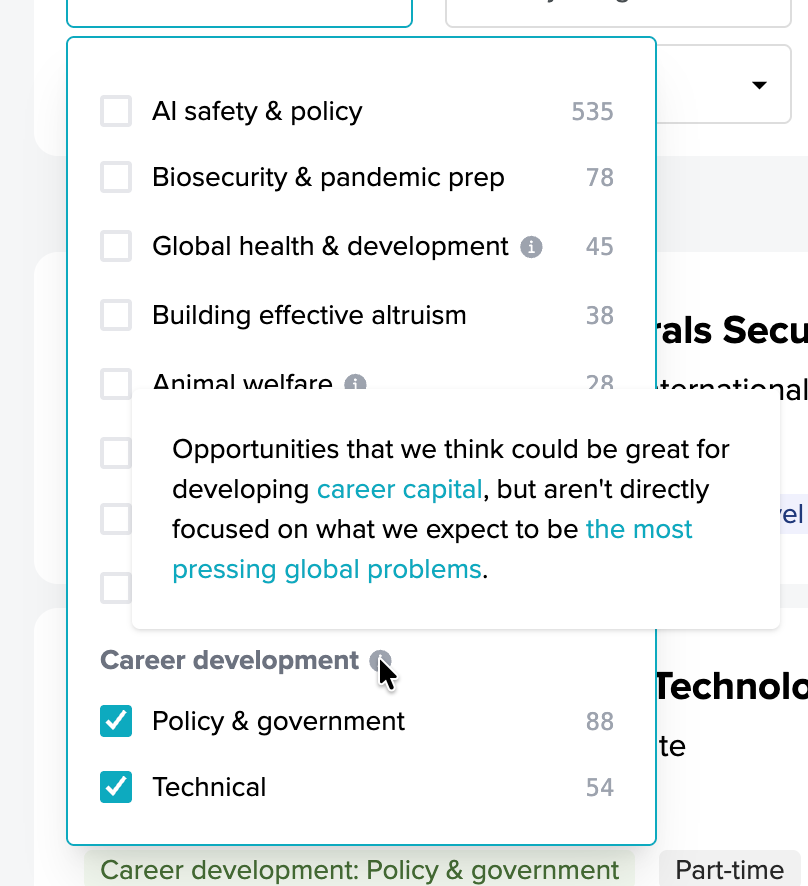
We explain further in our FAQ, in "How do you decide which roles to list?": "We include roles based on whether they have the potential to help someone contribute to solving one of our identified key problems and/or help people develop the career capital to work on these problems in the future."
We think it's useful for our audience to see opportunit...
https://plato.stanford.edu/entries/sorites-paradox/ This is worth reading on what philosophers have said about "no sharp cut-off" principles like "given 2 systems which only differ infinitesimally, it should not be the case that one has a moral value of exactly 0, and another has a moral value above exactly 0"
What does the phrase "current definitions of being tall" pick out exactly?
"The point I wanted to make is that, given 2 systems which only differ infinitesimally, it should not be the case that one has a moral value of exactly 0, and another has a moral value above exactly 0."
This is the famous claim that vague predicates shouldn't have sharp cut-offs. It's been analyzed to death in philosophy, because it generates paradox, but I don't know of any way of rejecting it that implies that when you have a continuous underlying thing, and a concept that is vague,...
re: "racial, ableist and gender biases about which parts of humanity are worth enhancing and saving – and which could be sacrificed for the supposed good of the whole." - I actually think this is (tendentiously) getting at a significant difference between EAs and the progressive left. This was made vivid to me when a (very left wing) Princeton philosophy professor invited me to respond to her critique of EA as "ableist" because it doesn't guarantee that disability accommodations should be prioritized for funding if they turn out to be less cost-effective t...
I was not clear. I think that view is right for the vast majority of current definitions of being tall.
The point I wanted to make is that, given 2 systems which only differ infinitesimally, it should not be the case that one has a moral value of exactly 0, and another has a moral value above exactly 0. Granting this, all systems have a moral value above exactly 0 if one can go from any system to another via a series of infinitesimal changes.
I'm also baffled by the rhetorical martyrdom and self-flagellation that became popular in EA circles post-FTX. It's surely worth forcefully pushing back against misleading coverage, having some courage in our convictions, and being clear about how ignorant (or sometimes outright dishonest) a lot of the critiques are.
Something I'm a bit torn on is the question of how much it's worth going on the offensive against competing ideologies. EA is a big tent, but it's true that a lot of us think anti-capitalism is bad and stupid. Personally, I do not have a positi...
Most AI-geopolitics analysis concentrates on frontier production. I've been exploring a complementary question: what happens to the capabilities the frontier leaves behind?
Downloadable models can persist after commercial support and meaningful developer control disappear. As inference and adaptation costs decline, some of these systems may become accessible to actors that could not have exploited them at release.
The longer piece develops this through the ideas of capability sedimentation, temporal capability arbitrage and “compute-poor but model-rich” stat...
Thanks Stan. I think this is a concise and reasonable critique- I mostly agree. A few thoughts.
- My understanding is the CG recently did an internal calculation of SCC along the lines of the Rethink analysis, but one key difference is that they cut off damages around 2100 (not sure the exact year). This was just to have a like-for-like comparison with other interventions where they project benefits out for a fixed amount of time. They came to a conclusion of an SCC around 700. So if you take $1/ton as a reasonable benchmark for climate you get 700x, which d
Why complete cluelessness is counterintuitive to me
I mean, specifically, this kind of pervasive cluelessness, where you can't justifiably decide between any two actions. It seems that such pervasive cluelessness is in tension with the idea of instrumental convergence. I'm personally sympathetic to imprecise probabilities, but intuitively I'm not convinced that cluelessness is that bad that we can't justify even basic learning and other (supposedly convergent) instrumental strategies, such as (at least) those in the low-footprint capacity building category...
The way I see it, the probability of someone being considered tall increases with height, and it is never exactly 0 or 1. In that sense, it applies to everyone to some extent. Likewise, I think "morally relevant" applies to all systems, organisms or not, if it means having a moral value above exactly 0.
It doesn't usually follow from a lack of sharp cut-off that something applies to everything. "Tall" lacks a sharp cut-off, but a 5 ft 1 inch tall man is not a little bit tall, he's just not tall. I also doubt you can get rid of arbitrariness here, because if you zoom in far enough the line between organism and not will probably itself get blurry, at least for some possible organism-ish things that could exist or around the moment of death etc.
I think any sharp falsifiable operationalisation of "morally relevant" will be arbitrary. So I would assume all organisms have morally relevant preferences of varying strengths.
More EA Near/Medium-Termist Money Should be Flowing to Climate Change Mitigation
My understanding of EA funding is that almost none goes to climate. I (loosely) tend think that it would be good that a bit more resources go to Giving Green and other environmental prioritization projects.
However, I also gather that such projects attract funding far more easily than most other EA-consensual-ish causes.
On the first point, maybe I'm wrong then.
On the second, only if bacteria have preferences in a morally relevant sense. But yes, it probably does imply that animals and humans get the same moral weight if combined with strict preference utilitarianism. But it's hard to see how else interpersonal utility comparison could be made-in my view, this is true of hedonistic utility comparisons too actually, although that's more controversial-so maybe the problem here is utilitarianism, not the rule.
This was interesting and had me thinking for a while. This made me consider mixed options as a very relevant consideration for clueless agents. I have some more specific thoughts below. I consider 1. and 5. to be somewhat serious objections to your argument but 2.-4. not so much.
1.
It seems hard to deny that mixed options are possible, and it directly follows from maximality that when they dominate some options, those should be impermissible. I however don’t think I agree with the actual substantive claim being made regarding those:
(*) Even if we don’t hav...
there's some reason, that does not come to mind rn, why bracketing over those would fail to provide action guidance?
The worry is very similar to the worry about bracketing on persons: identity of person-moments is super fragile.
Let's say I donate to AMF. There are some far-future person-moments for which I am clueful that donating to AMF seriously harms them, because these person-moments only exist in the possible worlds corresponding to [insert far-future backfire risk here]. And we can say the same substituting in "benefits" for "harms". We then end up a...
After the initial experiment period, we've decided to keep the featured page.
One of the key graphs in making this decision is below:
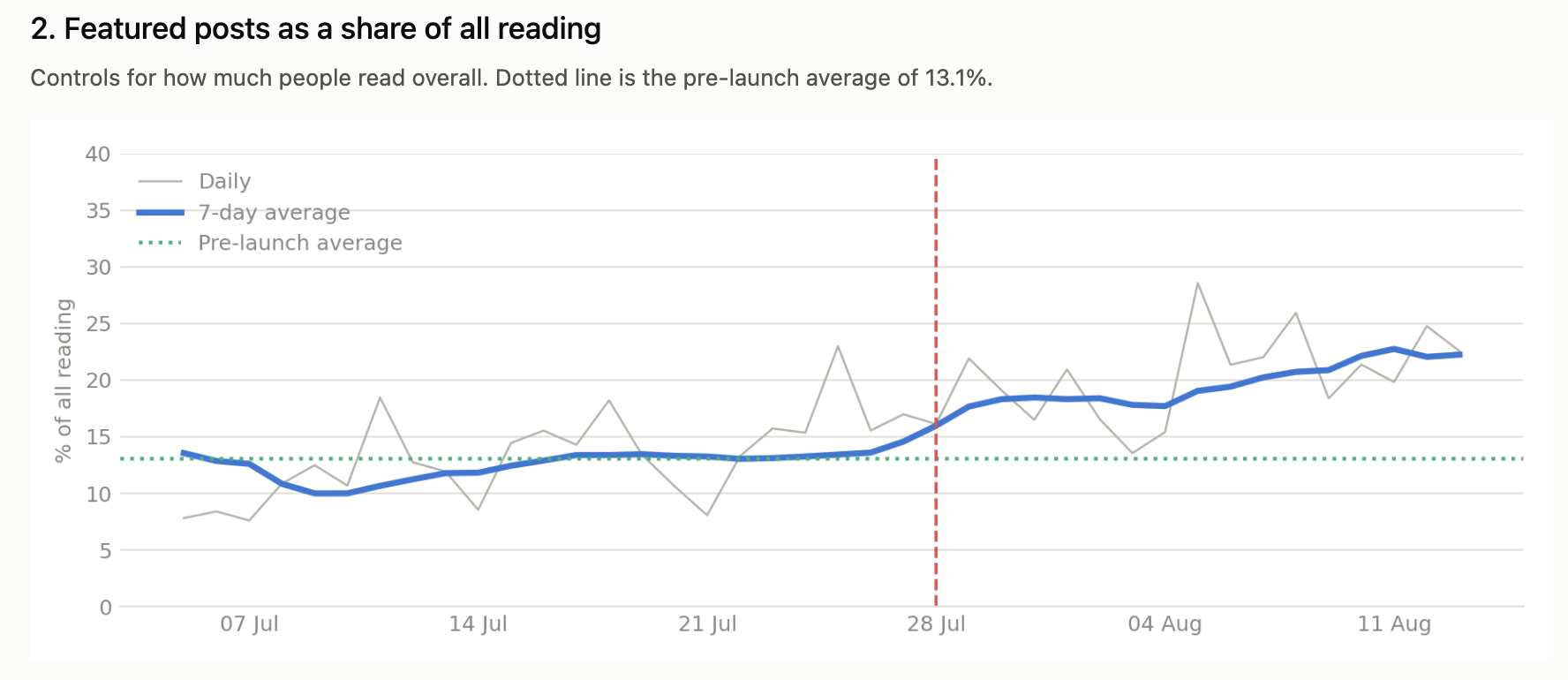
Now that the featured page is likely to stick around long term, I'd like to start collecting ideas for V2[1]. Do you use the page? Do you pointedly not use the page? I'd love to get any and all feedback, in the comments here, or via this form.
Please share small things like aesthetic tweaks as well as larger issues such as a disagreement on the kind of posts that get featured, or how featuring is done. Happy to answer questio...
Sure, here are examples (and I'll take reasons not explicitly mentioned in the post, so this hopefully adds some value):
- Reason to think expansion (such that Loic-the-ant/Dolores should not exist): that's what smart moral weight researchers have assumed so far.
- Asymmetric reason to think granularization (such that Loic-the-ant/Dolores could very well exist): some subtle weak localized pains might require a complex brain architecture.
Here are symmetric reasons to contrast:
- We might be in a simulation where the simulators are observing what sentience evo...
My original argument was aimed at P1. I argued that there is a class of decisions—decisions about how a model learns and changes—that cannot straightforwardly be reduced to comparisons of downstream consequences within that model.
The discussion has made me realise that this points to a more constructive response to DiGiovanni's challenge.
Suppose the cluelessness argument is correct. What should an impartial altruist do?
I think the answer is: we should shift part of our attention from predicting the future to preserving our capacity to correct our predictio...
Hi Tom. Which discount rate did you use for the benefits from endogenous growth? GiveWell (GW) uses a discount rate on future consumption of 4 %/year.
feel free to insert "person-moment" or "point of view occupied by a person" where my post says "person"; you'll get person-moment-centered bottom-up bracketing, or personal-point-of-view-centered bottom-up bracketing, based on exactly parallel arguments.
I've actually been confused about why Kollin et al. (2025) and Clifton (2025) never even mentioned something like "person-moments" as potential "locations of value". After a quick look, it seems they've been considered in infinite ethics, and I didn't find any argument for why they're clearly not suited as ...
Would you be willing to elaborate on this point?
We are in a situation of complex cluelessness where the reasons to believe evolution favors granularization over expansion, and reasons to believe the reverse, are asymmetric.
How are the reasons asymmetric?
More EA Near/Medium-Termist Money Should be Flowing to Climate Change Mitigation
As Abbie says in the report, climate can't compete with GHD on high-certainty interventions. It can compete if we: (a) interpret the economic effects of climate damage as mostly affecting growth rather than inflicting many one-off costs and (b) count effects well beyond the next century. Assumption (b) looks particularly shaky to anyone with a high credence that AI-powered and other growth will radically increase global resilience to climate change.
Hi both, thanks––yes, I agree this might justify Toby's intuition: Person-moments, or "points of view" that a person occupies (cf. Pettigrew's lecture 6 here), might be the appropriate basic objects of moral concern. I am sympathetic to some of the arguments for this view (e.g., drawing on the apparent existence of intrapersonal moral demands). It might also help us avoid the cluelessness problem potentially posed by prudential longtermism: Take the snack now, bracket your far future "selves."
So my response is this: I think we should first try and see how...
What if exact copies don't matter but future experiences still do?
I think an ethics resulting from the following two premises is worth exploring:
P1: The total moral value of subjectively indistinguishable observer-moments doesn't scale with the number of copies, i.e. they sum to a constant value.
- This is because subjectively indistinguishable observer-moments, in some sense, happen to the same "someone". One could think of themselves as all their copies. N observer-moments that are subjectively indistinguishable aren't felt N times by that same "someone". O
Update: The current job board seems to still list opportunities that "aren't directly focused on what [80k] expect to be the most pressing global problems.", but discovering this is hard, it's hidden in a tiny sub menu:
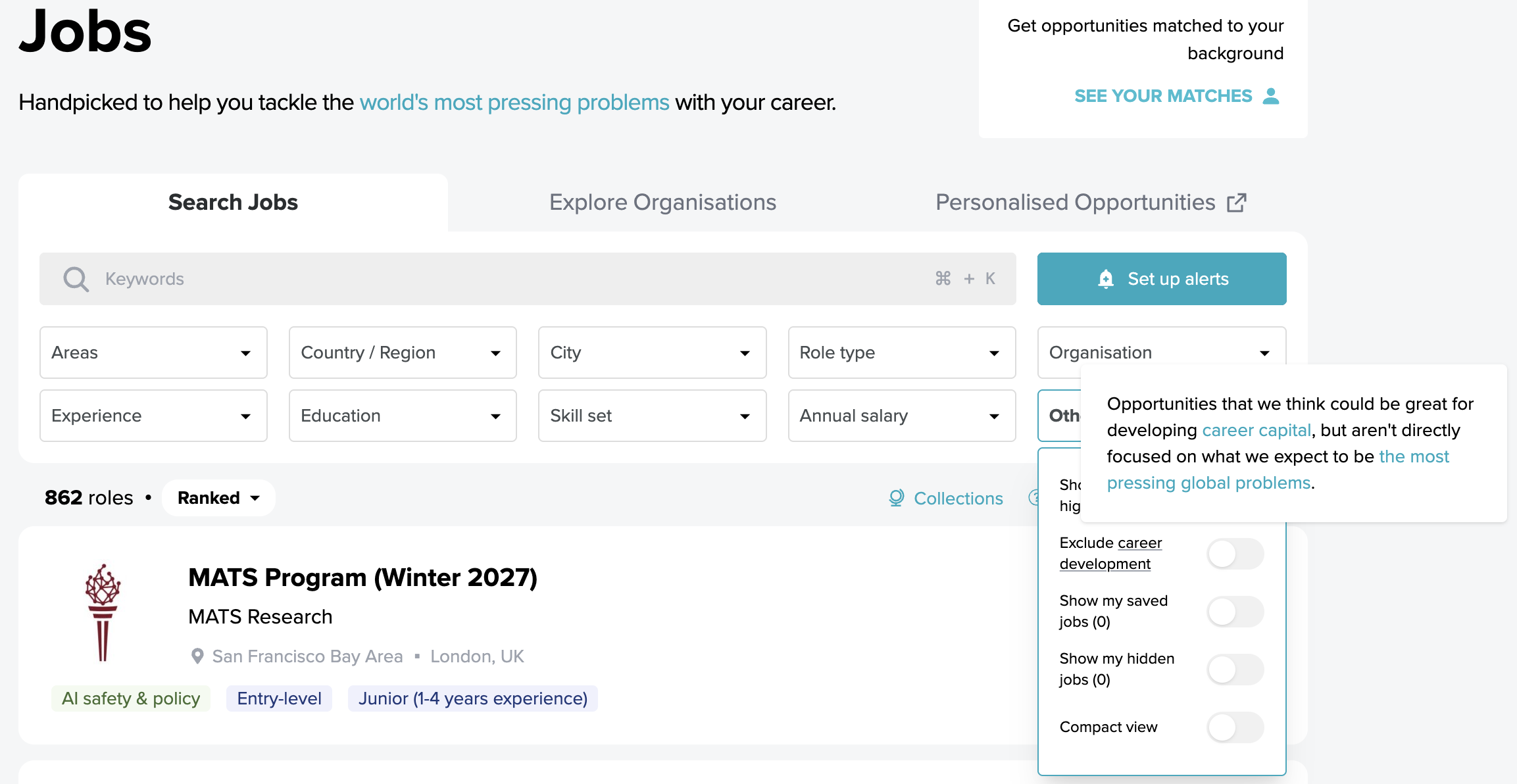
I don't like this.
I think people often come to the 80k job board to find impactful jobs, and that the current situation is misleading, and that this matters.
I don't remember if back when 80k added this filter it was more visible?
I wonder whether the option-value argument here has an additional timing dimension.
You emphasize that flexible resources can be preserved for better-informed future altruists. But waiting may improve not only our information; it may also radically improve the productivity of those resources.
For some interventions, technological progress that is largely exogenous to our own action may make the same objective dramatically cheaper or easier to achieve later. Recent progress in AI-assisted software development is an intuitive example: some projects that requir...
Yeah, I have noticed multiple left-wing sources directly misrepresenting the ideas of Effective Altruism and the Guardian article certainly does that:
There is also effective altruism and longtermism, both of which skip over redistributive approaches to helping those in need in the here and now in favor of a cost-benefit approach to doing the most good in the long term.
This sounds absurd on its face―I've always supported "redistributive approaches to helping those in need in the here and now".
...Though they can appear benign at first glance, these ideas are sh
Extremely randomly, I also have had vulture conservation on my list for ~ a year for “crazy-ish wild animal welfare intervention ideas.” Basically the rough argument is they reduce disease for wildlife also, and disease is probably a big welfare cost in the wild, and since they (mostly) don’t kill other animals directly, you don’t have to balance out an increase in “landscape of fear” effects. If you think maggots have really high moral value and net positive lives you might dislike the competitive population reduction effect, but most people won’t care about that.
If someone wants to do further research/a shallow dive into vulture preservation, I would fund it. You can just DM me a 1 paragraph proposal. Open to college/high school students doing this too.
Great find @MathiasKB🔸
Suzuki Roshi has a famous quote that says "You are perfect just as you are, and you could use a little improvement."
On another front, coming from the Brahmavihara framework and Ajahn Geoff, equanimity is not the goal, but a stepping stone, and must be balanced with goodwill (metta) for it to be fruitful. He quoted (very skillfuly in my view) one Thai Ajahn saying that simply accepting things as they are is the equanimity of a cow.
To land the point. You went on a retreat being taken care of almost completely, and there you could train yourself in letting ...
Thanks a lot for these thoughts, Tony. I'm not sure I have all the answers, but a few ideas to throw in the mix:
- A lot of what we think of as cost-effective interventions in GHD are on-the-ground, direct-delivery type stuff (bednets, vaccines) that require a lot of logistics and therefore large, sophisticated orgs to manage them. This isn't really true for climate (at least in my opinion) where we are focused more on charging policy, technology, and markets. There are still constraints in org capacity, but they look pretty different.
- The climate philanthrop
How much does music, literature and art influence people's perception of reality?
Where is it on the scale from "All our opinions come from external sources." via "The messages in art are irrelevant, people enjoy things without it changing their worldview." to "People consume only art that matches their worldview."?
Is the "tech-right" getting more traction because it embraces AI art which is quick to generate and can be captivating?
Example (not sure if this person is "tech-right"): A song about Elon Musk with genuinely catchy music: https://youtu.be/wWZYP5jn5w4
Hi Ghostman ! Is this your real name ? Anyways, you've identified a really fascinating phenomenon. I think your question answers itself. You said, "rigid invariant", invariants do not really change their behavior. Honestly, i don't know if the "prior structure" is really an invariant. Complexity in deep neural networks come from different places like activations, width, loss functions, resnets, optimizers etc. How the prior changes by changing the complexity of the network ? That's an open question. But if we think about it, we'll see that the conditions a...
Hey Joey, thanks for the kind words. The trigger for labeling a response as engaging in "manufactured uncertainty" was: "Presents a claim as less settled or definite than the evidence supports." Usually this happened by citing true evidence in a way that would alarm a casual reader beyond what's reasonably justified. This is obviously a somewhat subjective judgment call, so it would be helpful to have independent scorers apply these flags in future work.
As to how it might change, that depends on us! As I note in the writeup, many of the sources that the ag...
Hello everyone, I am Nii Simmonds, Founder and Executive Director of the Diaspora Country Index, known as DCI. At DCI, we assess how prepared countries in the Global South are to engage with their diaspora. As Western donor support declines due to shifting geopolitics and the rise of populist agendas, sustainable economic development has become more urgent for the Global South, and we offer the research, analysis, and frameworks needed to support national development. Our approach is grounded in evidence-based research that evaluates how effectively nation...
Great post! LMIC's are entering a lower-aid future. Many donors have reduced or reconsidered overseas development assistance (ODA), leaving governments with less predictable external financing. Countries need new ways to mobilize capital, expertise, networks, and institutional support.
Professional diasporas represent one underexamined resource. Yet diaspora engagement requires more than conferences, remittance campaigns, or government appeals. Effective engagement depends on credible strategies, trusted institutions, reliable data, investment pathways, and...
What happened at that moment of time, the Asian hate was despicable and deeply troubling. We must call out bigotry of all kinds, even if we think this person is a senior-level official. Oftentimes, we allow certain people to say something and get away with it because they are a well-known figure or they have agency - this is more of a reason to speak up and call out bigotry.
This was interesting to read, especially the point about the marginal cost of automating additional tasks falling as the underlying infrastructure gets better. One thing I was wondering about is how the maintenance side is developing as you add more automations.
At 11% you can probably still understand each automation fairly well, but if the aim is to automate a much larger share of program operations, some of the work presumably shifts from doing the task itself to keeping a growing set of automations working as forms, Drive structures, naming conventions,...
Thanks, Dan, for your reply. I think I still disagree pretty strongly and I’ll briefly outline how and why: (1) I don’t think we should give credence on studies based on government usage, (2) 22 century emissions are clearly very implausible, (3) there are reasons for this to really matter and (4) being able to find this in 5min should make us deeply skeptical of the wider paper. (5) As you, I deeply care about effective climate action but I don’t think we should propagate bad evidence to inflate the importance vis-a-vis other causes.
- Should we give speci
Hi David. I do not understand in which sense that would break the zero-one rule. The denominator of the normalised degree of preference satisfaction would be smaller for the person who is closer to indifferent between the best and worst possible experiences. However, for the purpose of comparing the degree of preference satisfaction across people, one person going from the worst to the best possible experience for them would be as good as the other person going from the worst to the best possible experience for them.
I do not like the zero-one rule. I understand it implies one bacterium going from their worst to best state would be as good as one human going from their worst to best state. I find this very counterintuitive.
I wouldn’t say that I require short timelines or immediate effects. If that were the case, I wouldn't support cultivated meat. I understand the argument for funding very speculative work where I can see the causal chain from research to an intervention with enormous potential impact. My concern with WAI is that they are still trying to discover both what the relevant welfare problems are and what interventions might eventually follow from understanding them. This seems to me an absurdly vague proposition for the level of funding involved.
You seem to find v...
I think 0 grains of sand could be a heap of sand under some definitions of being a heap of sand, and I also believe non-conscious non-living mindless objects could have moral value (and therefore be moral patients) under some definitions of consciousness, life, mind, and objects. For example, I think standard laptops could reasonably be described as non-conscious non-living mindless objects, but I would not assign them a moral value of exactly 0.