Comments
I was recently at “Skoll”, the biggest NGO/social entrepreneurship conference. From one conversation to the next, two topics popped up over and over……. and over
1. Scale, Scale, Scale
2. Scale through Government, Government, Government
We at OneDay Health grapple with these questions: how then Shall we scale? And shall we through Government? Right now we operate 88 one-nurse health centers which save lives in remote rural healthcare black holes. Our one nurse in one room model can get good primary care to people cheap and fast. But to get good healthcare to everyone, we’ll need to do more than “grow”, but “scale”.
If we continue to launch more health centers every year through donor money, we’ll do plenty of good but can only grow our impact in a linear-ish way. From 100 to 150 to 200 health centers. Each year we’ll have to increase our donations and budget to increase our impact. Even if we succeed we’ll never reach tens of millions of people. So what is this “scale” business and how could we get there? Kevin Starr has outlined two key principles of scale.
1. “Scale is about exponential impact. It’s a curve, not a line.”
2. Scale decouples philanthropy money and impact, which unlocks principle 1
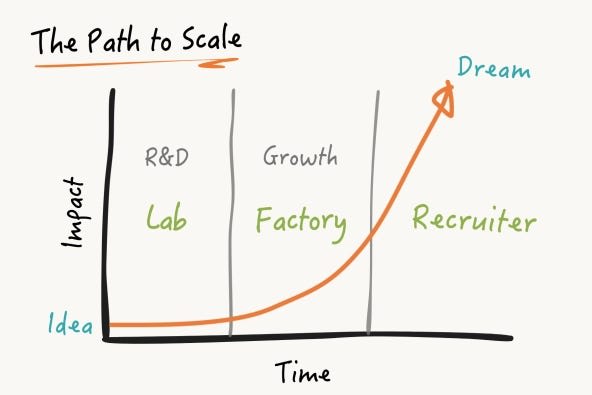
Now that we’ve said RIP to USAID, there remain two big piles of non-philanthropic money, which can take the best social solutions to the moon. The first is paying customers. The second is today’s topic, the government.
Scale-through-government has become a panacea for ambitious NGOs. The last slide of pitch decks shows how governments will scale their dream to millions. Smiling photos with ministry officials litter Linkedin.
But I have concerns
Three Concerns about Scale through Government
Government in an ideal world should be the major player who pays for and rolls out the highest impact interventions, not us do-good NGOs. Their core job is to do the best they can for their people. So while economic growth moves a whole country forward, governments should double down on the most cost-effective healthcare, education and income generating activities which improve the lives of thei most vulnerable. We at Oneday Health would love to help governments get good healthcare to everyone, yet we want to embark on this journey eyes wide open. Scale through government It is not the only way, can be morally dodgy and is really hard.
Not the only way
The exceptions might prove the rule, but a number of awesome interventions have scalde huuuuuge through donations, without government cash. International Aid agencies and huge foundations such as Gates and GiveWell still have enough money to “forever fund” important interventions. And we may soon get a new wave of philanthropic go-go-go with Anthropic’s IPO-O-O.
- Vaccines: The Global Vaccine Alliance (GAVI) scaled up vaccination with enormous success, with 50 million kids vaccinated every year. If GAVI were an NGO it’s 2 billion budget might might be the biggest in the world. Gavi covers 80-90% of vaccine costs in the poorest countries. As countries move to middle income status however, GAVI does force transition to government as payer.
- Mosquito nets: Mosquito net distribution is one of the most cost-effective ways to save lives in the world from deadly malaria. Between 2005 and 2020, Big Aid and Philanthropy scaled up malaria net distribution from close to zero to over 300 million nets delivered for free each year. The Global fund, President’s Malaria initiative and Against Malaria Foundation now spend One Billion dollars a year distributing mosquito nets. Little government money has been spent in this successful scale-up

- Cash Transfers: GiveDirectly spearhead the global cash-transfer movement, which argues that cash transfers help people more than most development interventions. Through a mixture of philanthropy and government AID they 10x-ed their giving in just 5 years, and have given away over 100 million dollars a year since. This philanthropy driven approach has also influenced big aid policy. The UN refugee agency has adopted the “‘why-not cash” approach, which gives cash transfers priority over in-kind assistance.” (https://indevelopmentmag.com/money-for-nothing-the-roles-of-evidence-in-givedirectlys-journey-to-1-billion-delivered).
Despite this wild success and the mountain of evidence which supports cash, you won’t find one low income country that gives out cash at any kind of scale. The Ugandan government recently gave ten millions of dollars of loans tied to buying livestock, an inefficient process mired in corruption. Free cash would have been way better.
Should governments pay for the best interventions?
Yes, governments should priortise that which helps their people the most. I wonder how much this continuous flow of philanthropy mega-cash reduces government’ incentive to pay. It seems strange that low-income governments don’t pay for vaccines and nets, the cheapest way to save lives. Meanwhile Uganda and Tanzania spend their meagre cash on 300 million dollar specialist hospitals which will serve the rich. Not to mention the 50 million Uganda gave to just 500 MPs this year as a car allowance…
Morally Dodgy
To build relationships with governments, you need to spend lots of money and effort on “sales” to bring them on-side. As Kevin Starr puts it “you stop building more factories, and you start building something that looks like a sales and customer service team.” Through this sales or lobbying process, NGOs will engage in a number of practices that could be considered corrupt in high income countries. I consider them “morally dodgy” at best. NGOs will often…
1. Hand rich government officials clean money through large “per diems” to entice them to attend meetings.
2. Pay for flights and hotel rooms to help officials attend conferences.
3. Pay for media opportunities for politicians to promote themselves while they champion your cause,
Some might consider this a form of “soft corruption”, while these practices also make it harder for other interventions to scale through government in future. You need a sizable “sales war chest” to even be taken seriously by Governments. I might be willing to suck up my self-righteousness and dish up money to govt. officials to help the poorest people get good healthcare, but this feels at best icky and at worst a bit corrupt.
Its really hard
Despite all this buzz about scale through government, there are few examples in low income countries where NGOs have helped government both do the thing and pay for it. In the few success stories, the money and time needed to get there is mind boggling. I deeply respect the Community Health Worker (CHW) movement who helped governments adopt and pay for salaried and supervised CHWs in many Sub-Saharan African countries. But this took a mountain of work - a multi-faceted campaign over 20+ years.
1. High profile experts championed their cause (Paul Farmer, Raj Panjabi)
2. Produced mountains of research to show that “Community Health workers Work”
3. Lobbied the WHO to change their official policy on paying CHWs
4. Formed Advocacy/Lobby coalition CHIC to co-ordinate and lead their charge
5. Spent Tens of millions in sales/lobbying governments
6. Guaranteed hundreds of millions in co-funding governments for a transition period.
For small orgs with big ideas like us, this kind of campaign seems impossible. Fortunately there are smaller govt-as-payer success stories such as Healthy Learners and Food for Educatoin But govt. Still only pays a small proportion of their interventions’ cost, most remains from donors for now.
And one bonus concern if we do succeed…
Poor Taxpayers not Excess Western Money now pay for the impact
We don’t get exponential impact for free, the burden shifts from philanthropy to fairly poor taxpayers. In low income countries, the “middle class” pays these taxes. Not rich politicians and business people, but wage workers like our nurses who earn $150 a month. The scale graph could be misleading to some as it only displays the philanthropy money spent, while the total spend still tracks the impact line. The advantage of scale through government lies in unlocking exponential scale and long term sustainability. Impact is not magically decoupled from money.
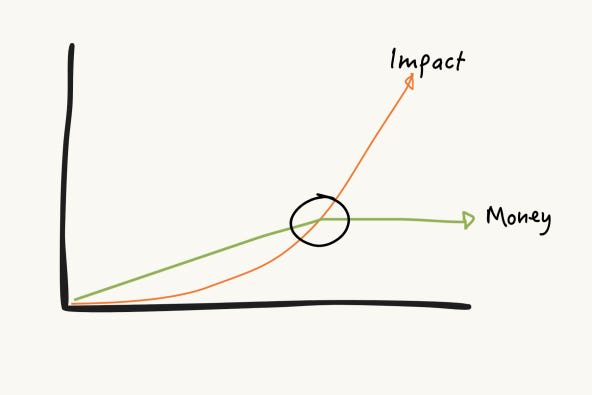
So we better make sure our interventions are really worth the government paying for.
All this said, I’m convinced that scale through government can be be the best path for many great ideas. If you work in government and are up for a chat about getting good healthcare to remote places, please do slip into my DMs!


I think the discussion about how we should think about working with governments is very important. Thanks for sharing your thoughts, Nick!