Note — I’m writing this in a personal capacity, and am not representing the views of my employer.
I’m interested in the EA red-teaming contest as an idea, and there are lots of interesting critiques I’d want to read. But I haven’t seen any of those written yet. I put together a big list of critiques of EA I’d be really interested in seeing come out of the contest. I personally would be interested in writing some of these, but don’t really have time to right now, so I am hoping that by sharing these, someone else will write a good version of them. I’d also welcome people to share other critiques they’d be excited to see written in the comments here!
I think that if someone wrote all of these, there are many where I wouldn’t necessarily agree with the conclusions, but I’d be really interested in the community having a discussion about each of them and I haven’t seen that discussion happen before.
If you want to write any of these, I’m happy to give brief feedback on it, or give you a bunch of bullet-points of my thoughts on them.
I agree that S-risks are more neglected by EA than extinction risks, and I think the explanation that many people associate S-risks with negative utilitarianism is plausible. I'm a regular utilitarian and I've reached the conclusion that S-risks are quite important and neglected, and I hope this bucks the perception of those focused on S-risks.
Two recent, related articles by Magnus Vinding that I enjoyed reading:
Strong upvote. My personal intuitions are suffering focused, but I’m currently convinced that I ought to do whatever evidential cooperation in large worlds (ECL) implies. I don’t know exactly what that is, but I find it eminently plausible that it’ll imply that extinction and suffering are both really, really bad, and s-risks, especially according to some of the newer, more extreme definitions, even more so.
Before ECL, my thinking was basically: “I know of dozens of plausible models of ethics. They contradict each other in many ways. But none of them is in favor of suffering. In fact, a disapproval of many forms of suffering seems to be an unusually consistent theme in all of them, more consistent than any other theme that I can identify.[1] Methods to quantify tradeoffs between the models are imprecise (e.g., moral parliaments). Hence I should, for now, focus on alleviating the forms of suffering of which this is true.”
Reducing suffering – in all the many cases where doing so is unambiguously good across a wide range of ethical systems – still strikes me as at least as robust as reducing extinction risk.
Some variation on universalizability, broadly construed, may be a contender.
I think I have a handful of critiques I want to make about EA that I am fairly certain would negatively impact my career to voice, even though I believe they are good faith criticisms, and I think engaging with them would strengthen EA.
This seems suboptimal, particularly if more people feel like that. But it does seem fixable: I'm up for receiving things like this anonymously at this link, waiting for a random period, rewording them using GPT-3, and publishing them. Not sure what proportion of that problem that would fix, though.
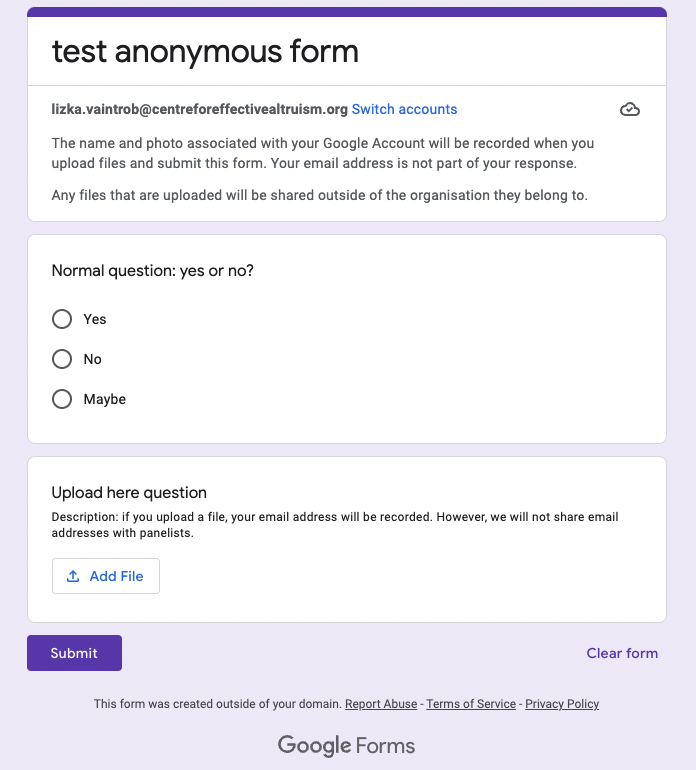
The criticism contest has an anonymous submission form too.
It's not anonymous, it records the name associated with your google account. (Of course you can just create a google account with a fake name, but then you can also just make an EA forum account with a fake name and post here.)
I believe this is just the confusing way that Google handles anonymous forms. It states the account you are currently using, but then has a parenthetical indicating that the information won't be shared.

Think that changed after Aleks commented
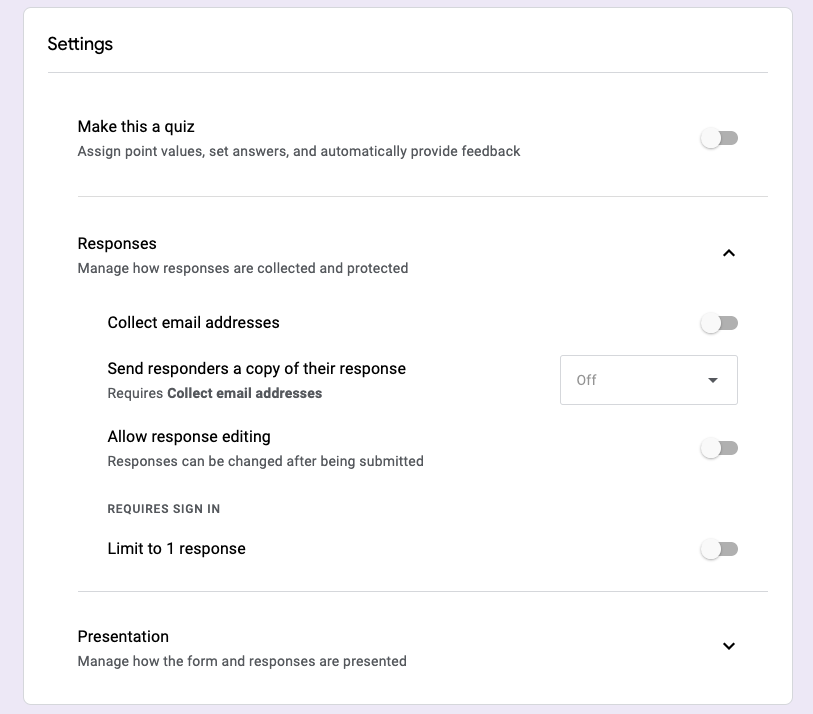
The issue was that we were letting people upload files as submissions. If you uploaded a file, your email or name would be shared (and we had a note explaining this in the description of the question that offered the upload option). Nearly no one was using the upload option, and if you didn't upload anything, your information wasn't shared.
Unfortunately, Google's super confusing UI says: "The name and photo associated with your Google account will be recorded when you upload files and submit this form. Your email is not part of your response," which makes it seem like the form is never anonymous. (See below.)
I removed the upload option today to reduce confusion, and hope people will just create a pseudonym or fake Google account if they want to share something that's not publicly accessible on the internet via link anonymously.
What the form looked like:

Here's what the settings for the test form look like:

Yeah I asked em to fix this
Yeah, I think that some percentage of this problem is fixable, but I think one issue is that there are lots of important critiques that might be made from a place of privileged information, and filling in a form will be deanonymizing to some extent. I think this is especially true when an actor's actions diverge from stated values/goals — I think many of the most important critiques of EA that need to be made come from actions diverging from stated values/goals, so this seems hard to navigate. E.g. I think your recent criminal justice reform post is a pretty good example of the kind of critique I'm thinking of, but there are ones like it based on actions that aren't public or at least aren't written up anywhere that seem really important to have shared.
Related to this, I feel like a lot of people in EA lately have expressed a sentiment that they have general concerns like the one I outlined here, but can't point to specific situations. One explanation for this is that their concerns aren't justified, but another is that people are unwilling to talk about the specifics.
That being said, I think the anonymous submission form is really helpful, and glad it exists.
For what its worth, I've privately been contacted more about about this particular critique resonating with people than any other in this post by a large degree, which suggests to me that many people share this view.
Someone suggested I should mention a few of the EA critiques I'm personally working on. I've only skimmed the comment so sorry if I've missed something relevant.
Three are of longtermism (and prospectively with funding support from the Forethought Foundation).
I've also got a 'red-team' of Open Philanthropy's cause prioritisation framework. That's written and should appear within a month.
On top of these, me and the team at HLI are generally doing research which starts with the assumption our cost-effectiveness analyses should directly measure the effects on people's subjective wellbeing (aka happiness) and see how that could change our priorities. Last week, we did a webinar with StrongMinds where I set out our work which found that treating depression in Africa is about 10x better than providing cash transfers (recording). More work in this vein to come too...
I also share sympathy with some of the other ones OP flags.
I'm looking forward to reading these critiques! A few thoughts from me on the person-affecting views critique:
Also maximizing expected choice-worthiness with intertheoretic comparisons can lead to fanaticism focusing on quantum branching actually increasing the number of distinct moral patients (rather aggregating over the quantum measure and effectively normalizing), and that can have important consequences. See this discussion and my comment.
Argue that we can have zero or virtually zero credence in total views
FWIW, I've comprehensively done this in my moral anti-realism sequence. In the post Moral Realism and Moral Uncertainty Are in Tension, I argue that you cannot be morally uncertain and a confident moral realist. Then, in The "Moral Uncertainty" Rabbit Hole, Fully Excavated, I explain how moral uncertainty works if it comes with metaethical uncertainty and I discuss wagers in favor of moral realism and conditions where they work and where they fail. (I posted the latter post on April 1st thinking people would find it a welcome distraction to read something serious next to all the silly posts, but it got hardly any views, sadly.) The post ends with a list of pros and cons for "good vs. bad reasons for deferring to (more) moral reflection." I'll link to that section here because it summarizes under which circumstances you can place zero or virtually zero credence in some view that other sophisticated reasoners consider appealing.
On 3, I actually haven't read the paper yet, so should probably do that, but I have a few objections:
When it comes to comparisons of values between PAVs and total views I don't really see much of a problem as I'm not sure the comparison is actually inter-theoretic. Both PAVs and total views are additive, consequentialist views in which welfare is what has intrinsic value. It's just the case that some things count under a total view that don't under (many) PAVs i.e. the value of a new life. So accounting for both PAVs and a total view in a moral uncertainty framework doesn't seem too much of a problem to me.
What about genuine inter-theoretic comparisons e.g. between deontology and consequentialism? Here I'm less sure but generally I'm inclined to say there still isn't a big issue. Instead of choosing specific values, we can choose 'categories' of value. Consider a meteor hurtling to earth destined to wipe us all out. Under a total view we might say it would be "astronomically bad" to let the meteor wipe us out. Under a deontological view we might say it is "neutral" as we aren't actually doing anything wrong by letting the meteor wipe us out (if you have a view that invokes an act/omission distinction). So what I'm doing here is assigning categories such as "astronomically bad", "very bad", "bad", "neutral", "good" etc. to acts under different ethical views - which seems easy enough. We can then use these categories in our moral uncertainty reasoning. This doesn't seem that arbitrary to me, although I accept it may still run into issues.
PAVs and total views are different theories, so the comparisons are intertheoretic, by definition. Even if they agree on many rankings (in fixed population cases, say), they do so for different reasons. The value being compared is actually of a different kind, as total utilitarian value is non-comparative, but PA value is comparative.
So what I'm doing here is assigning categories such as "astronomically bad", "very bad", "bad", "neutral", "good" etc. to acts under different ethical views - which seems easy enough.
These vague categories might be useful and they do seem kind of intuitive to me, but
Some of the above objections are similar to those in this chapter by MacAskill, Bykvist and Ord, and the book generally.
About the non-identity problem: Arden Koehler wrote a review a while ago about a paper that attempts to solve it (and other problems) for person-affecting views. I don't remember if I read the review to the end, but the idea is interesting.
About the correct way to deal with moral uncertainty: Compare with Richard Ngo's comment on a recent thread, in a very different context.
The fact that everyone in EA finds the work we do interesting and/or fun should be treated with more suspicion.
I know that "everyone" was an intentional exaggeration, but I'd be interested to see the actual baseline statistics on a question like "do you find EA content interesting, independent of its importance?"
Personally, I find "the work EA does" to be, on average... mildly interesting?
In college, even after I found EA, I was much more intellectually drawn to random topics in psychology and philosophy, as well as startup culture. When I read nonfiction books for fun, they are usually about psychology, business, gaming, or anthropology. Same goes for the Twitter feeds and blogs I follow.
From what I've seen, a lot of people in EA have outside interests they enjoy somewhat more than the things they work on (even if the latter takes up much more of their time).
*****
Also, as often happens, I think that "EA culture" here may be describing "the culture of people who spend lots of time on EA Twitter or the Forum", rather than "the culture of people who spend a lot of their time on EA work". Members of the former group seem more likely to find their work interesting and/or fun; the people who feel more like I do probably spend their free time on other interests.
I think I agree with everything here, though I don't think the line is exactly people who spend lots of time on EA Twitter (I can think of several people who are pretty deep into EA research and don't use Twitter/aren't avid readers of the Forum). Maybe something like, people whose primary interest is research into EA topics? But it definitely isn't everyone, or the majority of people into EA.
the culture of people who spend lots of time on EA Twitter or the Forum
there's an EA Twitter?
Yeah I'd be figuring out homotopy type theory and figuring out personal curiosities like pre-agriculture life or life in early cities, maybe also writing games. That's probably 15% of my list of things I'd do if it wasn't for all those pesky suffering lives or that annoying crap about the end of the world.
EA is neglecting trying to influence non-EA organizations, and this is becoming more detrimental to impact over time.
+1 to this — it's something I've been thinking about quite a bit lately, and I'm happy you mentioned it.
I'm not convinced the EA community will be able to effectively solve the problems we're keen on tackling if we mainly rely on a (relatively) small group of people who are unusually receptive to counterintuitive ideas, especially highly technical problems like AI safety. Rather, we'll need a large coalition of people who can make progress on these sorts of challenges. All else equal, I think we've neglected the value of influencing others, even if these folks might not become highly active EAs who attend conferences or whatever.
Thanks for sharing! I'd also love to read some of these critiques more fleshed out! Really appreciate that you posted bullet point summaries instead of either holding off for a more developed critique or just posting a vague list without summaries 😀
Here are four more things that I’m somewhat skeptical of and would like someone with more time on their hands and the right brain for the topic to see whether they hold water:
A bit of a tangent, but:
Sometimes funders try to play 5d chess with each other to avoid funging each other’s donations, and this results in the charity not getting enough funding.
That seems like it could be a defection in a moral trade, which is likely to burn gains of trade. Often you can just talk to the other funder and split 50:50 or use something awesome like the S-Process.
But I’ve been in the situation where I wanted to make a grant/donation (I was doing ETG), knew of the other donor, but couldn’t communicate with them because they were anonymous to me. Hence I resorted to a bit of proto-ECL: There are two obvious Schelling points, (1) both parties each fill half of the funding gap, or (2) both parties each put half of their pre-update budget into the funding gap. Point 2 is inferior because the other party knows, without even knowing me, that more likely than not my donation budget is much smaller than half the funding gap, and because the concept of the funding gap is subjective and unhelpful anyway. Point 1 should thus be the compromise point of which it is relatively obvious to both parties that is should be obvious to both parties. Hence I donated half my pre-update budget.
There’s probably a lot more game theory that can be done on refining this acausal moral trade strategy, but I think it’s pretty good already, probably better than the status quo without communication.
This seems very much too strong to me:
Person-affecting views are interesting, but pretty much universally dismissed in the EA community
I consider myself part of the EA community and I do not dismiss PAV... I am very sympathetic to them. When I have presented these others have not been dismissive. They are usually at least mentioned as a potential important part of a balanced breakfast of moral uncertainty.
Some articles in the forum seem to be sticking up for PAV, by Michael St Jules and others:
Here, the author states:
Unfortunately, these views have largely been neglected in population ethics, at least in EA and plausibly in academia as well,[69] while far more attention has been devoted to person-affecting views.
(Love your post by the way)
Yeah that's fair - there are definitely people who take them seriously in the community. To clarify, I meant my comment as person-affecting views seem pretty widely dismissed in the EA funding community (though probably the word "universally" is too strong there too.).
+1 for S-risk. I was surprised by the lack of its discussion on 80k podcast.
Defending person-affecting views
I'm working on a piece on this. (It's only a "critique of longtermism" in the weak sense that I think some longtermist claims are overstated.) If someone is working on something similar or interested in giving feedback, please DM me!
I think that these factors might be making it socially harder to be a non-longtermist who engages with the EA community, and that is an important and missing part of the ongoing discussion about EA community norms changing.
This has felt very true for me!
I came across EA way back around 2011 when I was at university, pre-longtermism... EA at that point formalised a lot of my existing thinking/values and I made graduate career decisions in line with 80k advice at the time. I started getting more involved again about a year ago and was surprised to see how things had changed! I've been increasingly engaging over the past year (including starting an EA job), but have often felt a strong sense of disconnection, and have heard similar from colleagues and friends who have followed EA for a while.
How has this impacted my interactions? Well this is actually my first comment on any EA Forum post! As an example, I remember reading a post recently about 80k's updated view on climate change - it was almost entirely focused on whether it was an existential risk. That didn't seem right to me and I almost wrote a comment, but in the end I felt like I was just coming from such a different perspective that it wasn't worth it. I knew I hadn't done much longtermist reading and I felt like I'd get shot down.
Kudos to the EA criticism contest for getting me to engage with this disengagement, look more closely at my gut feeling against long-termism and work through more ideas and reading. I'm hoping I'll finding something useful to share as part of the contest - currently thinking it may be along the lines of trying to more eloquently express what I think gets missed when we simplify camps into "neartermism vs longtermism". I feel like "neartermist" EA aligns with some values (fairness? reduction of inequality?) that longtermist EA may not, but also that we can do more to evaluate near-term causes (or even just less obviously evaluable longterm causes) with longterm methods/thinking.
I think something you raise here that's really important is that there are probably fairly important tensions to explore between the worlds that having a neartermist view and longtermist view suggest we ought to be trying to build, and that tension seems underexplored in EA. E.g. an inherent tension between progress studies and x-risk reduction.
And, if there was a convincing version of a person-affecting view, it probably would change a fair amount of longtermist prioritization.
This is an interesting question in itself that I would love someone to explore in more detail. I don't think it's an obviously true statement. Two give a few counterpoints:
I’d really love to see a strong defense of person-affecting views, or a formulation of a person-affecting view that tries to address critiques made of them.
I'd point out this attempt which was well-explained in a forum post. There is also this which I haven't really engaged with much but seems relevant. My sense is that the philosophical community has been trying to formulate a convincing person-affecting view and has, in the eyes of most EAs, failed. Maybe there is more work to be done though.
I think a person-affecting approach like the following is promising, and it and the others you've cited have received little attention in the EA community, parhaps in part because of their technical nature: https://globalprioritiesinstitute.org/teruji-thomas-the-asymmetry-uncertainty-and-the-long-term/
I wrote a short summary here: https://www.lesswrong.com/posts/Btqex9wYZmtPMnq9H/debating-myself-on-whether-extra-lives-lived-are-as-good-as?commentId=yidnhcNqLmSGCsoG9
Human extinction in particular is plausibly good or not very important relative to other things on asymmetric person-affecting views, especially animal-inclusive ones, so I think we would see extinction risk reduction relatively deemphasized. Of course, extinction is also plausibly very bad on these views, but the case for this is weaker without the astronomical waste argument.
AI safety's focus would probably shift significantly, too, and some of it may already be of questionable value on person-affecting views today. I'm not an expert here, though.
Broad longtermist interventions don't seem so robustly positive to me, in case the additional future capacity is used to do things that are in expectation bad or of deeply uncertain value according to person-affecting views, which is plausible if these views have relatively low representation in the future.
Fair enough. I shouldn't really have said these broad interventions are robust to person-affecting views because that is admittedly very unclear. I do find these broad interventions to be robustly positive overall though as I think we will get closer to the 'correct' population axiology over time.
I'm admittedly unsure if a "correct" axiology even exists, but I do think that continued research can uncover potential objections to different axiologies allowing us to make a more 'informed' decision.
AI safety's focus would probably shift significantly, too, and some of it may already be of questionable value on person-affecting views today. I'm not an expert here, though.
I've heard the claim that optimal approaches to AI safety may depend on one's ethical views, but I've never really seen a clear explanation how or why. I'd like to see a write-up of this.
Granted I'm not as read up on AI safety as many, but I've always got the impression that the AI safety problem really is "how can we make sure AI is aligned to human interests?", which seems pretty robust to any ethical view. The only argument against this that I can think of is that human interests themselves could be flawed. If humans don't care about say animals or artificial sentience, then it wouldn't be good enough to have AI aligned to human interests - we would also need to expand humanity's moral circle or ensure that those who create AGI have an expanded moral circle.
I would recommend CLR's and CRS's writeups for what more s-risk-focused work looks like:
https://longtermrisk.org/research-agenda
https://www.alignmentforum.org/posts/EzoCZjTdWTMgacKGS/clr-s-recent-work-on-multi-agent-systems
https://centerforreducingsuffering.org/open-research-questions/ (especially the section Agential s-risks)
Yeah those are fair - I guess it is slightly less clear to me that adopting a person-affecting view would impact intra-longtermist questions (though I suspect it would), but it seems more clear that person-affecting views impact prioritization between longtermist approaches and other approaches.
Some quick things I imagine this could impact on the intra-longtermist side:
Yeah, I'm not actually sure that a really convincing person-affecting view can be articulated. But I'd be excited to see someone with a strong understanding of the literature really try.
I also would be interested in seeing someone compare the tradeoffs on non- views vs person-affecting. E.g. person affecting views might entail X weirdness, but maybe X weirdness is better to accept than the repugnant conclusion, etc.
Agreed—while I expect people's intuitions on which is "better" to differ, a comprehensive accounting of which bullets different views have to bite would be a really handy resource. By "comprehensive" I don't mean literally every possible thought experiment, of course, but something that gives a sense of the significant considerations people have thought of. Ideally these would be organized in such a way that it's easy to keep track of which cases that bite different views are relevantly similar, and there isn't double-counting.
Prioritization between x-risks that cause only human extinction vs extinction of all/most life on earth (e.g. wild animals).
There are also person-neutral reasons for caring more about the extinction of all terrestrial life vs. human extinction. (Though it would be very surprising if this did much to reconcile person-affecting and person-neutral cause prioritization, since the reasons for caring in each case are so different: direct harms on sentient life, versus decreased probability that intelligent life will eventually re-evolve.)
Perhaps some of these criticisms might be even more useful if they were framed as opportunities. For example:
I'm not sure if this matters much but I think it puts the focus on what can be done (e.g., what projects EA entrepreneurs could start), rather than on people feeling bad about what they already did and then defending it.
Yeah, I agree with this entirely. I think that probably most good critiques should result in a change, so just talking about doing that change seems promising.
I think in particular not working on insect farming over the last decade may come to be one of the largest regrets of the EAA community in the near future.
This is something that I find myself thinking about a lot. If you could wave a magic wand, what changes would you implement? I'm aware of Rethink's work to incubate the Insect Welfare Project - with that in mind, do you have any recommendations for other EAAs to help out with insect work in the meantime, even if this requires a large commitment (like starting a new org)? (I am aware of your past research on insects and that of other Rethink staff.)
Something to note - the other thing that keeps me up at night is whether the EAA movement is missing out on the impact from animal-inclusive longtermism, which is something else you've argued for and I agree with. I'm currently chatting to some people in that space about possible ways forward.
Right now the thing we are most interested in is finding a strong candidate to work on the Insect Welfare Project full-time: https://careers.rethinkpriorities.org/en/jobs/50511
Donations would also be helpful. This kind of stuff can be harder to find financial support for than other things in EA. https://rethinkpriorities.org/donate
>Something to note - the other thing that keeps me up at night is whether the EAA movement is missing out on the impact from animal-inclusive longtermism, which is something else you've argued for and I agree with. I'm currently chatting to some people in that space about possible ways forward.
Ren - I have also reached out to a few folks on this subject. Let's chat and see if there's some opportunity to collaborate here.
Thanks for writing this post, I think it raises some interesting points and I'd be interested in reading several of these critiques.
(Adding a few thoughts on some of the funding related things, but I encourage critiques of these points if someone wants to write them)
Sometimes funders try to play 5d chess with each other to avoid funging each other’s donations, and this results in the charity not getting enough funding.
I'm not aware of this happening very much, at least between EA Funds, Open Phil and FTX (but it's plausible to me that this does happen occasionally). In general I think that funders have a preference to just try and be transparent with each other and cooperate. I think occasionally this will stop organisations being funded, but I think it's pretty reasonable to not want to fund org x for project y given that they already have money for it from someone or take actions in this direction. I am aware of quite a few projects that have been funded by both Open Phil and FTX - I'm not sure whether this is much evidence against your position or is part of the 5d chess.
Sometimes funders don’t provide much clarity on the amount of time they intend to fund organizations for, which makes it harder to operate the organization long-term or plan for the future. Lots of EA funding mechanisms seem basically based on building relationships with funders, which makes it much harder to start a new organization in the space if you’re an outsider.
This is a thing I've heard a few times from grantees, I think there is some truth to it, although most funding applications that I see are time bounded anyway and we tend to just fund for the lifetime of specific projects or orgs will apply for x years worth of costs and we provide funding for that with the expectation that they will ask for more if they need it. If there are better structures that you think are easier to implement I'd be interested in hearing them, perhaps you'd prefer funding for a longer period of time conditional on meeting certain goals? I think relationships with funders can be helpful but I think it is relatively rarely the difference between people receiving funding and not receiving it within EA (although this is pretty low confidence). I can think of lots of people that we have decided against funding who have pretty good professional/personal relationships with funders. To be clear, I'm just saying that pre-existing relationships are NOT required to get funding and they do not substantially increase the chances of being funded (in my estimation).
Relatedly, it’s harder to build these relationships without knowing a large EA vocabulary, which seems bad for bringing in new people. These interactions seem addressable through funders basically thinking less about how other funders are acting, and also working on longer time-horizons with grants to organizations.
I think I disagree that the main issue is vocabulary, maybe there's cultural differences? One way in which I could imagine non EAs struggling to get funding for good projects is if they over inflate their accomplishments or set unrealistic goals as might be expected when applying to other funders, if probably think they had worse judgement than people who are more transparent about their shortcomings and strengths or worry that they were trying to con me in other parts of the application. This seems reasonable to me though, I probably do want to encourage people to be transparent.
Re funders brain drain
I'm not super convinced by this, I do think grantmaking is impactful and I'm not sure it's particularly high status relative to working at other EA orgs (e.g. I'd be surprised if people were turning down roles at redwood or Arc to work at OPP because of status - but maybe you have similar concerns about these orgs?). Most grantmakers have pretty small teams so it's plausibly not that big an issue anyway although I agree that if these people weren't doing grant making they'd probably do useful things elsewhere.
Thanks for the response!
RE 5d chess - I think I've experienced this a few times at organizations I've worked with (e.g. multiple funders saying, "we think its likely someone else will fund this, so are not/only partially funding it, though we want the entire thing funded," and then the project ends up not fully funded, and the org has to go back with a new ask/figure things out. This is the sort of interaction I'm thinking of here. It seems costly for organizations and funders. But I've got like an n=2 here, so it might just be chance (though one person at a different organization has messaged me since I posted this and said this point resonated with their experiences). I don't think this is intentional on funders part!
RE timelines - I agree with everything here. I think this is a tricky problem to navigate in general, because funders can have good reasons to not want to fund projects for extended periods.
RE vocabulary - cultural differences make sense as a good explanation too. I can think of one instance where I felt like this was especially noticeable - I encouraged a non-EA project I thought was promising to apply for funding, and they didn't get it. I pitched the funder on the project personally, and they changed their mind. There are obviously other factors at play here (e.g. maybe the funder trusted my judgement?), but I felt like looking at their application, it seemed like they just didn't express things in "EA terms" despite being pretty cool, and their application wasn't overly sensational or something.
RE brain drain - I agree with everything here. I think I'm more concerned about less prestigious but really promising organizations losing their best people, and that grantmaking in particular is a big draw for folks (though maybe there is a lot of need for talented grantmakers so this isn't a bad thing!).
I'm confused about whether I should note my disagreements here or just wait for someone to write the proper versions.
So I'll just note one that I really want to see: I was unpersuaded by this
Alternative models for distributing funding are probably better and are definitely under-explored in EA.
until I saw
Grantmakers brain-drain organizations — is this good?
Alternate funding models as a solution to the grantmaking bottleneck could be great!
Thanks, I found this list really interesting!
I think that these factors might be making it socially harder to be a non-longtermist who engages with the EA community, and that is an important and missing part of the ongoing discussion about EA community norms changing.
Although note that Will MacAskill supports lead elimination from a broad longtermist perspective:
Well, it’s because there’s more of a rational market now, or something like an efficient market of giving — where the marginal stuff that could or could not be funded in AI safety is like, the best stuff’s been funded, and so the marginal stuff is much less clear. Whereas something in this broad longtermist area — like reducing people’s exposure to lead, improving brain and other health development — especially if it’s like, “We’re actually making real concrete progress on this, on really quite a small budget as well,” that just looks really good. We can just fund this and it’s no downside as well. And I think that’s something that people might not appreciate: just how much that sort of work is valued, even by the most hardcore longtermists.
Also, how are you defining "longtermist" here? You seem to be using it to mean "focused on x-risk".
Definitely mostly using it to mean focused on x-risk, but most because that seems like the largest portion / biggest focus area for the community.
I interpret that Will MacAskill quote as saying that even the most hardcore longtermists care about nearterm outcomes (which seems true), not that lead reduction is supported from a longtermist perspective. I think it's definitely right that most longtermists I meet are excited about neartermist work. But I also think that the social pressures in the community currently still push toward longtermism.
To be clear, I don't necessarily think this is a bad thing - it definitely could be good given how neglected longtermist issues are. But I've found the conversation around this to feel somewhat like it is missing what the critics are trying to get at, and that this dynamic is more real than people give it credit for.
I want to echo all the interest in leftist critique (usually it reduces into something about colonialism, racism, or capitalism), but from the perspective that @JulianHazell brought up, i.e. of being able to reach a wider audience. I.e. at some point, EA needs to get better at representing itself in a nontechnical manner.
Btw, I'm writing from the perspective of someone who doesn't have a job in EA, but who sees a lot of leftist leanings in organizations that I'm a part of.
My personal experience is that I doubt a point-by-point rebuttal would change any minds/reach a broader audience, but it would serve to "reinforce the faith" of people in EA. This does precious little to get EA values out.
I guess what I'm getting to is not so much a critique of EA, but wanting to think critically about how EA should make itself more accessible. Instead of forcing other movements to speak EA language, EA also needs to learn how to speak other languages, or at least provide more accessible language that others can buy into.
If someone wants to work on this, let me know!
=====
Some other ideas informing me:
I would say that any outsider's (including leftists' objection to EA) is fundamentally tied to some of the most counterintutive aspects of EA:
The fact that everyone in EA finds the work we do interesting and/or fun should be treated with more suspicion.
I would like to agree with Aaron's comment and make a stronger claim - my impression is that many EAs around me in Israel, especially those coming from a strong technical background, don't find most direct EA-work very intellectually interesting or fun (ignoring its impact).
Speaking for myself, my background is mostly in pure math and in cyber-security research / software engineering. Putting aside managerial and entrepreneurial roles, it seems to me that most of the roles in EA(-adjacent) organizations open for someone with background similar to mine are:
Additionally, most of the roles are not available in Israel or open for remote work.
In fact, I think this is a point where the EA community misses many highly capable individuals who could otherwise do great work, if we had interesting enough roles for them.
That's interesting and makes sense — for reference I work in EA research, and I'd guess ~90%+ of the people I regularly engage with in the EA community are really interested / excited about EA ideas. But that percentage is heavily influenced by the fact that I work at an EA organization.
Yeah, that makes sense, and is fairly clear selection bias. Since here in Israel we have a very strong tech hub and many people finishing their military service in elite tech units, I see the opposite selection bias, of people not finding too many EA (or even EA-inspired) opportunities that are of interest to them.
I failed to mention that I think your post was great, and I would also love to see (most of) these critiques flashed out.
a moral realism that seems somewhat popular in the EA space
Could you say more about this? (My anecdata suggest that EAs typically embrace anti-realism)
Also, moral realism seems more predictive of ethics being consistent, not less. (Not consistent with our unreflected intuitions, though.)
My spouse shared this view when reading a draft of this post, which I found interesting because my intuitions went somewhat strongly the other way.
I don't really have strong views here, but it seems like are three possible scenarios for realists:
And in 2/3 of those, this problem might exist, so I leaned toward saying that this was an issue for realists.
There is a defense of ideas related to your position here that I didn't find it particularly compelling personally.
There is a defense of ideas related to your position here
For the record I also don't find that post compelling, and I'm not sure how related it is to my point. I think you can coherently think that the moral truth is consistent (and that ethics is likely to not be consistent if there is no moral truth), but be uncertain about it. Analogously I'm pretty uncertain what the correct decision theory is, and think that whatever that decision theory is, it would have to be self-consistent.
Yeah that makes sense to me. To be clear, the fact that two smart people have told me that they disagree with my sense that moral realism pushes against consistency seems like good evidence that my intuitions shouldn't be taken too strongly here.
I'd be interested in a survey on this.
My impression is that realism isn't a majority view among EAs, but is way higher than the general non-religious public / greater tech and policy communities that lots of EAs come out of.
Though I think this is something I want to see critiqued regardless of realist-ness.
Alternative models for distributing funding are probably better and are definitely under-explored in EA
I’m particularly optimistic about “impact markets” here, where you get:
That model promises to greatly cut down on the work that funders have to do, and separates the concern “priorities research” or “What does success look like?” from the concern “due diligence” or “What sort of author or entrepreneur is likely to achieve such success and how to find them?”
The SFF is using a similar system internally.
Fittingly, we, Good Exchange, have received funding through the FTX Regrantor Program and are running our first MVP here.
Note that we started Good Exchange because we were already optimistic about this approach, and that it’s likely the most impactful thing that we can do with our time.
Some other solution concepts that come to mind:
What about critiques that you or another EA might not love but needs to read?
The intra-EA jargon is strong with this one, young padawan(s).
Something I personally would like to see from this contest is rigorous and thoughtful versions of leftist critiques of EA, ideally translated as much as possible into EA-speak. For example, I find "bednets are colonialism" infuriating and hard to engage with, but things like "the reference class for rich people in western countries trying to help poor people in Africa is quite bad, so we should start with a skeptical prior here" or "isolationism may not be the good-maximizing approach, but it could be the harm-minimizing approach that we should retreat to when facing cluelessness" make more sense to me and are easier to engage with.
That's an imaginary example -- I myself am not a rigorous and thoughtful leftist critic and I've exaggerated the EA-speak for fun. But I hope it points at what I'd like to see!
Strong upvote. I'm a former leftist and I've got a soft spot for a few unique ideas in their memeplex. I read our leftist critics whenever I can because I want them to hit the quality target I know the ideas are worth in my mind, but they never do.
If anyone reading this knows leftist critics that you think have hit a reasonable quality bar or you want to coauthor a piece for the contest where we roleplay as leftists, DM me on the forum or otherwise hit me up.
I consider myself a current leftist, and I honestly don't have a big "leftist critique of ea". Effective altruism seems uncomplicatedly good according to all the ideas I have that I consider "leftist", and leftism similarly seems good according to all the ideas that I consider EA.
Effective altruists as individuals aren't always radical leftist of course, though they are pretty much all left of center. If you press me to come up with criticisms of EA, I can think of harmful statements or actions made by high profile individuals to critique, I guess, though idk if that would be useful to anyone involved. I can also say that the community as a whole doesn't particularly escape the structural problems and interpersonal prejudices found in larger society - but it's certainly not any worse than larger society. Also EA organizations, are not totally immune to power and corruption and internal politics and things like that, these things could be pointed out too. What I am saying is, effective altruists and institutions aren't immune from things like racism and sexism and stuff like that. But that's true of most people and organizations, including leftist ones. But there's nothing that un-leftist about effective altruism, the ideology.
If the whole idea is that you're impartially treating everyone equally and doing the most you can to help them then that's... almost tautologically and by definition, good, from almost all reasonable political perspectives, leftist or otherwise? I think you really gotta make some stronger and more specific claims which touch upon a leftist angle, if you want someone to refute them from a leftist angle.
Hey, I've written up a post along these lines. If you're still interested: https://forum.effectivealtruism.org/posts/oD3zus6LhbhBj6z2F/red-teaming-contest-demographics-and-power-structures-in-ea
I definitely agree with this. Here are a bunch of ideas that are vaguely in line with this that I imagine a good critique could be generated from (not endorsing any of the ideas, but I think they could be interesting to explore):
I think that one issue is that lots of the left just isn't that utilitarian, so unless utilitarianism itself is up for debate, it seems hard to know how seriously people in the EA community will take lefty critiques (though I think that utilitarianism is worth debating!). E.g. "nobody's free until everyone is free" is fundamentally not a utilitarian claim.
Minor nitpick: "nobody's free until everyone is free" is precisely a (negative) utilitarian claim (albeit with unusual wording)
That doesn't seem quite right - negative utilitarians would still prefer marginal improvements even if all suffering didn't end (or in this case, a utilitarian might prefer many become free even if all didn't become free). The sentiment is interesting because it doesn't acknowledge marginal states that utilitarians are happy to compare against ideal states, or worse marginal states.
Got it, I think you're quite right on one reading. I should have been clearer about what I meant, which is something like
E.g. imagine a minor steelification (which loses the aesthetic and rhetorical strength) like "nobody's positive wellbeing (implicitly stemming from their freedom) can/should be celebrated until everyone has freedom (implicitly necessary to escape negative wellbeing)" which is consistent with some kind of lexical negative utilitarianism.
You're right that if we insist that 'freedom' be interpreted identically in both places (parsimonious, granted, though I think the symmetry is better explained by aesthetic/rhetorical concerns) another reading explicitly neglects the marginal benefit of lifting merely some people out of illiberty. Which is only consistent with utilitarianism if we use an unusual aggregation theory (i.e. minimising) - though I have also seen this discussed under negative utilitarianism.
Anecdata: as someone whose (past) political background and involvement (waning!) is definitely some kind of lefty, and who, if it weren't for various x- and s-risks, would plausibly consider some form (my form, naturally!) of lefty politics to be highly important (if not highly tractable), my reading of that claim at least goes something like the first one. I might not be representative in that respect.
I have no doubt that many people expressing that kind of sentiment would still celebrate marginal 'releases', while considering it wrong to celebrate further the fruits of such freedom, ignoring others' lack of freedom.
That makes sense to me.
Yeah, I definitely think that also many people from left-leaning spaces who come to EA also become sympathetic to suffering focused work in my experience, which also seems consistent with this.
For onlookers I want to point out that this doesn't read as leftist criticism.
This is very close (almost identical) to what classical conservatives say:
From:
This seemed to confuse Julia Wise too, and she's really smart.
I think the vocabulary is not fully separable from the ideology. As the latter evolves, I'd expect changes to be required in the former.
And for what it's worth, all the versions you gave are equally intellectually challenging for me to understand. The jargon is easier for some people but harder for others, most importantly to outsiders. This also means it's unfair to expect outsiders to voice their views in insider-speak.
Would you be interested in outside, non-EAs doing leftist critique? And if so, how would you convince them to participate by asking them to conform to our vocabulary? I am asking as I think that some of the best people to make a thoughtful critique of EA are placed in academia. If that is true, they would be much more interested in critiquing us if they are allowed to publish. And to publish there is a strong desire to "engage with and build on existing literature and thought in the field," meaning they want to draw on academic work on international aid, decolonialism, philanthropy, etc.
Maybe something along the lines of: Thinking in terms of individual geniuses, heroes, Leviathans, top charities implementing vertical health interventions, central charity evaluators, etc. might go well for a while but is a ticking time bomb because these powerful positions will attract newcomers with narcissistic traits who will usurp power of the whole system that the previous well-intentioned generation has built up.
The only remedy is to radically democratize any sort of power, make sure that the demos in question is as close as possible to everyone who is affected by the system, and build in structural and cultural safeguards against any later attempts of individuals to try to usurp absolute power over the systems.
But I think that's better characterized as a libertarian critique, left or right. I can’t think of an authoritarian-left critique. I wouldn’t pass an authoritarian-left intellectual Turing test, but I have thought of myself as libertarian socialist at one point in my life.
I'm in favor of good leftist criticism and there isn't any arch subtext here:
I'm a little worried that left criticism is going to just wander into a few stale patterns:
It would be very interesting to see a highly sophisticated (on multiple levels) leftist criticism EA.
I'm aware "bed nets are colonialism" is kind of barely a strawman of some of the shallowest criticisms of EA from the political left but is that the literal equivalent of any real criticism you've seen?
Also strong upvote. I think nearly 100% of the leftist critiques of EA I've seen are pretty crappy, but I also think it's relatively fertile ground.
For example, I suspect (with low confidence) that there is a community blindspot when it comes to the impact of racial dynamics on the tractability of different interventions, particularly in animal rights and global health.[1] I expect that this is driven by a combination of wanting to avoid controversy, a focus on easily quantifiable issues, the fact that few members of the community have a sociology or anthropology background, and (rightly) recognising that every issue can't just be boiled down to racism.
See, for eg, my comment here.