This policy does not apply to anything posted before this post's time of publication. This is version 2 of our LLM policy, updated July 3, 2026.
New policy:
Why this update?
Since we began the manual disclosure policy, we have seen over-disclosure — users who didn’t use AI, or used it in research writing unnecessary disclosures — and lots of subtle under-disclosure (low effort AI generated posts beginning with a disclosure claiming that the author substantially edited and endorses the post).
During this period, mods have been using an internal Pangram scan to adjudicate whether disclosure is necessary, and it has been remarkably accurate.
As such, we’re going to try out automatically labelling posts based on their Pangram score. So that we don’t have to rely on Pangram being or remaining completely accurate, we will be assigning labels based on score bands rather than precise scores. Specifically, the categories are:
- No label,
- ‘Partly AI-written’,
- ‘Mostly AI-written’,
- ‘~Entirely AI Written’.
We’ve currently set the boundaries such that I’d expect some underreporting (i.e. some posts which include a small amount of AI writing will not be labelled). We can adjust this if it isn't working.
If you want to check on how your post will be labelled while drafting, click 'save as draft' while editing a post, wait a few seconds, and Pangram will run automatically.
As always, give us feedback in the comments or in dms!
How to dispute
If your post is labelled as AI-written and you disagree, you may want to dispute the categorisation. The best way to do so is to contact the moderation team on forum-moderation [at] effectivealtruism [dot] org, or to report your own post (click 'Report' in the three dot menu on the post page, with an explanation).
Everything below is ~identical to version 1 of this policy.
General reasoning
This policy represents a decision not to go for an authoritarian or a laissez-faire option to LLM-generated text.
The authoritarian option would be to ban LLM-generated text. To find a good text detector and to remove from the Frontpage all posts which contain generated text.
A laissez-faire option would be to allow LLM-generated text and hope that the forces of karma, upvotes, and downvotes would take care of the low-quality content that would likely result.
Both options are flawed. Taking the authoritarian route, and banning all LLM text is flawed because some writers find LLMs very helpful for getting their ideas across, and some readers don't mind reading LLM-generated text.
The laissez-faire option is flawed because LLM-generated writing is increasingly difficult to detect. There are posts (I've seen a lot of these) which have the form of a good quality post which is worth reading, but on closer analysis turn out not to contain any ideas, or just to contain a couple of bullet points' worth of ideas, surrounded by a lot of fluff and repetition. This leads to quite a large waste of time for the reader.
We're opting for what I'd call the 'liberal' option. We'll discourage LLM generated content by lowering the visibility of low quality posts and enforcing disclosure of LLM use, but we'll ultimately be leaving the decision of whether to read LLM-generated content down to the Forum audience.
LessWrong is doing something reasonably similar, but with some caveats. Under their new policy, AI-written text must be published within labelled sections in a post. Our policy is therefore a chunk less onerous. I see our policies a little like this:
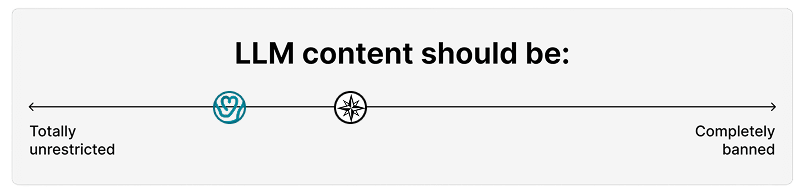
We're trying to have the best of both worlds, and I hope that we can. However, if it turns out that increasing amounts of content on the Forum is low-effort AI slop, or if valued authors find the Forum increasingly less valuable because of AI generated content, we are prepared to change our policy.
Good and bad uses of LLMs
Note that this section goes slightly beyond our policy, and into what we'd like to promote/discourage. Treat these as strong recommendations, rather than laws.
Examples of recommended use of LLMs
- A user uses an LLM to track down statistics on laws about gestation crates by country. They check the sources provided by the LLM, conclude that the statistics are accurate, and reference them in their post.
- A user sends a draft of a forum post to an LLM asking it for feedback. They make edits to their post in response to its feedback.
- A user who speaks English non-natively sends a draft of a forum post to an LLM asking it to correct any grammatical issues, and corrects the grammatical issues it raised.
- Alternatively, they allow the LLM to redraft their post, but include a note at the top of their post explaining that they have done so.
- A user creates a post discussing evaluation awareness in LLMs, in which they include several quotes from LLMs that appear to indicate evaluation awareness.
- A user has an idea for a forum post, then co-writes it with an LLM, turning a verbal mind-dump into bullet points, into an essay, into bullets again, etc… It turns out good.
Examples of discouraged use of LLMs
- A user wants to grow their reputation on the forum, so they feed popular forum posts into an LLM and ask it to write a thoughtful reply. This would lead to a ban under our existing rules against spam.
- A user sends a list of bullet points to an LLM, asks the LLM to write a post based on their outline, and posts the content to the EA forum without making any edits. The post is bad. This post would be moved to personal blog.
- A user uses an LLM to track down statistics on laws about gestation crates by country, but makes no effort to verify whether the information provided by the LLM is accurate.
As always, if you have any questions about our forum norms, feel free to contact the moderation team. Also, you are very welcome to share feedback on this policy below. I'm open to changing the policy if you change my mind.
PS - Thanks to the entire moderation and facilitation team for multiple rounds of feedback and discussion about this policy, and especially to @Francis for writing the first draft. Thanks to @Sarah Cheng 🔸, @Agnes Hasselblad 🔸, and @Ollie Etherington for takes on the second draft, and to Ollie in particular for building the automated feature.

Disclosure is a reasonable idea, but mandating it at the top is awful, because the first line of a essay generally should be a hook, or convey the most information about the essay (after the title, anyways; especially because EA Forum doesn't have a subtitle the way eg Substack does).
I would recommend allowing the author to put the disclosure anywhere in their essay. After the intro section might be a more natural place, or at the bottom similar to acknowledgements.
I disagree - disclosure is for the benefit of the reader, not the author[1]. If the reader had to read half a post, or even an entire post, before they were told they were reading LLM-generated text, they might be wasting quite a lot of time and attention.
We'll see how this shakes out in practice though. If it proves too costly for authors of good quality posts which are LLM-assisted, we can always reconsider.
Though we don't want disclosure to be too onerous, which is why it is currently just text rather than the callout boxes LessWrong is using.
I agree disclosure is for the benefit of the reader - I'm saying that, as a reader, I disprefer having to skip through a sentence at the top of many new posts disclaming that they used LLMs for copy editing and feedback.
I think the main thing I care about is "were large sections of this written directly by LLM" which I would prefer as first sentence so I know when to not read (which is actually the policy as written here, though I only realized that as of writing this comment). But -- it appears that the default warning box has started scaring people into disclosing all forms of LLM usage at the top of essays, which I argue is a bad norm.
I wonder if the disclosures could be non-text by default -- e.g. colour-coded with an optional footnote for details.
The thing I'm not liking as a reader is having words to process on this stuff at the start (for me this isn't just cases where people aren't following policy; I've felt it some about a case where the words were one of the suggested wordings from the policy). Non-text ways to signal could potentially get best-of-both-worlds in terms of reader attention.
Hmm yes - would it also work if it was a coloured callout you could get used to and ignore? I explicitly want newer users to know what the disclosures mean - i.e. a colour code without any text would be too esoteric.
Yeah I think that would be an improvement over the current behaviour. I'd still probably prefer something very short ("LLM usage: zero/minimal/moderate/major") which can be expanded if people want more texture.
From what I can see, the main issue here who writes the words, about how much LLMs are used in the process.
If most of the brainstorming, research and structuring was done by the LLM but you wrote the words yourself, from my perspective that wouldn't require any caveat at all. But if LLM's wrote half of the words than I would definitely want to know at the top of the post (and personally I probably wouldn't read it).
That's why it's so important that we get clear labelling. On this forum we should be able to choose whether or not to read something not written by a human. I would hope that only a minority of posts will have heavy LLM writing, so most posts won't need any disclosure at all.
I completely agree with @Austin that people shouldn't write anything if they use LLMs for feedback and copy editing - like he said they shouldn't have to under this policy. I have seen people stating doing that, but hopefully it will settle down when they realise it isn't necessary.
I don't understand why you put such a significance on the drafting of the material. Someone could have more problematic use of AI if they simply deferred to erroneous AI research findings and made a post in his/her own words. Someone could brainstorm and follow the erroneous reasoning of an AI and do so in human words. Conversely, AI could draft words where the research and reasoning is checked and the words to express the thoughts are iterated many times between human/AI to come to a very strong and clear method of expressing it.
Your drawing the line at drafting both does not capture many bad uses of AI and also captures many good or great uses of AI, in my view.
I think your perspective is reasonable here, it's just not what's important to me. Genuine unfiltered human interaction is important to me. Knowing that I'm talking with someone without an AI in between is important to me. If that's not important to you that's fine. This is important to me not only because I value true direct human interaction, but also (as a secondary problem) because I think AI writing is samey and boring. Maintaining a public writing space with true diversity, quirkiness and strong voices is part of what drives engagement and excitement.
When I see your name on something, I want it to be 100% your voice and your words like we are talking in a public space. Or at the very least I want you to tell me if it's not. If you're not concerned with that, then we have a fundamental almost axiomatic difference about what matters in a forum like this. I think that's part of the reason why there's a bit of a chasm between our views, and those who are happy with AI writing things. The quality of ideas and reasoning is only half of what matters for me. The other half is the discussion and interaction between us - the mingling of our minds. I'm not sure we can resolve this difference. If you genuinely don't mind who's "brain" words came from, and think that other's don't have the right to know that as well, that's reasonable but we may have fundamentally different beliefs.
A human or an AI could do good or bad research, I'm less concerned with that. Karma will sort that out. Karma can't answer the human interaction question above. We can discern from outside whether an argument is good or not. We can't discern from outside whose words they are - that's why we need the start-of-post disclosure at the very least (I would go further). An analogy might be if someone did a bunch of research for you and sent it to you, and then you used half of their words in your post. Ignoring the plagiarism element, that wouldn't be you talking with me it would be someone else which would be dishonest - unless you said "hey this article is half my research assistant's words and half mine).
I think as a human I have the right to know who I'm interacting with.
We updated the policy in a way that you guys might both like :) We're using Pangram to assign a label, and there is no longer any need for manual disclosure.
Thanks both for your thoughts! (This won't be exactly what either of you had in mind, but I'm sure your feedback fed into it).
Yep, that's different. I've only seen one example of this so far, but if it continues it's probably just a design issue we can tweak (i.e. maybe the copy isn't clear enough on the post-page).