It's Marginal Funding Week! In order to help us all make better donation decisions this giving season, organisations will be sharing what they would be able to do with extra funding.
If your project is fundraising, consider writing a full post tagged "Marginal Funding Week" or answering below. If your project would like to take part in the Donation Election (beginning next week) posting with the tag or answering this question are pre-requisites[1].
What to include in your response:
* The name of the project, and your role in relation to it.
* A description of how your project is likely to use extra donations.
* Any other information which might help readers understand the value of marginal donations: for example, if your organisation would be able to hire an assistant with the money, how much more productive would this make you? How would it affect the output of your intervention?
For Marginal Funding week inspiration, check out this google doc: "Writing a great marginal funding post", or last year's posts.
1. ^
The other requirements are here.
What would effective charities actually do with your money?
Highly effective charities will be sharing their 2026 funding plans throughout the week. Read their posts below and choose where to give, or donate to the Donation Election Fund and let the Effective Altruism Forum decide.
The Center for Wild Animal Welfare (CWAW) is a new policy advocacy organization, working to improve the lives of wild animals today and build support for wild animal welfare policy. We’re now fundraising for our first year, and the next $60,000 will be matched 1:1 by a generous supporter.
We’ve already started engaging policymakers on wild animal-friendly urban infrastructure (e.g. bird-safe glass). In 2026, we plan to keep engaging on urban infrastructure; start working on additional policy areas like fertility control and pesticide policy; and pursue agenda setting (e.g. publishing a State of Wild Animal Welfare Policy report).
Wild animal welfare is one of the world’s most important and neglected issues. Governments routinely make decisions that affect trillions of wild animals without considering their individual wellbeing. We want to change this: CWAW is one of the first organizations in the world dedicated to ensuring policymakers consider the individual welfare of wild animals. Our focus on near term policy will help wild animals now, and also build future support by proving that wild animal welfare is a legitimate and tractable policy concern.
CWAW is co-founded by Richard Parr MBE, a former policy adviser to the UK Prime Minister, and Ben Stevenson, a researcher with Animal Ask. It is fiscally sponsored by Rethink Priorities. We’re pleased to have the support of Wild Animal Initiative, the NYU Wild Animal Welfare Program, and Animal Ethics.
We’re now fundraising for our 2026 budget and a generous donor will 1:1 match the next $60,000 we raise. Marginal donations will make a real difference to the success of this project. If this donation opportunity feels like a good fit for you, then please consider donating or reaching out to us at team@wildanimalwelfare.org for more information. Tax-deductible donation options are available in a number of countries including the US, UK, Canada, Germany, Switzerland, and many others - please see the end of this post
Center for Wild Animal Welfare
To a first approximation, all farmed animals are bugs. (Recalling, of course, that shrimps is bugs.) We don’t know much about their needs in current production systems. The Arthropoda Foundation is trying to fix that. If we want to help the most numerous farmed animals, we have to answer some basic empirical questions. Arthropoda funds the scientists who provide those answers.
Good science isn’t cheap, fast, or flashy. But if we don’t fund it, we’re left guessing about the welfare of the most numerous animals on farms (and in the wild). The stakes are too high for guesswork.
This year, Arthropoda granted out ~$160K to fund seven studies. That’s seven studies for at least a trillion farmed animals. (And untold numbers of wild animals.)
We could easily grant out much more. And with a staff person, we could actively develop projects to support. But as it is, we’re at capacity.
In 2025, Arthropoda cost about $175K, over 90% of which went to grants. The rest covered costs associated with learning more about the state of the industry, running a small coordination event, and legal compliance with charitable regulations. We want to spend at least $205K in 2026. Currently, we’re about $55K short.
Anything toward that $55K is helpful. Anything beyond it means we can scale our grantmaking and field-building efforts. With additional funds, we could support two, three, or four times as many studies. With a part-time staff person (roughly $45K, all in), we could do more active grantmaking.
The elephant (beetle) in the room: Can these animals feel anything?
The question is fair: We have our doubts too. But just for a moment, consider the fruit fly. One research team denied them sleep and sex, finding anxiety-like states that were moderated by anti-anxiety medications. Another team inserted the human capsaicin receptor into fruit flies, laced their food with capsaicin, and then found that they starved to death instead of eating. A third burned them with a probe and discover
Arthropoda Foundation
Today we’re announcing a new cluster headache advocacy and research initiative: ClusterFree
Learn more about how you (and anyone) can help.
Our mission
ClusterFree’s mission is to help cluster headache patients globally access safe, effective pain relief treatments as soon as possible through advocacy and research.
Cluster headache (also known as ‘suicide headache’) is considered the most painful condition known to mankind. We believe it is one of the largest sources of preventable extreme suffering in humans today. Every year, about 3 million adults (and an unknown number of minors) suffer from this debilitating condition.
And yet, even in the EU, only 47% of the cluster headache population had unrestricted access to standard treatments (primarily oxygen and triptans) in 2019. Despite affecting a similar number of people as multiple sclerosis, global investment into cluster headache is minuscule.
At the same time, countless patients have reported previously unattainable relief using certain psychedelics, even at low doses. For example, psilocybin, LSD and 5-MeO-DALT can effectively prevent attacks, and N,N-DMT can abort attacks within seconds and also have some preventative effects. However, these life-saving treatments are inaccessible to the vast majority of patients.
We want to tackle these problems by:
* Publishing open letters demanding that governments, regulatory bodies, and medical associations worldwide take action immediately, with a focus on easing restrictions around psychedelic use.
* Providing patient groups with high-quality resources and supporting their advocacy efforts.
* Engaging with policymakers globally to advocate for better access to treatments.
* Publishing research on cluster headache and supporting other researchers in the field.
* Collaborating with entrepreneurs and philanthropists motivated to bring new, effective treatments to market.
About us
ClusterFree is a non-profit initiative incubated by the Qualia Research Insti
ClusterFree
Written as part of the EA Forum's Marginal Funding Week 2025.
Exec Summary
I believe there’s a popular perspective in EA that animal welfare organisations can't absorb much more funding — but I actually think there are ambitious megaprojects in the movement (and within Shrimp Welfare Project specifically) that could each absorb millions of dollars.
Shrimp Welfare Project doesn't have a funding gap, fortunately. I'm confident that by maintaining our current funding levels, we can continue to catalyse the future of shrimp welfare through cutting-edge research, collaborative corporate engagement, and farmer outreach. But, at the same time, I see real opportunities for large-scale funding to unlock exciting possibilities with exceptional impact, and I’m confident Shrimp Welfare Project is well-equipped to lead on them. We have concrete ideas that pave the way for new shrimp welfare solutions implemented across entire regions, potentially increasing our (Shr)Impact from our current ~4.5 billion per year to more than 100 billion shrimps per year, as soon as 2030.
Our Humane Slaughter Initiative (HSI) is already incredibly impactful, and the number of corporate partnerships in the program has essentially doubled each year since 2022. I believe there's potential for us to build on this momentum with ambitious projects that could absorb $5-10 million, allowing us to not just double the impact but 20x-ing it.
Over the next year, Shrimp Welfare Project is prepared to execute on groundbreaking initiatives and accelerate the industry’s adoption of humane slaughter. We will also utilise about 10% of donations to fund exploratory projects, so we can identify the most effective interventions beyond slaughter and continue to guide the industry towards the best welfare practices of the future.
We currently have the following priorities we’re pursuing into 2026:
* Expanding the Humane Slaughter Initiative
* Scaling up - Exploring ambitious opportunities to radically scale
Shrimp Welfare Project
We are the Centre for Enabling EA Learning and Research (CEEALAR) (formerly known as the ‘EA Hotel’).
Donate directly
TLDR
* Minimum critical need: £30k for essential roof repairs to prevent building damage.
* Full 2026 budget: £270k ($355k) to run operations, launch structured programs, and expand capacity
* What we do: Cost-effective residential incubator supporting ~20 EA researchers and entrepreneurs at a time, at half the cost of major cities. We're the only year-round space in EA where people can live, work, and be in community. We also host retreats and events for EA organizations.
* Recent wins: Thus far, 66 grantees in 2025 (+36% YoY), 106% productivity increase vs. the counterfactual, 89% say CEEALAR is more impactful than EAG.
* 2026 plans: Launch 3-month AI safety fellowship, host 2 hackathons, sign 5+ partner MOUs, build KPI infrastructure for impact measurement, extend runway and diversify funding, and complete infrastructure improvements.
Background: Why CEEALAR Exists and What it Does
The Gap in EA's Talent Pipeline
CEEALAR was founded in 2018 to address a gap in the EA talent and project pipeline. We believe there are many more altruistically minded, talented, and motivated individuals than are given the chance to develop and test their ideas. Funders sensibly optimize for legibility and track record, but this approach overlooks a significant number of high-potential people:
* Entrepreneurs building something early-stage that institutional funders are too risk-averse to support
* Career transitioners with raw talent but insufficient EA credentials
* Researchers with unconventional or pre-paradigmatic ideas that don't fit neatly into existing categories
Many of these people don't get rejected because they lack potential or good ideas – they get filtered out because they lack legibility. Many of them probably don’t even get to the point of seeking funding, as they expect they would be unsuccessful given their credentials or track rec
CEEALAR
Read the proposal as a visualized PDF here.
440 billion farmed shrimp, 85 billion chickens, 100 billion farmed fish. These are the staggering numbers of animals raised in factory farms each year—most suffer in systems where their welfare is an afterthought, if considered at all.
But 2025 proved that strategic grantmaking can change the fate of those animals. A single $28,500 grant helped ban cages for 270,000 hens in Slovenia. $290,000 in seed funding launched campaigns that secured welfare commitments for billions of shrimp from six major European retailers in just ten months. These demonstrates how pooled resources and rigorous grantmaking can unlock and amplify the impact of many activists.
The EA Animal Welfare Fund (AWF) just published our three-year grantmaking strategy at a crucial moment for animals around the world. Having deployed $4.2M across 45 grants in 2025 (with $2M more planned for Q4), we've identified high-impact opportunities that could help the most numerous yet most neglected animals. Our strategy aims to deploy at least $20M to proven and emerging interventions, but we face an $11.6M funding gap for 2026 that will determine whether these opportunities can be leveraged or remain unexplored.
This figure may seem daunting for an individual donor. But remember that AWF operates as a pooled fund, aggregating donations that together can fund more meaningful projects than individual donations could achieve alone. In such a model, every contribution—whether $100, $1,000, $100,000, or $1M—matters. When you contribute $5,000 and another donor gives $5,000, together you can fund a pilot program that could later scale and improve welfare standards for millions of animals. This pooling effect works at every level, turning individual donations into an opportunity for major impact.
This post details AWF grantmaking in 2025, shares concrete victories from our grantees that demonstrate our approach, and shows exactly how your contribution—whether $100 or
Animal Welfare Fund
I lead Forethought: we research how to navigate the transition to superintelligent AI, and then help people to address the issues we identify.
I think we might soon be funding constrained, in the sense that we’ll have more people that we’d like to hire than funding to hire them. (We’re currently in the middle of a hiring round. While we’re still evaluating candidates, we’ve been pleasantly pleased with our applicant pool, and we think that we might want to end up making offers to (or offering grants to) more people than we can currently fund.) If we end up in this situation, I think that marginal funding would (in expectation) lead to more good macrostrategy research.
You can see a bit more about the case for donating, budget, impact to date, and plans on our donate page and our 2025 fundraiser page. You can donate here.
Donations are tax-deductible for donors in the US, UK and the Netherlands. For more details on donation methods and tax-deductibility, see here.
Some quick FAQs:
Why haven’t other funders picked this up?
* Forethought has been evaluated and endorsed by Longview Philanthropy and Coefficient Giving (formerly Open Philanthropy), who are pitching us to donors in their network.
* Our work is pretty unusual, which means we’re mostly trying to raise money from highly-aligned private donors, who are not giving at a scale where they can easily fill our funding gap.
* That said, some of this information is new, so our current donors might be willing to give more, and new donors might chip in. You could be a part of that, though!
What sort of opportunity is this?
* I think that this style of work has a strong track record.
* I think we have a good team and we have made some significant research progress as well as influenced some important decisions.
* As mentioned, Forethought has been endorsed by both Longview and by Coefficient Giving. We also have some testimonials on our donate page, and I think most people who’ve seriously engaged with ou
Forethought
AMF has had a busy 12 months distributing 25.4 million nets to protect 46 million people.
In 2026 we will be distributing 69 million nets to protect 124 million people.
Our immediate funding gap currently stands at US$462 million and is for distributions in 2027 to 2029. More information here.
There are significant opportunities in front of our team of 15 and our partners to change health outcomes in a fundamental way for tens of millions of people.
One of the reasons for the size of the immediate funding gap is the shortfall in funding to major partners including The Global Fund, meaning gaps are significantly higher than all had hoped or expected.
We feel fortunate as an organisation to receive occasional individual donations of tens or hundreds of thousands of dollars or more. The occasional US$1 million donation allows us to protect close to a million people. However, our lifeblood is the many tens of thousands of donations we receive that are of US$2, £5, €10, NZD20, CHF30, AUD50 etc that underpin our work. No donation is too small as every US$2 matters and buys a net that protects two people when they sleep at night. All donations, given our immediate gap, are put to work straight away with each donor seeing exactly where the nets they fund are distributed with an ability to track their progress from manufacture, through shipping and in-country transport, to eventual distribution.
We hope the remainder of 2025 and all of 2026 will be a busy time for donations as we try and close as many funding gaps as we can to protect as many people as we can.
Thank you for reading this, and for your interest in what we do - Rob, CEO, AMF
More information: againstmalaria.com
AMF
TLDR:
* Rethink Priorities has room for more funding. With a core budget for 2026 of $7.5 million, we believe that we can productively use at least $9.3 million to scale high-leverage opportunities in our areas of global health and development, animal welfare, worldview investigations (including AI and digital minds), and surveys.
* Unrestricted funding is most valuable, as it enables the entire organization to run more efficiently, and allows us to act quickly on neglected or time-sensitive opportunities.
* We are advancing multiple new initiatives within the RP ecosystem:
* AI Strategy
* AI Cognition Initiative
* Interdisciplinary Research Hub
* GHD Research Subsidy Fund for EA ecosystem support
* Neglected Animals Project Fund and Neglected Animals Talent Program
* Open Philanthropy will match all unrestricted donations to our GHD work (up to $400K).
* Learn more about results and plans for each RP department.
Read a visualized summary of this post here.
Read this whole post as a visualized PDF here.
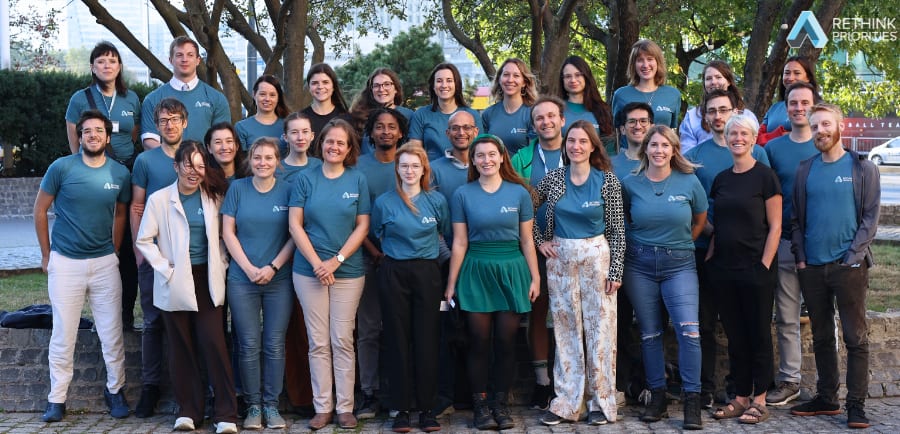
When Peter Wildeford and I, Marcus A. Davis, founded Rethink Priorities (RP) in 2018, we saw a gap in the charity landscape: too few organizations were providing the rigorous comparative analysis needed to allocate resources optimally. Seven years later, thanks to the trust and support of this community, RP has become one of the few research organizations pioneering work in areas that didn't exist as distinct fields when we began.
Since our early days, RP has grown into a think-and-do tank that combines careful analysis with practical action to make progress on global priorities. We think our comparative advantage lies in working upstream, and so aim to contribute where rigorous thinking and early, well-informed decisions can make a meaningful difference.
We've adopted a cross-cause perspective because we believe understanding trade-offs and connections between areas like animal welfare, global health, and longtermist priorities is importa
Rethink Priorities
ALLFED
Legal Impact for Chickens
Wild Animal Initiative
Sentinel
Animal Charity Evaluators
Amplify
The Snake Food Company
Respira Health
Vida Plena
The Humane League UK
Emerging Challenges Fund
Talos Network
ARMoR
THL
NOVAH
ACTRA
Lafiya
The Unjournal
Anneta Targalt
Humane and Sustainable Food Lab
Center for Reducing Suffering
FEM
One Acre Fund
Hive
Faunalytics
EAIF
EcoResilience Initiative
Aquatic Life Institute
Animal Ask
Compassion in World Farming
Animal Ethics
One for the World
Fortify Health
From Fauna
Center for Election Science
Development Media International
1Day Sooner
MSI Reproductive Choices
Strategic Alliances for a Viable Earth (SAVE)
Malaria Consortium
IDinsight
New Roots Institute
Dimagi