I recently resigned as Columbia EA President and have stepped away from the EA community. This post aims to explain my EA experience and some reasons why I am leaving EA. I will discuss poor epistemic norms in university groups, why retreats can be manipulative, and why paying university group organizers may be harmful. Most of my views on university group dynamics are informed by my experience with Columbia EA. My knowledge of other university groups comes from conversations with other organizers from selective US universities, but I don’t claim to have a complete picture of the university group ecosystem.
Disclaimer: I’ve written this piece in a more aggressive tone than I initially intended. I suppose the writing style reflects my feelings of EA disillusionment and betrayal.
My EA Experience
During my freshman year, I heard about a club called Columbia Effective Altruism. Rumor on the street told me it was a cult, but I was intrigued. Every week, my friend would return from the fellowship and share what he learned. I was fascinated. Once spring rolled around, I applied for the spring Arete (Introductory) Fellowship.
After enrolling in the fellowship, I quickly fell in love with effective altruism. Everything about EA seemed just right—it was the perfect club for me. EAs were talking about the biggest and most important ideas of our time. The EA community was everything I hoped college to be. I felt like I found my people. I found people who actually cared about improving the world. I found people who strived to tear down the sellout culture at Columbia.
After completing the Arete Fellowship, I reached out to the organizers asking how I could get more involved. They told me about EA Global San Francisco (EAG SF) and a longtermist community builder retreat. Excited, I applied to both and was accepted. Just three months after getting involved with EA, I was flown out to San Francisco to a fancy conference and a seemingly exclusive retreat.
EAG SF was a lovely experience. I met many people who inspired me to be more ambitious. My love for EA further cemented itself. I felt psychologically safe and welcomed. After about thirty one-on-ones, the conference was over, and I was on my way to an ~exclusive~ retreat.
I like to think I can navigate social situations elegantly, but at this retreat, I felt totally lost. All these people around me were talking about so many weird ideas I knew nothing about. When I'd hear these ideas, I didn't really know what to do besides nod my head and occasionally say "that makes sense." After each one-on-one, I knew that I shouldn't update my beliefs too much, but after hearing almost every person talk about how AI safety is the most important cause area, I couldn't help but be convinced. By the end of the retreat, I went home a self-proclaimed longtermist who prioritized AI safety.
It took several months to sober up. After rereading some notable EA criticisms (Bad Omens, Doing EA Better, etc.), I realized I got duped. My poor epistemics led me astray, but weirdly enough, my poor epistemics gained me some social points in EA circles. While at the retreat and at EA events afterwards, I was socially rewarded for telling people that I was a longtermist who cared about AI safety. Nowadays, when I tell people I might not be a longtermist and don't prioritize AI safety, the burden of proof is on me to explain why I "dissent" from EA. If you're a longtermist AI safety person, there's no need to offer evidence to defend your view.
(I would be really excited if more experienced EAs asked EA newbies why they take AI safety seriously more often. I think what normally happens is that the experienced EA gets super excited and thinks to themselves “how can I accelerate this person on their path to impact?” The naïve answer is to point them only towards upskilling and internship opportunities. Asking the newbie why they prioritize AI safety may not seem immediately useful and may even convince them not to prioritize AI safety, God forbid!)
I became President of Columbia EA shortly after returning home from the EAG SF and the retreat, and I'm afraid I did some suboptimal community building. Here are two mistakes I made:
- In the final week of the Arete Fellowship (I was facilitating), I asked the participants what they thought the most pressing problem was. One said climate change, two said global health, and two said AI safety. Neither of the people who said AI safety had any background in AI. If after Arete, someone without background in AI decides that AI safety is the most important issue, then something likely has gone wrong (Note: prioritizing any non-mainstream cause area after Arete is epistemically shaky. By mainstream, I mean a cause area that someone would have a high prior on). I think that poor epistemics may often be a central part of the mechanism that leads people to prioritize AIS after completing the Arete Fellowship. Unfortunately, rather than flagging this as epistemically shaky and supporting those members to better develop their epistemics, I instead dedicated my time and resources to push them to apply to EAG(x)'s, GCP workshops, and our other advanced fellowships. I did not follow up with the others in the cohort.
- I hosted a retreat with students from Columbia, Cornell, NYU, and UPenn. All participants were new EAs (either still completing Arete or just finished Arete). I think I felt pressure to host a retreat because "that's what all good community builders do." The social dynamics at this retreat were pretty solid (in my opinion), but afterwards I felt discontent. I had not convinced any of the participants to take EA seriously, and I felt like I had failed. Even though I knew that convincing people of EA wasn't necessarily the goal, I still implicitly aimed for that goal.
I served as president for a year and have since stepped down and dissociated myself from EA. I don't know if/when I will rejoin the community, but I was asked to share my concerns about EA, particularly university groups, so here they are!
Epistemic Problems in Undergraduate EA Communities
Every highly engaged EA I know has converged on AI safety as the most pressing problem. Whether or not they have a background in AI, they have converged on AI safety. The notable exceptions are those who were already deeply committed to animal welfare or those who have a strong background in biology. The pre-EA animal welfare folks pursue careers in animal welfare, and the pre-EA biology folks pursue careers in biosecurity. To me, some of these notable exceptions may not have performed rigorous cause prioritization. For students who converge on AI Safety, I also think it's unlikely that they have performed rigorous cause prioritization. I don't think this is that bad because cause prioritization is super hard, especially if your cause prioritization leads you to work on a cause you have no prior experience in. But, I am scared of a community that emphasizes the importance of cause prioritization yet few people actually cause prioritize.
Perhaps, people are okay with deferring their cause prioritization to EA organizations like 80,000 Hours, but I don't think many people would have the guts to openly admit that their cause prioritization is a result of deferral. We often think of cause prioritization as key to the EA project and to admit to deferring on one's cause prioritization is to reject a part of the Effective Altruism project. I understand that everyone has to defer on significant parts of their cause prioritization, but I am very concerned with just how little cause prioritization seems to be happening at my university group. I think it would be great if more university group organizers encourage their members to focus on cause prioritization. I think if groups started organizing writing fellowships where people focus on working through their cause prioritization, we could make significant improvements.
My Best Guess on Why AI Safety Grips Undergraduate Students
The college groups that I know best, including Columbia EA, seem to function as factories for churning out people who care about existential risk reduction. Here's how I see each week of the Arete (Intro) Fellowship play out.
- Woah! There's an immense opportunity to do good! You can use your money and your time to change the world!
- Wow! Some charities are way better than others!
- Empathy! That's nice. Let's empathize with animals!
- Doom! The world might end?! You should take this more seriously than everything we've talked about before in this fellowship
- Longtermism! You should care about future beings. Oh, you think that's a weird thing to say? Well, you should take ideas more seriously!
- AI is going to kill us all! You should be working on this. 80k told me to tell you that you should work on this.
- This week we'll be discussing WHAT ~YOU~ THINK! But if you say anything against EA, I (your facilitator) will lecture for a few minutes defending EA (sometimes rightfully so, other times not so much)
- Time to actually do stuff! Go to EAG! Go to a retreat! Go to the Bay!
I'm obviously exaggerating what the EA fellowship experience is like, but I think this is pretty close to describing the dynamics of EA fellowships, especially when the fellowship is run by an inexperienced, excited, new organizer. Once the fellowship is over, the people who stick around are those who were sold on the ideas espoused in weeks 4, 5, and 6 (existential risks, longtermism, and AI) either because their facilitators were passionate about those topics, they were tech bros, or they were inclined to those ideas due to social pressure or emotional appeal. The folks who were intrigued by weeks 1, 2, and 3 (animal welfare, global health, and cost-effectiveness) but dismissed longtermism, x-risks, or AI safety may (mistakenly) think there is no place for them in EA. Over time, the EA group continues to select for people with those values, and before you know it your EA group is now a factory that churns out x-risk reducers, longtermists, and AI safety prioritizers. I am especially fearful that almost every person who becomes highly engaged due to their college group is going to have world views and cause prioritizations that are strikingly similar to those who compiled the EA handbook (intro fellowship syllabus) and AGISF.
It may be that AI safety is in fact the most important problem of our time, but there is an epistemic problem in EA groups that cannot be ignored. I’m not willing to trade off epistemic health for churning out more excellent AI safety researchers (This is an oversimplification. I understand that some of the best AI researchers have excellent epistemics as well). Some acclaimed EA groups might be excellent at churning out competent AI safety prioritizers, but I would rather have a smaller, epistemically healthy group that embarks on the project of effective altruism.
Caveats
I suspect that I overestimate how much facilitators influence fellows' thinking. I think that the people who become highly engaged don't become highly engaged because their facilitator was very persuasive (persuasiveness is a smaller part); rather, people become highly engaged because they already had worldviews that mapped closely to EA.
How Retreats Can Foster an Epistemically Unhealthy Culture
In this section, I will argue that retreats cause people to take ideas seriously when they perhaps shouldn't. Retreats make people more susceptible to buying into weird ideas. Those weird ideas may in fact be true, but the process of buying into those weird ideas rests on shaky epistemics grounds.
Against Taking Ideas Seriously
According to LessWrong, "Taking Ideas Seriously is the skill/habit of noticing when a new idea should have major ramifications." I think taking ideas seriously can be a useful skill, but I'm hesitant when people encourage new EAs to take ideas seriously.
Scott Alexander warns against taking ideas seriously:
for 99% of people, 99% of the time, taking ideas seriously is the wrong strategy. Or, at the very least, it should be the last skill you learn, after you’ve learned every other skill that allows you to know which ideas are or are not correct. The people I know who are best at taking ideas seriously are those who are smartest and most rational. I think people are working off a model where these co-occur because you need to be very clever to resist your natural and detrimental tendency not to take ideas seriously. But I think they might instead co-occur because you have to be really smart in order for taking ideas seriously not to be immediately disastrous. You have to be really smart not to have been talked into enough terrible arguments.
Why Do People Take Ideas Seriously in Retreats?
Retreats are sometimes believed to be one of the most effective university community building strategies. Retreats heavily increase people's engagement with EA. People cite retreats as being key to their onramp to EA and taking ideas like AI safety, x-risks, and longtermism more seriously. I think retreats make people take ideas more seriously because retreats disable people's epistemic immune system.
- Retreats are a foreign place. You might feel uncomfortable and less likely to “put yourself out there." Disagreeing with the organizers, for example, “puts you out there." Thus, you are unlikely to dissent from the views of the organizers and speakers. You may also paper over your discontents/disagreements so you can be part of the in-group.
- When people make claims confidently about topics you know little about, there's not much to do. For five days, you are bombarded with arguments for AI safety, and what can you do in response? Sit in your room and try to read arguments and counterarguments so you can be better prepared to talk about these issues the next day? Absolutely not. The point of this retreat is to talk to people about big ideas that will change the world. There’s not enough time to do the due diligence of thinking through all the new, foreign ideas you’re hearing. At this retreat, you are encouraged to take advantage of all the networking opportunities. With no opportunity to do your due diligence to read into what people are confidently talking about, you are forced to implicitly trust your fellow retreat participants. Suddenly, you will have unusually high credence in everything that people have been talking about. Even if you decide to do your due diligence after the retreat, you will be fighting an uphill battle against your unusually high prior on those "out there" takes from those really smart people at the retreat.
Other Retreat Issues
- Social dynamics are super weird. It can feel very alienating if you don't know anyone at the retreat while everyone else seems to know each other. More speed friending with people you’ve never met before would be great.
- Lack of psychological safety
- I think it's fine for conversations at retreats to be focused on sharing ideas and generating impact, but it shouldn't feel like the only point of the conversation is impact. Friendships shouldn't feel centered around impact. It’s a bad sign if people feel that they will jeopardize a relationship if they stop appearing to be impactful.
- The pressure to appear to be “in the know” and send the right virtue signals can be overwhelming, especially in group settings.
- Not related to retreats but similar: sending people to the Bay Area is weird. Why do people suddenly start to take longtermist, x-risk, AI safety ideas more seriously when they move to the Bay? I suspect moving to the Bay Area has similar effects as going to retreats.
University Group Organizer Funding
University group organizers should not be paid so much. I was paid an outrageous amount of money to lead my university's EA group. I will not apply for university organizer funding again even if I do community build in the future.
Why I Think Paying Organizers May Be Bad
- Being paid to run a college club is weird. All other college students volunteer to run their clubs. If my campus newspaper found out I was being paid this much, I am sure an EA take-down article would be published shortly after.
- I doubt paying university group organizers this much is increasing their counterfactual impact much. I don't think organizers are spending much more time because of this payment. Most EA organizers are from wealthy backgrounds, so the money is not clearing many bottlenecks (need-based funding would be great—see potential fixes section).
- Getting paid to organize did not make me take my role more seriously, and I suspect that other organizers did not take their roles much more seriously because of being paid. I'd be curious to read the results of the university group organizer funding exit survey to learn more about how impactful the funding was.
Potential Solutions
- Turn the University Group Organizer Fellowship into a need-based fellowship. This is likely to eliminate financial bottlenecks in people's lives and accelerate their path to impact, while not wasting money on those who do not face financial bottlenecks.
- If the University Group Organizer Fellowship exit survey indicates that funding was somewhat helpful in increasing people's commitment to quality community building, then reduce funding to $15/hour (I’m just throwing this number out there; bottom line is reduce the hourly rate significantly). If the results indicate that funding had little to no impact, abandon funding (not worth the reputational risks and weirdness). I think it’s unlikely that the results of the survey indicate that the funding was exceptionally impactful.
I found an awesome community at Columbia EA, and I plan to continue hanging out with the organizers. But I think it’s time I stop organizing for the reasons outlined above. I plan to spend the next year focusing on my cause prioritization and building general competencies.

Hey,
I’m really sorry to hear about this experience. I’ve also experienced what feels like social pressure to have particular beliefs (e.g. around non-causal decision theory, high AI x-risk estimates, other general pictures of the world), and it’s something I also don’t like about the movement. My biggest worries with my own beliefs stem around the worry that I’d have very different views if I’d found myself in a different social environment. It’s just simply very hard to successfully have a group of people who are trying to both figure out what’s correct and trying to change the world: from the perspective of someone who thinks the end of the world is imminent, someone who doesn’t agree is at best useless and at worst harmful (because they are promoting misinformation).
In local groups in particular, I can see how this issue can get aggravated: people want their local group to be successful, and it’s much easier to track success with a metric like “number of new AI safety researchers” than “number of people who have thought really deeply about the most pressing issues and have come to their own well-considered conclusions”.
One thing I’ll say is that core researchers are often (but not always) much more uncertain and pluralist than it seems from “the vibe”. The second half of Holden Karnofsky’s recent 80k blog post is indicative. Open Phil splits their funding across quite a number of cause areas, and I expect that to continue. Most of the researchers at GPI are pretty sceptical of AI x-risk. Even among people who are really worried about TAI in the next decade, there’s normally significant support (whether driven by worldview diversification or just normal human psychology) for neartermist or other non-AI causes. That’s certainly true of me. I think longtermism is highly non-obvious, and focusing on near-term AI risk even more so; beyond that, I think a healthy EA movement should be highly intellectually diverse and exploratory.
What should be done? I have a few thoughts, but my most major best guess is that, now that AI safety is big enough and getting so much attention, it should have its own movement, separate from EA. Currently, AI has an odd relationship to EA. Global health and development and farm animal welfare, and to some extent pandemic preparedness, had movements working on them independently of EA. In contrast, AI safety work currently overlaps much more heavily with the EA/rationalist community, because it’s more homegrown.
If AI had its own movement infrastructure, that would give EA more space to be its own thing. It could more easily be about the question “how can we do the most good?” and a portfolio of possible answers to that question, rather than one increasingly common answer — “AI”.
At the moment, I’m pretty worried that, on the current trajectory, AI safety will end up eating EA. Though I’m very worried about what the next 5-10 years will look like in AI, and though I think we should put significantly more resources into AI safety even than we have done, I still think that AI safety eating EA would be a major loss. EA qua EA, which can live and breathe on its own terms, still has huge amounts of value: if AI progress slows; if it gets so much attention that it’s no longer neglected; if it turns out the case for AI safety was wrong in important ways; and because there are other ways of adding value to the world, too. I think most people in EA, even people like Holden who are currently obsessed with near-term AI risk, would agree.
As someone who is extremely pro investing in big-tent EA, my question is, "what does it look like, in practice, to implement 'AI safety...should have its own movement, separate from EA'?"
I do think it is extremely important to maintain EA as a movement centered on the general idea of doing as much good as we can with limited resources. There is serious risk of AIS eating EA, but the answer to that cannot be to carve AIS out of EA. If people come to prioritize AIS from EA principles, as I do, I think it would be anathema to the movement to try to push their actions and movement building outside the EA umbrella. In addition, EA being ahead of the curve on AIS is, in my opinion, a fact to embrace and treat as evidence of the value of EA principles, individuals, and movement building methodology.
To avoid AIS eating EA, we have to keep reinvesting in EA fundamentals. I am so grateful and impressed that Dave published this post, because it's exactly the kind of effort that I think is necessary to keep EA EA. I think he highlights specific failures in exploiting known methods of inducing epistemic ... untetheredness?
For example, I worked with CFAR where the workshops deliberately employed the same intensive atmosphere to get people to be receptive to new ways of thinking and being actually open to changing their minds. I recognized that this was inherently risky, and was always impressed that the ideas introduced in this state were always about how to think better rather than convince workshop participants of any conclusion. Despite many of the staff and mentors being extremely convinced of the necessity of x-risk mitigation, I never once encountered discussion of how the rationality techniques should be applied to AIS.
To hear that this type of environment is de facto being used to sway people towards a cause prioritization, rather than how to do cause prio makes me update significantly away from continuing the university pipeline as it currently exists. The comments on the funding situation are also new to me and seem to represent obvious errors. Thanks again Dave for opening my eyes to what's currently happening.
"what does it look like, in practice, to implement 'AI safety...should have its own movement, separate from EA'?"
Creating AI Safety focused Conferences, AI Safety university groups and AI Safety local meet-up groups? Obviously attendees will initially overlap very heavily with EA conferences and groups but having them separated out will lead to a bit of divergence over time
Wouldn't this run the risk of worsening the lack of intellectual diversity and epistemic health that the post mentions? The growing divide between long/neartermism might have led to tensions, but I'm happy that at least there's still conferences, groups and meet-ups where these different people are still talking to each other!
There might be an important trade-off here, and it's not clear to me what direction makes more sense.
I don’t think there’s much of a trade-off, I’d expect a decent proportion of AI Safety people to still be coming to EA conferences
I am all for efforts to do AIS movement building distinct from EA movement building by people who are convinced by AIS reasoning and not swayed by EA principles. There's all kinds of discussion about AIS in academic/professional/media circles that never reference EA at all. And while I'd love for everyone involved to learn about and embrace EA, I'm not expecting that. So I'm just glad they're doing their thing and hope they're doing it well.
I could probably have asked the question better and made it, "what should EAs do (if anything), in practice to implement a separate AIS movement?" Because then it sounds like we're talking about making a choice to divert movement building dollars and hours away from EA movement building to distinct AI safety movement building, under the theoretical guise of trying to bolster the EA movement against getting eaten by AIS? Seems obviously backwards to me. I think EA movement building is already under-resourced, and owning our relationship with AIS is the best strategic choice to achieve broad EA goals and AIS goals.
Or, the ideal form for the AI safety community might not be a "movement" at all! This would be one of the most straightforward ways to ward off groupthink and related harms, and it has been possible for other cause areas, for instance, global health work mostly doesn't operate as a social movement.
Global health outside of EA may not have the issues associated with being a movement, but it has even bigger issues.
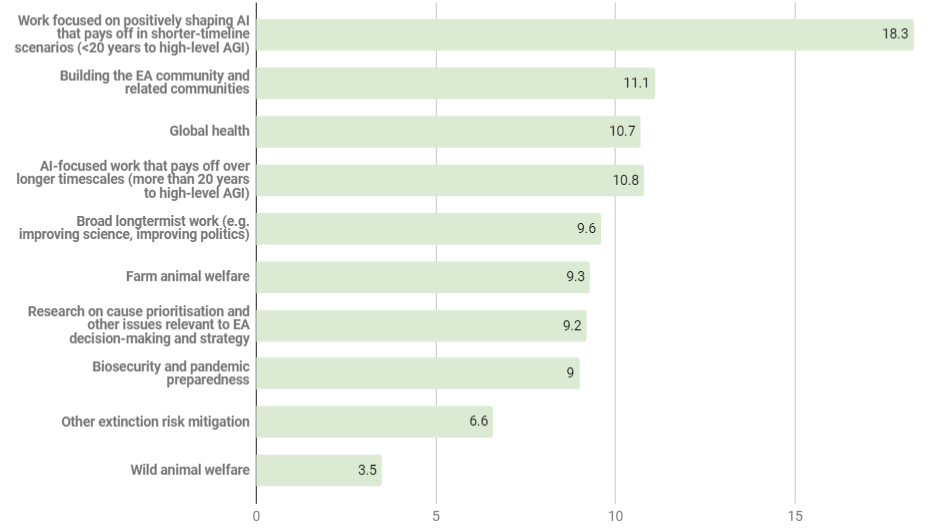
I wonder how this would look different from the current status quo:
To me this picture makes everything but AI safety already look like an afterthought.
Regarding the funding aspect:
Holden also stated in his recent 80k podcast episode that <50% of OP's grantmaking goes to longtermist areas.
I realise I didn't make this distinction, so I'm shifting the goalposts slightly, but I think it's worth distinguishing between 'direct work' organisations and EA infrastructure. It seems pretty clear from the OP that the latter is being strongly encouraged to primarily support EA/longtermist work.
Im a bit confused about the grammar of the last sentence - are you saying that EA infrastructure is getting more emphasis than direct work, or that people interested in infrastructural work are being encouraged to primarily support longtermism?
Sorry - the latter.
I’d imagine it’s much harder to argue that something like community building is cost-effective within something like global health, than within longtermist focused areas? There’s much more capacity to turn money into direct work/bednets, and those direct options seem pretty hard to beat in terms of cost effectiveness.
Community building can be nonspecific, where you try to get a build a group of people who have some common interest (such as something under big tent EA), or specific, where you try to get people who are working on some specific thing (such as working on AI/longtermist projects, or moving in that direction). My sense is that (per the OP), community builders are being pressured to do the latter.
The theory of change for community building is much stronger for long-termist cause areas than for global poverty.
For global poverty, it's much easier to take a bunch of money and just pay people outside of the community to do things like hand out bed nets.
For x-risk, it seems much more valuable to develop a community of people who deeply care about the problem so that you can hire people who will autonomously figure out what needs to be done. This compares favourably to just throwing money at the problem, in which case you’re just likely to get work that sounds good, rather than work advancing your objective.
Right, although one has to watch for a possible effect on community composition. If not careful, this will end up with a community full of x-risk folks not necessarily because x-risk is correct cause prioritization, but because it was recruited for due to the theory of change issue you identify.
This seems like a self-fulfilling prophecy. If we never put effort into building a community around ways to reduce global poverty, we'll never know what value they could have generated.
Also it seems a priori really implausible that longtermists could usefully do more things in their sphere alone than that EAs focusing on the whole of the rest of EA-concern-space could.
Well EA did build a community around it and we’ve seen that talent is a greater bottleneck for longtermism than it is for global poverty.
The flipside argument would be that funding is a greater bottleneck for global poverty than longtermism, and one might convince university students focused on global poverty to go into earning-to-give (including entrepreneurship-to-give). So the goals of community building may well be different between fields, and community building in each cause area should be primarily judged on its contribution to that cause area's bottleneck.
I could see a world in which the maths works out for that.
I guess the tricky thing there is that you need the amount raised with discount factor applied to exceed the cost, incl. the opportunity cost of community builders potentially earning to give themselves.
And this seems to be a much tighter constraint than that imposed by longtermist theories of change.
True -- although I think the costs would be much lower for university groups run by (e.g.) undergraduate student organizers who were paid typical student-worker wages (at most). The opportunity costs would seem much stronger for community organizing by college graduates than by students working a few hours a week.
Not really responding to the comment (sorry), just noting that I'd really like to understand why these researchers at GPI and careful-thinking AI alignment people - like Paul Christiano - have such different risk estimates! Can someone facilitate and record a conversation?
David Thorstadt, who worked at GPI, Blogs about reasons for his Ai skepticism (and other EA critiques) here https://ineffectivealtruismblog.com/
Which of David's posts would you recommend as a particularly good example and starting point?
Imo it would his Existential Risk Pessimism and the Time of Perils series (it's based on a GPI paper of his that he also links to)
Clearly written, well-argued, and up there amongst both his best work and I think one of the better criticisms of xRisk/longtermist EA that I've seen.
I think he's pointed out a fundamental tension in utilitarian calculus here, and pointed out the additional assumption that xRisk-focused EAs have to make this work - "the time of perils", but I think plausibly argues that this assumption is more difficult to argue for that the initial two (Existential Risk Pessism and the Astronomical Value Thesis)[1]
I think it's a rich vein of criticism that I'd like to see more xRisk-inclined EAs responed to further (myself included!)
I don't want to spell the whole thing out here, go read those posts :)
Thanks! I read it, it's an interesting post, but it's not "about reasons for his Ai skepticism ". Browsing the blog, I assume I should read this?
Depends entirely on your interests! They are sorted thematically https://ineffectivealtruismblog.com/post-series/
Specific recommendations if your interests overlap with Aaron_mai's: 1(a) on a tension between thinking X-risks are likely and thinking reducing X-risks have astronomical value; 1(b) on the expected value calculation in X-risk; 6(a) as a critical review of the Carlsmith report on AI risk.
The object-level reasons are probably the most interesting and fruitful, but for a complete understanding of how the differences might arise, it's probably also valuable to consider:
An interesting exercise could be to go through the categories and elucidate 1-3 reasons in each category for why AI alignment people might believe X and cause prio people might believe not X.